中国企业低空技术创新的组态机制
|
赵瑞彤,男,山东临沂人,博士研究生,研究方向为企业技术创新管理。E-mail: zhruitong@163.com |
收稿日期: 2025-05-22
修回日期: 2025-07-27
网络出版日期: 2025-09-09
基金资助
国家社会科学基金重大项目(24&ZD083)
国家社会科学基金一般项目(23BGL115)
兵团研究生科研创新项目(BTYJXM-2024-K71)
The configuration mechanisms of low-altitude technology innovation in Chinese enterprises
Received date: 2025-05-22
Revised date: 2025-07-27
Online published: 2025-09-09
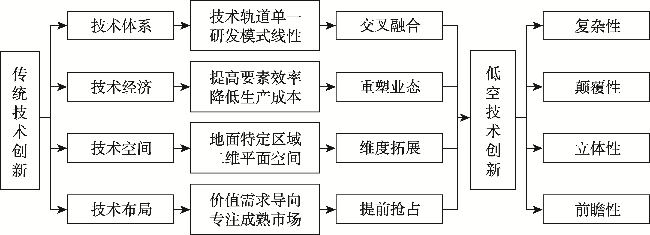
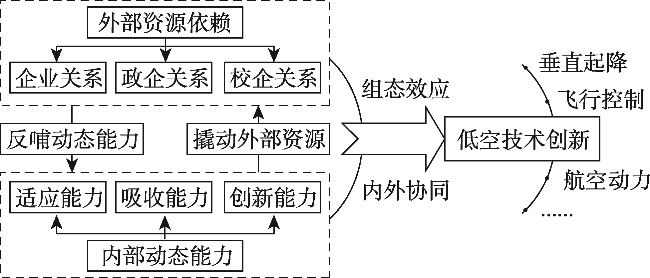
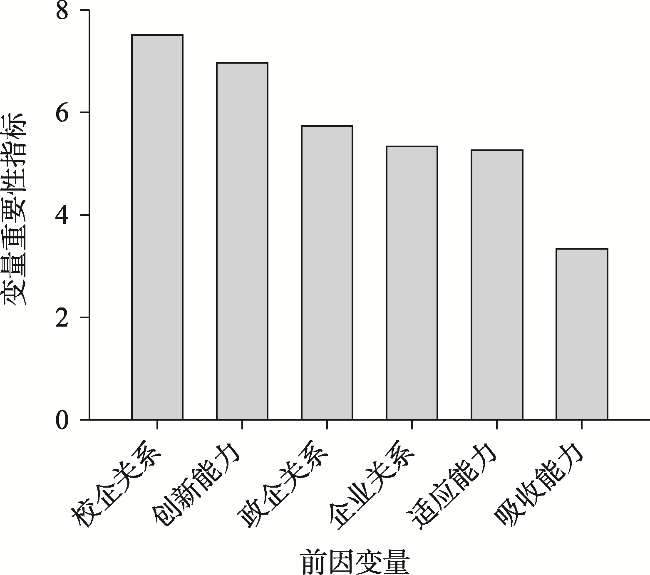
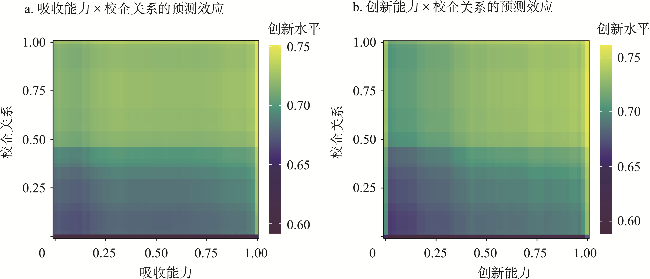
【目的】 针对低空技术创新的复杂性、颠覆性、立体性和前瞻性所带来的技术管理难题,揭示企业低空技术创新的内外协同机制,为新兴产业的技术布局与政策制定提供理论与实践指引。【方法】 整合动态能力理论与资源依赖理论,选取中国2023年参与低空技术创新的296家A股上市公司为样本,运用模糊集定性比较分析(fsQCA)与机器学习方法,探究企业低空技术创新的多元组态路径。【结果】 研究发现:①低空技术创新存在政策引导型、校企依赖型、校政依赖型、创新联合型和自主突破型5类等效组态,其核心驱动机制体现为动态能力与外部资源的非线性协同和动态转化;②权变分析表明,数智化转型、组织冗余和企业规模较大时,会通过强化内部能力或重构外部依赖关系,影响创新模式选择;③机器学习结果验证了fsQCA结果的稳健性,揭示了创新能力、政企关系与校企关系的关键作用。【结论】 企业低空技术创新需基于内部能力与外部资源的精准匹配和有效协同,综合考虑权变因素,依据自身资源禀赋与外部环境动态灵活地选择适合自身的创新模式。
赵瑞彤 , 胡海晨 , 李斌 , 郝国明 . 中国企业低空技术创新的组态机制[J]. 资源科学, 2025 , 47(8) : 1809 -1820 . DOI: 10.18402/resci.2025.08.15
[Objective] To address the technological management challenges posed by the complexity, disruptiveness, elevational characteristics, and foresight characteristics of low-altitude technological innovation, this study aims to reveal the internal and external coordination mechanisms of enterprises’ low-altitude technological innovation, providing theoretical and practical guidance for the technology layout and policy-making of emerging industries. [Methods] By integrating dynamic capabilities theory and resource dependence theory, 296 A-share listed companies in China engaged in low-altitude technological innovation in 2023 were selected as the samples. Using fuzzy-set qualitative comparative analysis (fsQCA) and machine learning methods, the multiple configuration paths of enterprises’ low-altitude technological innovation were explored. [Results] (1) Five equivalent configurations of low-altitude technological innovation were identified: policy-guided, university-enterprise dependent, university-government dependent, collaborative innovation, and independent breakthrough models. The core driving mechanism was reflected in the nonlinear synergy and dynamic transformation between dynamic capabilities and external resources. (2) Contingency analysis indicates that when enterprises exhibit higher levels of digital-intelligent transformation, organizational redundancy, and larger size, this influences the selection of innovation models by strengthening internal capabilities or restructuring external dependencies. (3) Machine learning results validated the robustness of the fsQCA results and highlighted the critical roles of innovation capability, government-enterprise relationships, and university-enterprise cooperation. [Conclusion] Enterprises’ low-altitude technology innovation requires precise alignment and effective coordination between internal capabilities and external resources, comprehensively considering contingency factors, dynamically and flexibly selecting suitable innovation models based on their resource endowments and external environment.
表1 前因变量的测量方式Table 1 Measurement methods of antecedent variables |
| 理论维度 | 前因变量 | 变量衡量方式 |
|---|---|---|
| 动态能力 | 适应能力 | 研发支出、广告支出和资本支出的变异系数 |
| 吸收能力 | 研发支出占营业收入的比例 | |
| 创新能力 | 研发支出与技术人员标准化之和 | |
| 资源依赖 | 企业关系 | 供应链集中度:前5大供应商采购占比与前5大客户销售占比的平均值 |
| 政企关系 | 政府补助占营业收入的比例 | |
| 校企关系 | 校企联合研发专利的数量 |
表2 前因变量的必要性检验Table 2 Necessity test of antecedent variables |
| 前因变量 | 低空技术创新 | ~低空技术创新 | |||
|---|---|---|---|---|---|
| 一致性 | 覆盖度 | 一致性 | 覆盖度 | ||
| 适应能力 | 0.582 | 0.731 | 0.597 | 0.480 | |
| ~适应能力 | 0.587 | 0.695 | 0.666 | 0.505 | |
| 吸收能力 | 0.601 | 0.731 | 0.614 | 0.477 | |
| ~吸收能力 | 0.570 | 0.698 | 0.654 | 0.512 | |
| 创新能力 | 0.619 | 0.725 | 0.628 | 0.471 | |
| ~创新能力 | 0.548 | 0.697 | 0.634 | 0.516 | |
| 企业关系 | 0.582 | 0.714 | 0.624 | 0.490 | |
| ~企业关系 | 0.584 | 0.709 | 0.635 | 0.493 | |
| 政企关系 | 0.571 | 0.736 | 0.578 | 0.477 | |
| ~政企关系 | 0.594 | 0.687 | 0.680 | 0.504 | |
| 校企关系 | 0.530 | 0.844 | 0.518 | 0.325 | |
| ~校企关系 | 0.606 | 0.608 | 0.591 | 0.395 | |
注:“~”表示布尔运算中的“非”,如“~适应能力”即“非高适应能力”。 |
表3 高/非高低空技术创新的驱动路径Table 3 Driving paths of high/non-high low-altitude technological innovation |
| 前因变量 | H1 | H2 | H3a | H3b | H4 | L1 | L2 | L3 |
|---|---|---|---|---|---|---|---|---|
| 适应能力 | × | ○ | ● | ● | $\otimes $ | ● | ||
| 吸收能力 | ● | $\otimes $ | $\otimes $ | ● | $\otimes $ | |||
| 创新能力 | ● | ● | $\otimes $ | $\otimes $ | ● | |||
| 企业关系 | × | ○ | $\otimes $ | ● | ● | $\otimes $ | ||
| 政企关系 | ● | ○ | $\otimes $ | $\otimes $ | ● | $\otimes $ | ||
| 校企关系 | ● | ● | ● | × | × | |||
| 一致性 | 0.951 | 0.961 | 0.998 | 1.000 | 0.984 | 0.853 | 0.839 | 0.900 |
| 覆盖度 | 0.164 | 0.012 | 0.012 | 0.004 | 0.095 | 0.148 | 0.157 | 0.122 |
| 总体一致性 | 0.956 | 0.832 | ||||||
| 总体覆盖度 | 0.231 | 0.308 | ||||||
注:●表示核心条件存在;$\otimes $表示核心条件缺失;○表示边缘条件存在;×表示边缘条件缺失;空白表示无关条件;下同。 |
表4 基于D-D框架的组态机制总结Table 4 Summary of configuration mechanisms based on D-D framework |
| 组态类型 | D-D框架 | 机制简述 |
|---|---|---|
| 政策引导型(H1) | 内部动态能力与外部资源依赖的正反馈循环 | 政府资源对适应能力的补充 |
| 创新联合型(H2) | 内部动态能力与外部资源依赖的正反馈循环 | 创新能力与高校资源的互馈 |
| 校企依赖型(H3a) | 外部资源依赖反哺内部动态能力 | 企业高校资源对吸收能力的替代 |
| 校政依赖型(H3b) | 外部资源依赖反哺内部动态能力 | 政府高校资源与适应能力的互补 |
| 自主突破型(H4) | 内部动态能力撬动外部资源依赖 | 完整动态能力的自主驱动 |
表5 权变分析结果Table 5 Results of contingency analysis |
| 前因变量 | HD1 | HD2 | HR1 | HR2a | HR2b | HS |
|---|---|---|---|---|---|---|
| 适应能力 | ○ | ● | ○ | ○ | ○ | ○ |
| 吸收能力 | ● | ○ | ● | ○ | ○ | |
| 创新能力 | ● | $\otimes $ | ● | ● | $\otimes $ | |
| 企业关系 | $\otimes $ | ● | $\otimes $ | ○ | × | |
| 政企关系 | ● | ○ | ○ | ● | ● | ● |
| 校企关系 | × | × | × | |||
| 数智化转型 | ● | $\otimes $ | ||||
| 冗余资源 | ● | $\otimes $ | $\otimes $ | |||
| 企业规模 | ● | |||||
| 一致性 | 0.962 | 0.977 | 0.989 | 0.959 | 0.985 | 0.995 |
| 覆盖度 | 0.149 | 0.099 | 0.098 | 0.151 | 0.121 | 0.079 |
| 整体一致性 | 0.960 | 0.967 | 0.995 | |||
| 整体覆盖度 | 0.196 | 0.227 | 0.079 | |||
| [1] |
欧阳桃花. 低空经济的技术创新与场景创新[J]. 人民论坛·学术前沿, 2024, (15): 57-68.
[
|
| [2] |
欧阳桃花, 郑舒文. 基于共同演化的低空经济产业生态策略研究: 以“低空航空器+”为例[J]. 北京航空航天大学学报(社会科学版), 2024, 37(5): 109-119.
[
|
| [3] |
|
| [4] |
钟成林, 胡雪萍. 低空经济高质量发展的新质生产力逻辑与提升路径[J]. 深圳大学学报(人文社会科学版), 2024, 41(5): 84-93.
[
|
| [5] |
张嘉昕, 许倩. 低空经济产业链发展的制约因素与优化对策研究[J]. 经济纵横, 2024, (8): 63-70.
[
|
| [6] |
王宝义. 我国低空经济的技术经济范式分析与发展对策[J]. 中国流通经济, 2024, 38(9): 14-26.
[
|
| [7] |
周钰哲. 低空经济发展的理论逻辑、要素分析与实现路径[J]. 东南学术, 2024, (4): 87-97.
[
|
| [8] |
欧阳日辉. 低空经济助推新质生产力的运行机理与路径选择[J]. 新疆师范大学学报(哲学社会科学版), 2025, 46(1): 118-131.
[
|
| [9] |
李晓华. 政府引导、产业生态构建与低空经济发展[J]. 改革, 2025, (2): 21-35.
[
|
| [10] |
廖小罕, 黄耀欢, 徐晨晨. 面向无人机应用的低空空域资源研究探讨[J]. 地理学报, 2021, 76(11): 2607-2620.
[
|
| [11] |
|
| [12] |
焦豪, 杨季枫, 金宇珂. 企业消极反馈对战略变革的影响机制研究: 基于动态能力和冗余资源的调节效应[J]. 管理科学学报, 2022, 25(8): 22-44.
[
|
| [13] |
沈海军. 从飞行汽车看低空经济新业态[J]. 人民论坛·学术前沿, 2024, (15): 69-75.
[
|
| [14] |
|
| [15] |
杨凡, 杜德斌, 段德忠, 等. 长三角产学协同创新的空间模式演化[J]. 资源科学, 2023, 45(3): 668-682.
[
|
| [16] |
张明, 杜运周. 组织与管理研究中QCA方法的应用: 定位、策略和方向[J]. 管理学报, 2019, 16(9): 1312-1323.
[
|
| [17] |
赵丽, 胡植尧. 数据要素、动态能力与企业全要素生产率: 破解“数据生产率悖论”之谜[J]. 经济管理, 2024, 46(7): 55-72.
[
|
| [18] |
张冰晔, 刘紫琦, 周君, 等. 供应链集中度对中国上市企业ESG表现的影响分析: 基于企业经营视角[J]. 系统工程理论与实践, 2024, 44(6): 1795-1814.
[
|
| [19] |
王昶, 王恺霖, 宋慧玲. 风险投资与政府补贴对新材料企业技术创新的激励效应及差异[J]. 资源科学, 2020, 42(8): 1566-1579.
[
|
| [20] |
范剑勇, 张丰, 唐为. 高校学科质量与区域科技创新[J]. 世界经济, 2024, 47(4): 65-98.
[
|
| [21] |
|
| [22] |
|
| [23] |
高鲜鑫, 王黎萤. 企业标准创新网络突破技术锁定的路径研究[J]. 科研管理, 2024, 45(8): 73-82.
[
|
| [24] |
姚海琳, 罗锡铃, 曾辉祥, 等. 新材料产业公共服务平台政策对企业“卡脖子”技术创新的影响[J]. 资源科学, 2023, 45(4): 694-705.
[
|
| [25] |
|
| [26] |
|
| [27] |
张秀娥, 王卫, 于泳波. 数智化转型对企业新质生产力的影响研究[J]. 科学学研究, 2025, 43(5): 943-954.
[
|
| [28] |
|
| [29] |
|
/
| 〈 |
|
〉 |