珠三角城市群低空经济制造业时空关联模式及其影响因素
|
冯瑜满,女,广东梅州人,博士生,研究方向为经济地理与区域发展。E-mail: fengyuman21@mails.ucas.ac.cn |
收稿日期: 2025-04-08
修回日期: 2025-07-28
网络出版日期: 2025-09-09
基金资助
国家自然科学基金项目(42471201)
国家自然科学基金项目(42271187)
广东省哲学社会科学规划2024年度学科共建项目(GD24XYJ48)
Spatiotemporal correlation patterns and influencing factors of low-altitude economy manufacturing in Pearl River Delta urban agglomeration
Received date: 2025-04-08
Revised date: 2025-07-28
Online published: 2025-09-09
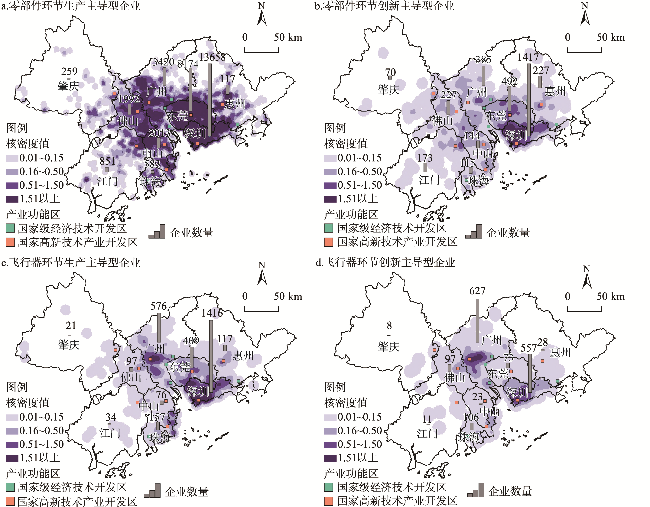
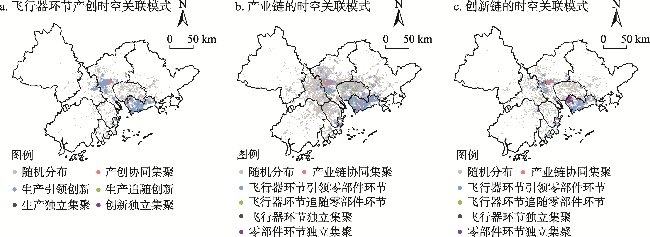
【目的】 本文旨在厘清低空经济制造业空间分布及其产业链与创新链的时空关联模式与影响因素,为低空经济产创融合提供理论依据和政策支撑。【方法】 在获取截至2025年2月的珠三角城市群低空经济制造业零部件与飞行器环节企业数据的基础上,分别利用核密度分析、协同区位分析与无序多分类逻辑回归模型,探究低空经济制造业的空间集聚性、产业链与创新链的时空关联模式及其影响因素。【结果】 ①珠三角城市群低空经济制造业生产主导型和创新主导型两类企业均呈现显著的广州-深圳双核结构,企业主要分布于各类产业功能区与中心城区。②低空经济制造业生产-创新的时空关联表现为生产主导型企业引领创新主导型企业的时空关联特征,产业链与创新链的时空关联均表现为零部件环节追随飞行器环节、但飞行器环节趋于独立集聚的时空关联模式。③不同时空关联模式受产业功能区等级、集群类型、机场距离、土地价格、经济活力与企业规模等因素综合影响,其中国家级产业功能区的作用较为突出。【结论】 珠三角城市群低空经济制造业初步形成生产-创新、产业链与创新链协同集聚格局,但区域整体协同集聚程度仍有待提升,建设并提升产业功能区能级是推动企业协同集聚的关键。
冯瑜满 , 马丽 , 金凤君 , 叶志聪 . 珠三角城市群低空经济制造业时空关联模式及其影响因素[J]. 资源科学, 2025 , 47(8) : 1758 -1771 . DOI: 10.18402/resci.2025.08.12
[Objective] This study aims to analyze the spatial distribution of the low-altitude economy manufacturing, along with the spatiotemporal correlation patterns and influencing factors of its industry and innovation chains. The findings are expected to provide a theoretical basis and policy support for enhancing the integration of production and innovation in the low-altitude economy. [Methods] Based on the obtained enterprise data related to components and aircraft sectors of the low-altitude economy manufacturing in the Pearl River Delta (PRD) urban agglomeration, this study employed kernel density analysis, co-location quotient analysis, and unordered multinomial logistic regression models to explore the spatial clustering characteristics of low-altitude economy manufacturing, the spatiotemporal correlation patterns between its industry and innovation chains, and their influencing factors. [Results] (1) Both production-oriented and innovation-oriented enterprises in the low-altitude economy manufacturing of the PRD urban agglomeration exhibited a pronounced Guangzhou-Shenzhen dual-core structure. These enterprises were predominantly distributed in various industrial functional zones and central urban areas. (2) The spatiotemporal correlation between production and innovation in the low-altitude economy manufacturing was characterized by production-oriented enterprises leading the spatiotemporal patterns of innovation-oriented enterprises. Meanwhile, the spatiotemporal correlation between industry and innovation chains demonstrated a pattern where component sectors followed the aircraft sectors, while the latter showed a tendency toward independent agglomeration. (3) Different spatiotemporal correlation patterns were influenced by factors such as the levels of industrial functional zones, economic vitality, land prices, distance to airports, cluster types, and enterprise scale, among which national-level industrial functional zones played a particularly prominent role. [Conclusion] The low-altitude economy manufacturing in the PRD urban agglomeration has preliminarily formed a co-agglomeration pattern of production-innovation and industry-innovation chains. However, the overall level of regional co-agglomeration still needs improvement. Building and upgrading the level of industrial functional zones is key to promoting the co-agglomeration among enterprises.
表1 基于协同区位商的时空关联模式分类Table 1 Classification of spatiotemporal correlation patterns based on co-location quotients |
| LCLQ值区间 | LCLQ类型 | 时空关联模式 |
|---|---|---|
| A引领B | 协同集聚 | |
| A追随B | ||
| A引领B | 引领型 | |
| A不追随B | ||
| A不引领B | 追随型 | |
| A追随B | ||
| A不引领B | 独立集聚 | |
| A不追随B | ||
| =1或该值不存在或 | AB无显著关联 | 随机分布 |
图2 2025年珠三角城市群低空经济制造业的时空关联模式Figure 2 Spatiotemporal correlation patterns of low-altitude economy manufacturing in PRD urban agglomeration, 2025 |
表2 珠三角城市群低空经济制造业LCLQ值结果统计Table 2 Statistical results of LCLQ values for low-altitude economy manufacturing in PRD urban agglomeration |
| 中心要素 | 相邻要素 | 均值 | 均值 |
|---|---|---|---|
| 飞行器环节生产主导型企业 | 飞行器环节创新主导型企业 | 1.30 | 0.22 |
| 飞行器环节创新主导型企业 | 飞行器环节生产主导型企业 | 0.44 | 1.04 |
| 零部件环节生产主导型企业 | 飞行器环节生产主导型企业 | 0.49 | 1.26 |
| 飞行器环节生产主导型企业 | 零部件环节生产主导型企业 | 0.98 | 0.73 |
| 零部件环节创新主导型企业 | 飞行器环节创新主导型企业 | 0.51 | 0.88 |
| 飞行器环节创新主导型企业 | 零部件环节创新主导型企业 | 0.79 | 0.56 |
表3 低空经济制造业时空关联模式赋值表Table 3 Value assignment of spatiotemporal correlation patterns of low-altitude economy manufacturing |
| 飞行器环节生产-创新 时空关联模式 | 产业链、创新链时空关联模式 | 赋值 |
|---|---|---|
| 产创协同集聚 | 零部件与飞行器环节协同集聚 | 1 |
| 生产引领创新 | 飞行器环节引领零部件环节 | 2 |
| 生产追随创新 | 飞行器环节追随零部件环节 | 3 |
| 生产独立集聚 | 飞行器环节独立集聚 | 4 |
| 创新独立集聚 | 零部件环节独立集聚 | 5 |
| 随机分布 | 随机分布 | 6 |
表4 低空经济制造业时空关联模式的回归结果Table 4 Regression results of spatiotemporal correlation patterns of low-altitude economy manufacturing |
| 变量 | 飞行器环节生产-创新时空关联模式 | 产业链时空关联模式 | 创新链时空关联模式 | ||||||||||||||
|---|---|---|---|---|---|---|---|---|---|---|---|---|---|---|---|---|---|
| 产创协同 集聚 | 生产引领 创新 | 生产追随 创新 | 生产独立 集聚 | 创新独立 集聚 | 产业链协 同集聚 | 飞行器环 节引领零 部件环节 | 飞行器环 节追随零 部件环节 | 飞行器 环节独 立集聚 | 零部件 环节独 立集聚 | 创新链协 同集聚 | 飞行器环 节引领零 部件环节 | 飞行器环 节追随零 部件环节 | 飞行器 环节独 立集聚 | 零部件 环节独 立集聚 | |||
| 功能区等级(参考组=非功能区) | |||||||||||||||||
| 国家级 | 6.643*** | 2.627*** | 3.061 | 0.431 | 28.636*** | 6.003*** | 2.701*** | 3.700*** | 3.810*** | 0.000 | 5.039*** | 2.762*** | 2.585*** | 4.173*** | 1.084 | ||
| 一般级 | 0.000 | 0.927 | 6.673*** | 1.247 | 0.000 | 0.000 | 0.571** | 1.736 | 3.445*** | 0.000 | 0.000 | 1.133 | 2.088 | 0.205 | 0.000 | ||
| 集群类型(参考组=非集聚区) | |||||||||||||||||
| 专业化 | 7.7×10⁶ | 2.412*** | 0.523 | 2.6×10⁵ | 6.007*** | 7.8×10⁶ | 2.154*** | 0.802 | 1.2×10⁷ | 244.103 | 4.719 | 2.375** | 3.208 | 0.827 | 2.4×10⁶ | ||
| 多样化 | 1.1×10⁷ | 1.447 | 0.553 | 1.1×10⁵ | 16.063*** | 0.282 | 0.624** | 0.468** | 0.376 | 0.000 | 1.973 | 0.972 | 2.599 | 1.062 | 1.0×10⁷ | ||
| 机场距离 | 1.420 | 0.743*** | 1.088 | 0.469*** | 1.636*** | 0.683*** | 0.478*** | 1.126 | 0.500*** | 0.640 | 1.154 | 0.642*** | 0.864 | 0.923 | 0.860 | ||
| 土地价格 | 1.179 | 1.177*** | 1.325 | 1.201 | 1.527*** | 1.132 | 1.222*** | 1.176** | 1.180*** | 1.173 | 1.507*** | 1.271*** | 1.176 | 1.420*** | 0.890 | ||
| 经济活力 | 0.778 | 1.245*** | 0.952 | 3.054*** | 0.671*** | 2.361*** | 1.728*** | 1.372*** | 1.775*** | 2300*** | 0.718* | 1.143** | 0.812* | 1.315*** | 1.537*** | ||
| 企业规模 | 0.381* | 1.007 | 0.793 | 0.938 | 0.912 | 1.456*** | 1.064** | 1.102 | 1.246** | 0.514 | 0.508* | 0.697*** | 0.793 | 0.708*** | 1.004 | ||
| 常数项 | 0.000 | 0.184*** | 0.002* | 0.000 | 0.000*** | 0.000 | 0.528** | 0.000*** | 0.000 | 0.000 | 0.003* | 1.184 | 0.037 | 0.019*** | 0.000 | ||
| 观测数 | 4736 | 35937 | 4829 | ||||||||||||||
| 伪R2 | 0.133 | 0.214 | 0.108 | ||||||||||||||
注:***、**、*分别表示回归系数在1%、5%和10%置信水平下显著;表中系数为发生比率,即选择变量与参考变量的事件发生比;由于样本稀疏性与算法在边界条件下的收敛特性,部分模型系数值极高且未达到统计学显著性[46]。 |
| [1] |
廖小罕, 张捷, 黄耀欢. 浅析低空地理学的特征及其对地理学的拓展[J]. 地理学报, 2024, 79(3): 551-564.
[
|
| [2] |
李晓华. 政府引导、产业生态构建与低空经济发展[J]. 改革, 2025, (2): 21-35.
[
|
| [3] |
郭亮, 曾镜灵, 林超辉, 等. 全球视野下广东省高端装备制造业发展问题及对策分析[J]. 广东科技, 2021, 30(6): 62-66.
[
|
| [4] |
于英杰, 吕拉昌. 中国城市知识创新职能空间分异及其影响因素[J]. 地理学报, 2023, 78(2): 315-333.
[
|
| [5] |
李国平, 徐祯. 粤琼区域协同与海南自由贸易港建设[J]. 资源科学, 2021, 43(2): 241-255.
[
|
| [6] |
习近平. 在深圳经济特区建立40周年庆祝大会上的讲话[N]. 人民日报, 2020-10-15(002).
[
|
| [7] |
刘城, 林平凡. 传统产业集群产业链和创新链融合升级的模式: 来自广东中山古镇灯饰集群的经验[J]. 南方经济, 2015, (5): 120-126.
[
|
| [8] |
龚忠杰, 马丽. 珠三角城市群电子计算机产业链与创新链融合空间格局与演化路径[J]. 地理学报, 2023, 78(12): 3000-3017.
[
|
| [9] |
狄乾斌, 梁晨露, 陈小龙, 等. 共生理论下海洋渔业“双链”融合机制、演化模式与路径[J]. 经济地理, 2024, 44(9): 133-143.
[
|
| [10] |
郭倩钰, 孙威, 孙涵. 北京市制造业与生产性服务业协同集聚的测度方法与时空演变[J]. 地理学报, 2025, 80(2): 415-432.
[
|
| [11] |
|
| [12] |
钟韵, 李书凝, 李寒. 深圳高技术产业协同集聚与空间追随[J]. 地理学报, 2024, 79(10): 2638-2650.
[
|
| [13] |
|
| [14] |
|
| [15] |
冯超. 中国通用航空发展空间与产业链[J]. 中国流通经济, 2014, 28(5): 117-121.
[
|
| [16] |
何瑶, 杨永春, 王绍博. 价值链视角下中国新能源汽车产业网络及其机制[J]. 地理学报, 2023, 78(12): 3018-3036.
[
|
| [17] |
王文凯, 陈志远. 高新技术企业认定政策与企业创新[J]. 中国经济学, 2024, (2): 92-118, 291-293.
[
|
| [18] |
郑舒文, 欧阳桃花, 陈昕童, 等. 自主可控的中国产业价值链构建路径研究: 以中国大型无人机产业创新为例[J/OL]. 科研管理, (2025-05-09) [2025-07-28]. https://link.cnki.net/urlid/11.1567.G3.20250508.1927.002.
[
|
| [19] |
韩燕, 潘成, 金凤君, 等. 黄河流域数字经济产业空间格局演化及影响因素[J]. 资源科学, 2024, 46(3): 488-504.
[
|
| [20] |
丁俊, 王开泳. 珠江三角洲城市群工业生产空间格局、形态特征及影响因素[J]. 地理科学进展, 2016, 35(5): 610-621.
[
|
| [21] |
张嘉望, 李博阳, 彭晖. 国家高新区“以集群促发展”政策是否提升了城市创新水平: 兼论创新集群“中心-外围”结构的技术互补效应[J]. 经济学家, 2023, (11): 79-88.
[
|
| [22] |
樊邦奎, 李云, 张瑞雨. 浅析低空智联网与无人机产业应用[J]. 地理科学进展, 2021, 40(9): 1441-1450.
[
|
| [23] |
廖小罕, 徐晨晨, 叶虎平. 低空经济发展与低空路网基础设施建设的效益和挑战[J]. 中国科学院院刊, 2024, 39(11): 1966-1981.
[
|
| [24] |
李经成, 黄春晓. 创新型企业城市内部空间分布及组织逻辑: 以南京市为例[J]. 经济地理, 2022, 42(7): 93-105.
[
|
| [25] |
乔莉, 霍达, 顾雯嘉, 等. 低空经济现代化发展的路径优化研究: 基于3D无人飞行的视角[J]. 科学管理研究, 2025, 43(2): 29-38.
[
|
| [26] |
|
| [27] |
郭倩钰, 李承锦, 侯林春, 等. 北京市高技术产业协同集聚的测度与影响因素分析[J]. 地理科学进展, 2025, 44(2): 313-326.
[
|
| [28] |
钟韵, 秦嫣然. 高质量发展视角下产业协同集聚研究进展[J]. 人文地理, 2023, 38(4): 1-8, 120.
[
|
| [29] |
许闻博, 王兴平, 陈秋伊. 制造业企业迁移和城市创新格局演化互动: 基于51家深圳企业的实证[J]. 城市规划学刊, 2023, (3): 92-99.
[
|
| [30] |
刘婧, 甄峰, 张姗琪, 等. 新一代信息技术企业空间分布特征及影响因素: 以南京市中心城区为例[J]. 经济地理, 2022, 42(2): 114-123, 211.
[
|
| [31] |
|
| [32] |
|
| [33] |
|
| [34] |
|
| [35] |
任亚文, 杨宇. 珠三角地区半导体产业布局特征及其区位关联模式[J]. 地理科学进展, 2022, 41(9): 1622-1634.
[
|
| [36] |
周臻, 陈浩, 王磊. 人口收缩型中小城市建设用地供应动态特征及分异[J]. 资源科学, 2024, 46(2): 321-335.
[
|
| [37] |
戴靓, 曹湛, 朱青, 等. 中国城市群知识多中心发展评价[J]. 资源科学, 2021, 43(5): 886-897.
[
|
| [38] |
汪越, 岳隽, 杜雁, 等. 供需视角下的深圳创新型产业空间政策评价及优化建议[J]. 规划师, 2024, 40(6): 62-71.
[
|
| [39] |
田镇宁. 广深地区低空经济全产业链发展的策略研究[J]. 中国商论, 2024, 33(16): 108-113.
[
|
| [40] |
陈肖飞, 蔡和倩, 胡永桂, 等. 新能源汽车生产网络与区域发展战略耦合模式及机制: 基于比亚迪案例[J]. 地理研究, 2025, 44(1): 21-35.
[
|
| [41] |
刘国巍, 邵云飞. 产业链创新视角下战略性新兴产业合作网络演化及协同测度: 以新能源汽车产业为例[J]. 科学学与科学技术管理, 2020, 41(8): 43-62.
[
|
| [42] |
杨煜, 王昕灵. 培育科技型企业的作用机理与路径研究: 基于“有效市场”与“有为政府”协同的视角[J]. 科学管理研究, 2024, 42(1): 115-125.
[
|
| [43] |
|
| [44] |
林剑铬, 夏丽丽, 蔡润林, 等. 中国高新技术产业开发区的知识基础及其创新效应: 基于国家级高新区上市企业的研究[J]. 地理研究, 2021, 40(2): 387-401.
[
|
| [45] |
|
| [46] |
|
| [47] |
杨凡, 杜德斌, 段德忠, 等. 长三角产学协同创新的空间模式演化[J]. 资源科学, 2023, 45(3): 668-682.
[
|
/
| 〈 |
|
〉 |