“双碳”目标下中国新能源汽车关键矿产需求的多情景动态考察
|
郑林昌,男,山东阳谷人,教授,研究方向为资源利用、生态保护与可持续发展。E-mail: zhenglinchang@126.com |
收稿日期: 2024-07-14
修回日期: 2024-10-14
网络出版日期: 2025-08-13
基金资助
国家社会科学基金重大项目(23ZDA106)
Multi-scenario dynamic analysis of demand for critical minerals in China’s new energy vehicles under “dual carbon” goals
Received date: 2024-07-14
Revised date: 2024-10-14
Online published: 2025-08-13
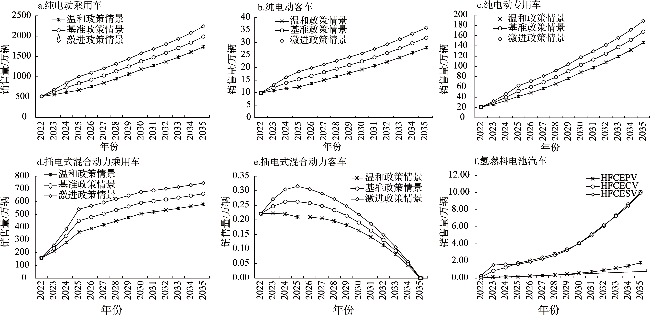
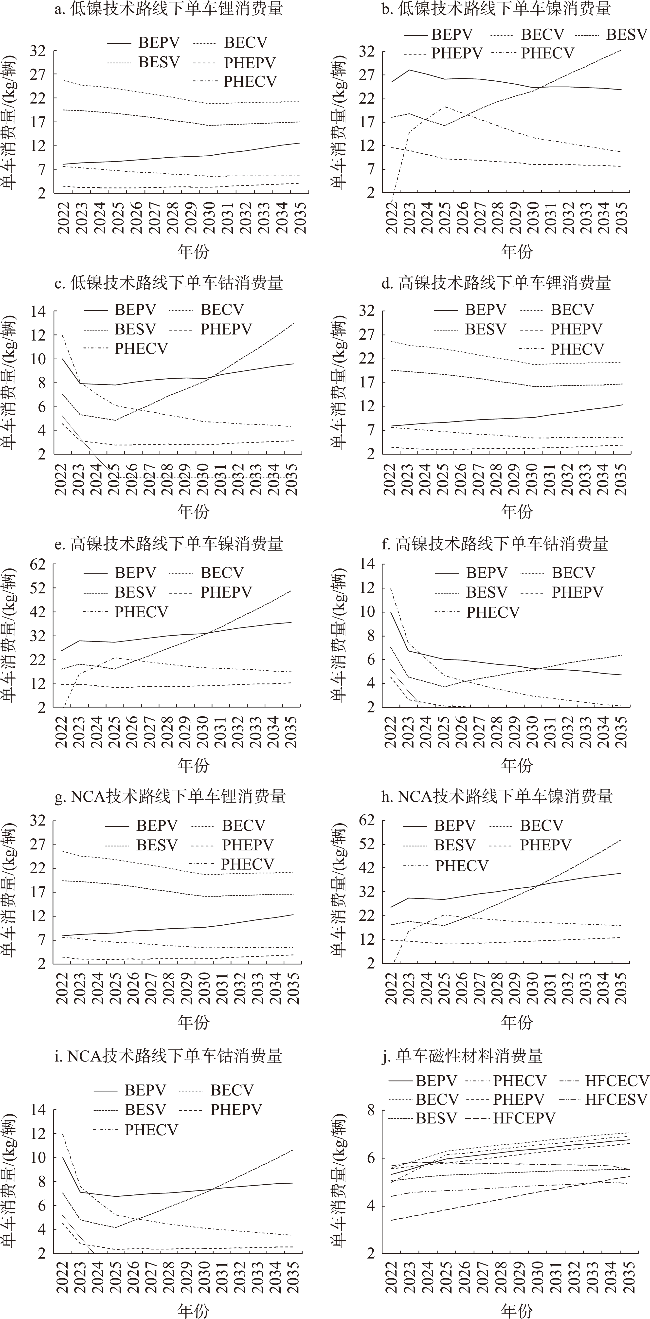
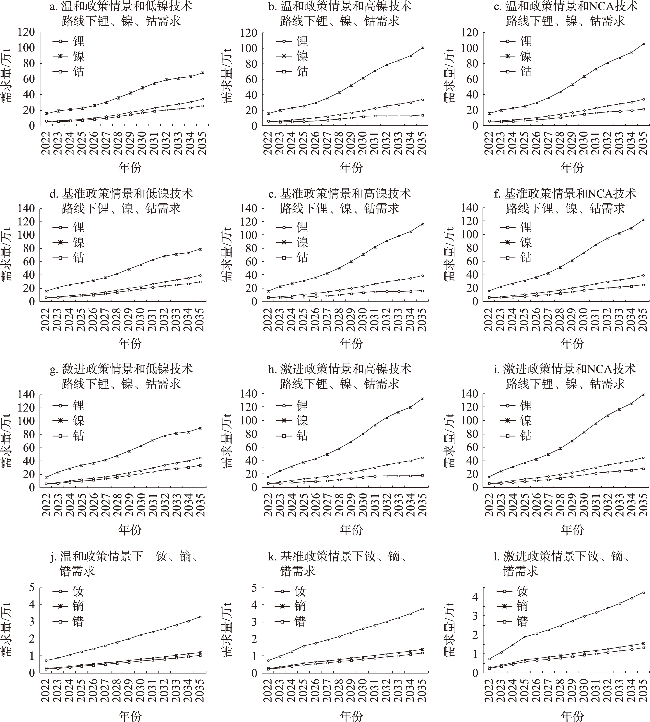
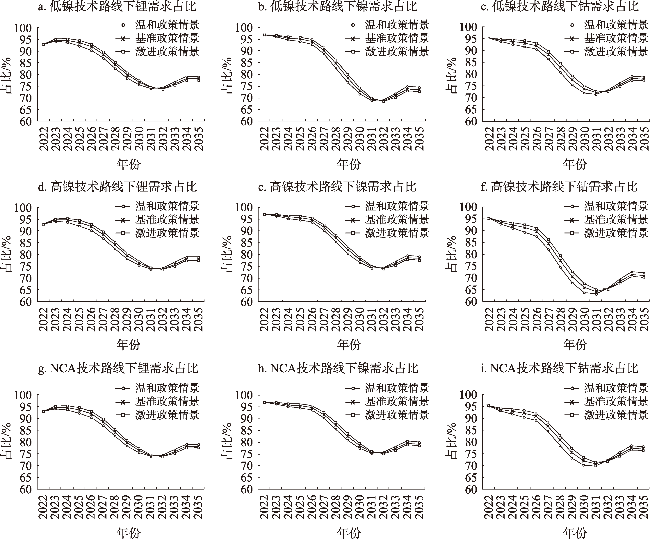
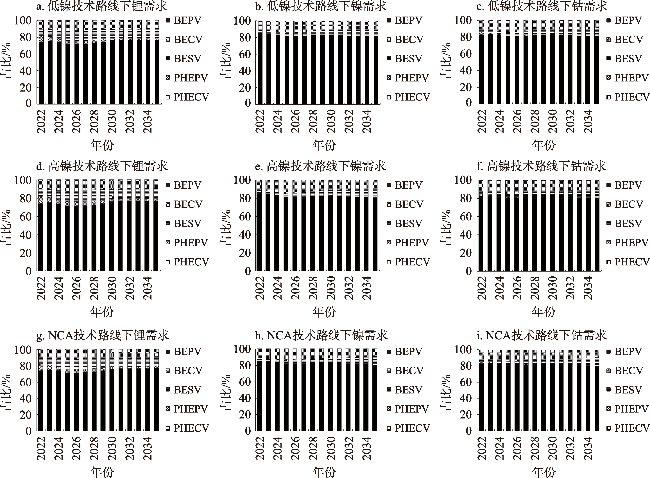
【目的】 交通领域实施“双碳”政策,能够影响新能源汽车的规模和性能,并最终影响新能源汽车关键矿产的消费需求。为积极应对关键矿产供需压力,亟需考察“双碳”政策对中国新能源汽车关键矿产消费需求的影响。【方法】 基于Gompertz模型预测新能源汽车销量,以及新能源汽车相关参数的测算和设定,测算不同“双碳”政策情景和锂电池技术路线下,2022—2035年新能源汽车对关键矿产的消费需求。【结果】 ①新能源汽车不同车型的单车关键矿产消费量有不同的变化,如纯电动乘用车、纯电动专用车的单车锂消费量会增加。②新能源汽车对锂、镍、钴、钕、镝、镨的消费需求量会快速增加,在基准政策情景下,消费需求年均增速高达15.97%~16.10%、13.15%~17.01%、7.42%~12.66%、12.05%~14.24%、11.94%~14.12%、11.94%~14.12%。③新车生产是新能源汽车关键矿产消费需求的主要贡献力量但贡献力量会减小;纯电动乘用车是新能源汽车关键矿产消费需求的主要贡献力量;锂电池更换产生的关键矿产消费需求的贡献会增加。④采用相同三元材料电池技术路线,激进政策情景下新能源汽车对锂、镍、钴、钕、镝、镨的消费需求更大;在相同“双碳”政策情景下,采用高镍、NCA电池技术路线新能源汽车对镍的需求量更多,采用低镍技术路线新能源汽车对钴的需求量更多。【结论】 2022—2035年,中国新能源汽车规模的快速增长和单车矿产消费量的变化会大幅增加对关键矿产的需求,并进一步增加锂、钴、镍等关键矿产的供需压力,需要通过引导新能源汽车绿色消费、推动循环经济发展、全球布局产业链和供应链、强化技术研发等来缓解关键矿产的供需压力。
郑林昌 , 鲍文琪 , 陈格 , 耿傲淼 . “双碳”目标下中国新能源汽车关键矿产需求的多情景动态考察[J]. 资源科学, 2025 , 47(7) : 1485 -1504 . DOI: 10.18402/resci.2025.07.08
[Objective] The implementation of the “dual carbon” goals in the transportation sector significantly affects the scale and performance of new energy vehicles, thereby altering the consumption demand for critical minerals in these vehicles. To actively address the supply and demand pressure on critical minerals, it is imperative to evaluate the impact of the “dual carbon” goals on the consumption demand of critical minerals for new energy vehicles in China. [Methods] Based on the Gompertz model, this study predicted the sales of new energy vehicles, and calculated and set the related parameters for new energy vehicles. The consumption demand for critical minerals in new energy vehicles from 2022 to 2035 was estimated under different “dual carbon” policy scenarios and lithium battery technology pathways. [Results] (1) The per-vehicle consumption of critical minerals varied across different types of new energy vehicles, with lithium consumption increasing in passenger battery electric vehicles and special-purpose battery electric vehicles. (2) The consumption demand for lithium, nickel, cobalt, neodymium, dysprosium, and praseodymium in new energy vehicles was expected to increase rapidly. Under the benchmark policy scenario, the annual growth rates of consumption demand were 15.97%~16.10%, 13.15%~17.01%, 7.42%~12.66%, 12.05%~14.24%, 11.94%~14.12%, and 11.94%~14.12%, respectively. (3) The production of new vehicles was the main contributor to the consumption demand for critical minerals in new energy vehicles, although its contribution was expected to decline. Passenger battery electric vehicles remained the primary contributor to consumption demand for critical minerals in new energy vehicles. Meanwhile, the contribution from battery swapping was projected to increase. (4) When adopting the same ternary battery technology pathways, new energy vehicles under aggressive policy scenarios demonstrated increased demand for lithium, nickel, cobalt, neodymium, dysprosium, and praseodymium. Under identical “dual carbon” policy scenarios, new energy vehicles adopting high-nickel and nickel-cobalt-aluminum battery technologies had higher demand for nickel, while those using low-nickel alternatives had higher demand for cobalt. [Conclusion] From 2022 to 2035, the rapid expansion of China’s new energy vehicle market, along with changes in per-vehicle mineral consumption, will significantly increase demand for critical minerals while exacerbating supply-demand tensions, particularly for lithium, cobalt, and nickel. To mitigate these pressures, it is necessary to promote green consumption of new energy vehicles, advance the development of a circular economy, optimize the global layout of industrial and supply chains, and strengthen technological research and development.
表1 不同政策情景下新能源汽车市场渗透率 (%)Table 1 Market penetration rate of new energy vehicles under different policy scenarios (%) |
| 年份 | 温和政策情景 | 基准政策情景 | 激进政策情景 |
|---|---|---|---|
| 2025 | 40 | 50 | 60 |
| 2030 | 60 | 70 | 80 |
| 2035 | 70 | 80 | 90 |
表2 2025、2035年新能源汽车装配永磁电机平均功率设定值 (kW)Table 2 Average power settings of permanent magnet motors for new energy vehicles in 2025 and 2035 (kW) |
| 年份 | 纯电动乘用车 | 纯电动客车 | 纯电动专用车 | 插电式混合 动力乘用车 | 插电式混合 动力客车 | 氢燃料电池 乘用车 | 氢燃料电池 客车 | 氢燃料电池 专用车 |
|---|---|---|---|---|---|---|---|---|
| 2025 | 180 | 190 | 160 | 175 | 185 | 116 | 175 | 140 |
| 2035 | 220 | 230 | 180 | 215 | 225 | 170 | 180 | 160 |
注:中间年份按照年均增速处理。 |
表3 新能源汽车及动力锂电池平均最长使用年限Table 3 Average maximum service life of new energy vehicles and lithium batteries |
| 平均最长使用年限 | 时间 | 乘用车 | 客车 | 专用车 |
|---|---|---|---|---|
| 汽车 | 2010—2035年 | 15 | 10 | 10 |
| 动力锂电池 | 2010—2018年 | 8 | 5 | 4 |
| 2019—2025年 | 10 | 7 | 5 | |
| 2026—2035年 | 12 | 9 | 6 |
| [1] |
吴巧生, 周娜, 成金华, 等. 全产业链锂产品贸易格局演化与中国地位[J]. 中南大学学报(社会科学版), 2023, 29(3): 102-112.
[
|
| [2] |
International Energy Agency. Global EV Outlook 2016: Beyond one Million Electric Cars[R/OL]. (2016-05-01) [2025-05-19]. https://www.iea.org/reports/global-ev-outlook-2016.
|
| [3] |
International Energy Agency. Global EV Outlook 2023: Catching up with Climate Ambitions[R/OL]. (2023-04-01) [2025-05-19]. https://www.iea.org/reports/global-ev-outlook-2023.
|
| [4] |
|
| [5] |
李文昌, 李建威, 谢桂青, 等. 中国关键矿产现状、研究内容与资源战略分析[J]. 地学前缘, 2022, 29(1): 1-13.
[
|
| [6] |
宋慧玲, 王智源, 周思源. 大国竞争背景下伴生能源金属可持续供给研究综述[J]. 中南大学学报(社会科学版), 2024, 30(1): 99-111.
[
|
| [7] |
邵留国, 王子杨, 蓝婷婷. 中国新能源汽车产业震荡的形成机制与对策[J]. 资源科学, 2022, 44(7): 1316-1330.
[
|
| [8] |
陈从喜, 张雅丽, 孙春强, 等. 战略性矿产概念和矿种目录的国际比较研究[J]. 中南大学学报(社会科学版), 2024, 30(1): 87-98.
[
|
| [9] |
彭忠益, 高峰. 政策工具视角下中国矿产资源安全政策文本量化研究[J]. 中南大学学报(社会科学版), 2021, 27(5): 11-24.
[
|
| [10] |
|
| [11] |
|
| [12] |
|
| [13] |
|
| [14] |
|
| [15] |
|
| [16] |
|
| [17] |
|
| [18] |
|
| [19] |
|
| [20] |
|
| [21] |
|
| [22] |
|
| [23] |
|
| [24] |
|
| [25] |
|
| [26] |
|
| [27] |
|
| [28] |
|
| [29] |
中国汽车工程学会. 节能与新能源汽车技术路线2.0[M]. 北京: 机械工业出版社, 2020.
[China Society of Automotive Engineering. Energy Saving and New Energy Vehicle Technology Route 2.0[M]. Beijing: Mechanical Industry Press, 2020.]
|
| [30] |
中华人民共和国国务院办公厅. 新能源汽车产业发展规划(2021-2035年)[EB/OL]. (2020-11-02) [2025-05-19]. https://www.gov.cn/zhengce/content/2020-11/02/content_5556716.htm.
[General Office of the State Council, The People’s Republic of China. New Energy Vehicle Industry Development Plan (2021-2035)[EB/OL]. (2020-11-02) [2025-05-19]. https://www.gov.cn/zhengce/content/2020-11/02/content_5556716.htm.]
|
| [31] |
王旖旎. 中国汽车需求预测: 基于Gompertz模型的分析[J]. 财经问题研究, 2005, (11): 45-52.
[
|
| [32] |
赵红梅. 基于Gompertz曲线模型之上的中国千人汽车保有量中长期预测[J]. 工业技术经济, 2012, 31(7): 7-23.
[
|
| [33] |
|
| [34] |
项目综合报告编写组. 《中国长期低碳发展战略与转型路径研究》综合报告[J]. 中国人口·资源与环境, 2020, 30(11): 1-25.
[Project Comprehensive Report Preparation Team. Comprehensive report on China’s long-term low-carbon development strategy and transformation path[J]. China Population, Resources and Environment, 2020, 30(11): 1-25.]
|
| [35] |
|
| [36] |
中国汽车工业协会. 中国汽车工业年鉴2021[M]. 天津: 中国汽车工业年鉴社, 2021.
[China Automobile Industry Association. China Automobile Industry Yearbook 2021[M]. : Tianjin: China Automobile Industry Yearbook, 2021.]
|
| [37] |
国际清洁交通委员会, 中国电动汽车百人会. 驱动绿色未来: 中国电动汽车发展回顾及未来展望[R/OL]. (2021-01-14) [2025-05-19]. https://theicct.org/wp-content/uploads/2021/06/China-green-future-ev-ch-jan2021.pdf.
[International Clean Transportation Committee, China Electric Vehicle 100 People’S Association. Driving a Green Future: Review and Future Prospects of Electric Vehicles in China[R/OL]. (2021-01-14) [2025-05-19]. https://theicct.org/wp-content/uploads/2021/06/China-green-future-ev-ch-jan2021.pdf.]
|
| [38] |
郑林昌, 张亚楠, 吴锦霞. 中国新能源汽车生产端锂消费的测算[J]. 中国矿业, 2021, 30(3): 43-51.
[
|
| [39] |
International Energy Agency. Global EV Outlook 2018: Towards Cross-modal Electrification[R/OL]. (2018-05-01) [2025-05-19]. https://www.iea.org/reports/global-ev-outlook-2018.
|
| [40] |
董清飞周寿增, 高学绪. 烧结钕铁硼稀土永磁材料与技术[M]. 北京: 冶金工业出版社, 2011.
[
|
| [41] |
|
| [42] |
郑林昌, 张亚楠, 李泽阳, 等. 不同消费情景下中国新能源汽车锂回收潜力[J]. 资源科学, 2022, 44(1): 97-113.
[
|
/
| 〈 |
|
〉 |