中国数字基础设施发展水平的时空格局
|
刘建君,男,黑龙江哈尔滨人,博士研究生,研究方向为环境经济学。E-mail: edwardljj@126.com |
收稿日期: 2024-06-21
修回日期: 2024-11-26
网络出版日期: 2025-07-04
基金资助
国家自然科学基金项目(72174043)
The spatiotemporal pattern of digital infrastructure development level in China
Received date: 2024-06-21
Revised date: 2024-11-26
Online published: 2025-07-04
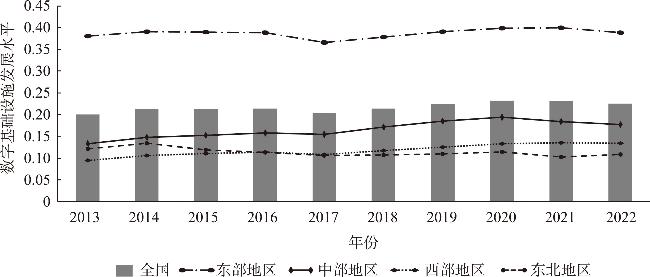
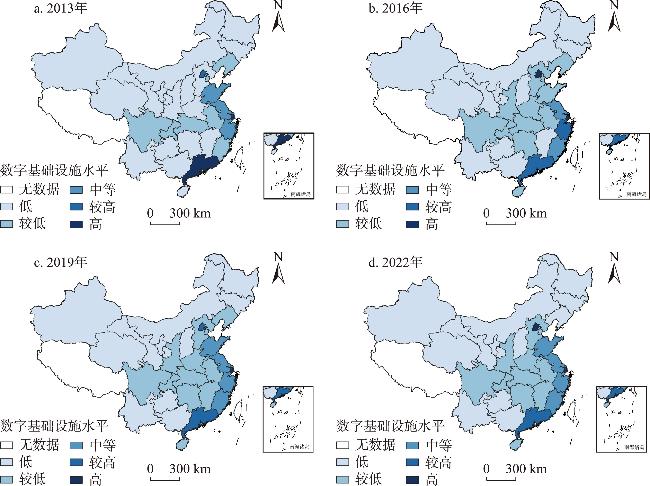
【目的】 数字基础设施为新质生产力形成提供持续驱动力。揭示中国数字基础设施发展水平的时空演变、区域差异及空间收敛特性,对于助力区域均衡发展、赋能高质量发展,进而推动新质生产力发展具有重要意义。【方法】 基于2013—2022年中国省级面板数据,构建涵盖数字基础设施建设与应用的指标评价体系,利用熵值法、泰尔指数、收敛模型、双向固定效应模型和空间计量等方法,对数字基础设施的时空演变、区域差异和空间收敛性进行深入研究。【结果】 ①中国数字基础设施发展水平整体呈上升趋势,但存在空间差异,呈现出东部地区水平较高、西部和东北地区相对较低的空间分布特征。②数字基础设施发展水平的总体差异逐渐缩小,由区域间差异转向区域内差异,区域内差异呈现“东部>西部>中部>东北”的层次结构。③在收敛特性上,中国数字基础设施发展水平的收敛性逐渐呈现缩小趋势,全国及各区域数字基础设施发展水平均表现出空间条件收敛特性,其具体收敛速度依次为:中部地区最快,其次为西部、东部,东北地区最慢。【结论】 补齐数字基础设施发展短板、缩小区域差距、加强跨区域联动是实现区域均衡发展的关键。本文还为推动区域数字基础设施趋同发展及因地制宜制定政策提供了理论支持与实践指导。
刘建君 , 梁大鹏 . 中国数字基础设施发展水平的时空格局[J]. 资源科学, 2025 , 47(6) : 1295 -1311 . DOI: 10.18402/resci.2025.06.10
[Objective] Digital infrastructure serves as a sustained driving force for the formation of new-quality productive forces. This study aims to reveal the spatiotemporal evolution, regional disparities, and spatial convergence characteristics of digital infrastructure development in China. This is of great significance for promoting balanced regional development and empowering high-quality growth, and thereby driving the development of new productive forces. [Methods] Using China’s provincial panel data from 2013 to 2022, an indicator evaluation system for digital infrastructure construction and application was established. Methods such as the entropy method, Theil index, convergence models, two-way fixed effects models, and spatial econometrics were employed to conduct an in-depth analysis of the spatiotemporal evolution, regional disparities, and spatial convergence of digital infrastructure. [Results] (1) The level of digital infrastructure development in China exhibited an overall upward trend, but there are spatial differences. It shows a spatial distribution pattern where the eastern region has a higher level, while the western and northeastern regions are relatively lower. (2) The overall differences in the development level of digital infrastructure are gradually narrowing. The differences are shifting from being mainly between regions to being more pronounced within regions. The regional differences within regions show a hierarchical structure of “eastern > western > central > northeastern”. (3) In terms of convergence characteristics, a gradually weakening trend was observed in the convergence of China’s digital infrastructure development level. Both national and regional levels of digital infrastructure development demonstrated spatial conditional convergence, with convergence speeds ranked as follows: the central region was th e fastest, followed by the western and eastern regions, while the northeastern region was the slowest. [Conclusion] Bridging the gaps in digital infrastructure development, reducing regional disparities, and strengthening cross-regional collaboration are key to balanced regional development. This study provides theoretical support and practical guidance for promoting the convergent development of regional digital infrastructure and formulating tailored policies based on regional conditions.
表1 数字基础设施发展水平指标构建Table 1 Establishment of indicators for digital infrastructure development level |
| 一级指标 | 二级指标 | 三级指标 | 数据来源 |
|---|---|---|---|
| 数字基础设施 发展水平 | 数字基础设施 建设 | 互联网宽带接入端口数/万个 | 《中国统计年鉴》 |
| 互联网域名数/万个 | 《中国统计年鉴》 | ||
| 单位面积长途光缆线路长度/(km/km2) | 《中国统计年鉴》 | ||
| 数字基础设施投入存量/亿元 | 《中国固定资产投资统计年鉴》《中国统计年鉴》 | ||
| 移动电话基站数/万个 | 《中国统计年鉴》 | ||
| 人工智能企业数/个 | 天眼查(https://www.tianyancha.com/) | ||
| 数字基础设施 应用 | 互联网宽带普及率/% | 《中国统计年鉴》 | |
| 移动电话普及率/% | 《中国统计年鉴》 | ||
| 数字金融普惠指数 | 北京大学数字金融研究中心 | ||
| 电子商务交易活动企业比例 | 《中国统计年鉴》 | ||
| 每百家企业拥有网站数/个 | 《中国统计年鉴》 | ||
| 企业电子商务占GDP比重 | 《中国统计年鉴》 |
表2 数字基础设施发展水平的影响因素及衡量方式Table 2 Influencing factors and measurement methods of digital infrastructure development level |
| 符号 | 变量名称 | 衡量方式 |
|---|---|---|
| lnpop | 人口规模 | 年末常住人口/万人 |
| urban | 城镇化率 | 城镇人口与年末常住人口之比 |
| lnpgdp | 经济发展水平 | 实际人均GDP/(元/人) |
| rd | 研发比例 | 研究与发展经费内部支出与GDP之比 |
| is | 产业结构 | 第三产业增加值与第二产业增加值之比 |
| gov | 政府干预 | 地方财政一般预算支出与GDP之比 |
| lnfina | 金融发展水平 | 年末全部金融机构各项借款和贷款总额与GDP之比 |
表3 2013—2022年全国及4个地区数字基础设施发展水平的泰尔指数及其贡献率Table 3 Theil index and contribution rate of digital infrastructure development levels in China and its four regions, 2013-2022 |
| 年份 | 总体 差异 | 区域间差异及 贡献率 | 区域内差异及贡献率 | ||||
|---|---|---|---|---|---|---|---|
| 全国 | 东部地区 | 中部地区 | 西部地区 | 东北地区 | |||
| 2013 | 0.2735 | 0.1895 (69.30) | 0.0840 (30.70) | 0.1062 (24.52) | 0.0163 (0.79) | 0.0695 (4.44) | 0.0427 (0.95) |
| 2014 | 0.2542 | 0.1678 (66.02) | 0.0864 (33.98) | 0.1085 (26.18) | 0.0153 (0.84) | 0.0826 (5.98) | 0.0398 (0.99) |
| 2015 | 0.2545 | 0.1635 (64.23) | 0.0910 (35.77) | 0.1183 (28.35) | 0.0200 (1.12) | 0.0638 (4.79) | 0.0688 (1.52) |
| 2016 | 0.2447 | 0.1576 (64.43) | 0.0870 (35.57) | 0.1076 (26.57) | 0.0208 (1.25) | 0.0799 (6.39) | 0.0623 (1.36) |
| 2017 | 0.2383 | 0.1539 (64.60) | 0.0844 (35.40) | 0.0993 (25.00) | 0.0213 (1.36) | 0.0964 (7.92) | 0.0507 (1.12) |
| 2018 | 0.2239 | 0.1434 (64.05) | 0.0805 (35.95) | 0.0959 (25.19) | 0.0153 (1.09) | 0.0949 (8.53) | 0.0508 (1.14) |
| 2019 | 0.2126 | 0.1360 (63.96) | 0.0766 (36.04) | 0.0855 (23.33) | 0.0200 (1.55) | 0.1013 (9.81) | 0.0585 (1.35) |
| 2020 | 0.2027 | 0.1280 (63.16) | 0.0747 (36.84) | 0.0824 (23.26) | 0.0171 (1.41) | 0.1071 (11.12) | 0.0427 (1.05) |
| 2021 | 0.2003 | 0.1330 (66.40) | 0.0673 (33.60) | 0.0801 (23.12) | 0.0178 (1.42) | 0.0748 (8.10) | 0.0421 (0.95) |
| 2022 | 0.2036 | 0.1278 (62.78) | 0.0758 (37.22) | 0.0951 (26.85) | 0.0147 (1.14) | 0.0788 (8.48) | 0.0312 (0.74) |
注:括号内数字是贡献率,单位为%。 |
表4 2013—2022年中国数字基础设施发展水平全局莫兰指数Table 4 Global Moran’s I of digital infrastructure development levels in China, 2013-2022 |
| 年份 | |||||||
|---|---|---|---|---|---|---|---|
| I | Z | P | I | Z | P | ||
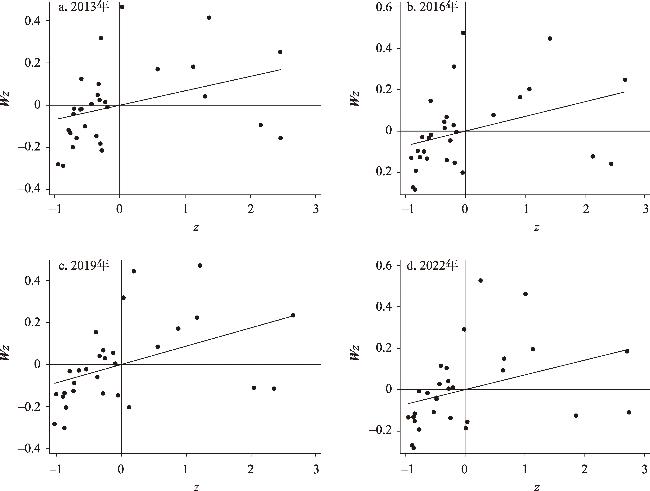
| 2013 | 0.068*** | 2.913 | 0.002 | 0.324*** | 2.846 | 0.002 | |
| 2014 | 0.066*** | 2.887 | 0.002 | 0.324*** | 2.895 | 0.002 | |
| 2015 | 0.069*** | 2.974 | 0.001 | 0.351*** | 3.112 | 0.001 | |
| 2016 | 0.071*** | 3.010 | 0.001 | 0.353** | 3.101 | 0.001 | |
| 2017 | 0.075*** | 3.106 | 0.001 | 0.358*** | 3.117 | 0.001 | |
| 2018 | 0.074*** | 3.048 | 0.001 | 0.344*** | 3.009 | 0.001 | |
| 2019 | 0.088*** | 3.459 | 0.000 | 0.368*** | 3.200 | 0.001 | |
| 2020 | 0.097*** | 3.741 | 0.000 | 0.372*** | 3.242 | 0.001 | |
| 2021 | 0.086*** | 3.421 | 0.000 | 0.375*** | 3.272 | 0.001 | |
| 2022 | 0.071*** | 3.043 | 0.001 | 0.356** | 3.153 | 0.001 | |
表5 2013年、2016年、2019年和2022年地理距离权重矩阵下高-高型、低-低型数字基础设施发展水平省份Table 5 Provinces with HH-type and LL-type digital infrastructure development levels under geographical distance weight matrix in 2013, 2016, 2019, and 2022 |
| 年份 | 高-高型 | 低-低型 |
|---|---|---|
| 2013 | 天津、上海、江苏、浙江、福建、山东 | 山西、内蒙古、辽宁、吉林、黑龙江、广西、重庆、四川、贵州、云南、陕西、甘肃、青海、宁夏、新疆 |
| 2016 | 上海、江苏、浙江、福建、山东 | 山西、内蒙古、辽宁、吉林、黑龙江、广西、重庆、四川、贵州、云南、陕西、甘肃、青海、宁夏、新疆 |
| 2019 | 天津、上海、江苏、浙江、安徽、福建、山东 | 山西、内蒙古、辽宁、吉林、黑龙江、广西、重庆、贵州、云南、陕西、甘肃、青海、宁夏、新疆 |
| 2022 | 天津、上海、江苏、浙江、福建、山东 | 山西、内蒙古、辽宁、吉林、黑龙江、广西、贵州、云南、陕西、甘肃、青海、宁夏、新疆 |
表6 2013—2022年中国及4个地区数字基础设施发展水平的σ收敛检验结果Table 6 Results of σ-convergence test for digital infrastructure development levels in China and its four regions, 2013-2022 |
| 年份 | 全国 | 东部地区 | 中部地区 | 西部地区 | 东北地区 |
|---|---|---|---|---|---|
| 2013 | 0.8125 | 0.4453 | 0.1785 | 0.3761 | 0.2949 |
| 2014 | 0.7877 | 0.4618 | 0.1731 | 0.4103 | 0.2869 |
| 2015 | 0.7935 | 0.4814 | 0.1985 | 0.3676 | 0.3799 |
| 2016 | 0.7673 | 0.4552 | 0.2002 | 0.4120 | 0.3635 |
| 2017 | 0.7479 | 0.4343 | 0.2016 | 0.4506 | 0.3277 |
| 2018 | 0.7217 | 0.4271 | 0.1739 | 0.4492 | 0.3274 |
| 2019 | 0.6975 | 0.4076 | 0.1945 | 0.4650 | 0.3522 |
| 2020 | 0.6786 | 0.4014 | 0.1800 | 0.4743 | 0.3000 |
| 2021 | 0.6813 | 0.3968 | 0.1862 | 0.3983 | 0.2979 |
| 2022 | 0.6956 | 0.4342 | 0.1690 | 0.4073 | 0.2558 |
| 变化幅度/% | -14.39 | -2.49 | -5.32 | 8.30 | -13.26 |
表7 地理距离权重矩阵下中国及4个地区数字基础设施发展水平条件β收敛检验结果Table 7 Results of conditional β-convergence test for digital infrastructure development levels in China and its four regions under geographical distance weight matrix |
| 模型 | 全国 | 东部地区 | 中部地区 | 西部地区 | 东北地区 |
|---|---|---|---|---|---|
| SDM | OLS | SDM | SDM | SDM | |
| β | -0.592*** (-11.82) | -0.612*** (-7.91) | -1.135*** (-7.13) | -0.864*** (-7.37) | -1.439*** (-10.30) |
| lnpop | -0.195 (-0.65) | -1.556*** (-4.21) | 2.036 (0.73) | 5.843*** (3.02) | -97.117*** (-24.25) |
| urban | 2.127*** (3.86) | 1.393*** (3.57) | 3.377 (0.58) | 0.172 (0.04) | 111.411*** (92.37) |
| lnpgdp | 0.256 (1.01) | -0.805* (-2.22) | 0.424 (0.68) | 0.720 (0.72) | -44.516*** (-31.30) |
| rd | -6.586* (-1.78) | -0.235 (-0.15) | 4.096 (0.22) | -6.639 (-0.41) | -213.407*** (-26.96) |
| is | -0.076 (-1.63) | -0.046 (-1.08) | -0.681*** (-2.81) | 0.260 (0.97) | -6.878*** (-31.27) |
| gov | 0.123 (0.21) | -1.015 (-1.65) | -3.906*** (-2.85) | 6.074** (2.55) | 21.493*** (19.29) |
| lnfina | -0.230* (-1.84) | -0.046 (-0.35) | 0.579 (0.80) | -0.267 (-0.60) | 13.358*** (25.52) |
| ρ | -1.071*** (-3.63) | -1.483*** (-5.52) | -0.469 (-1.43) | 0.289** (2.00) | |
| φ | -0.439 (-1.01) | -1.475** (-2.13) | -0.802 (-0.86) | 0.838** (1.97) | |
| W×lnpop | -3.261 (-1.14) | 14.119 (1.50) | 43.546*** (3.45) | -142.916*** (-21.67) | |
| W×urban | 8.711*** (2.79) | -5.939 (-0.32) | 8.914 (0.40) | 204.969*** (136.65) | |
| W×lnpgdp | -3.217 (-1.62) | -2.004 (-0.85) | 4.525 (0.66) | -68.816*** (-38.09) | |
| W×rd | -8.714 (-0.43) | -21.589 (-0.30) | 190.790* (1.79) | -392.4441*** (-47.92) | |
| W×is | -0.763** (-2.19) | -2.150** (-2.34) | 1.363 (1.05) | -12.439*** (-22.68) | |
| W×gov | -0.367 (-0.10) | -4.210 (-0.74) | 10.359 (0.75) | 42.986*** (18.69) | |
| W×lnfina | -1.678* (-1.85) | 3.063 (1.19) | -1.002 (-0.39) | 21.583*** (25.45) | |
| LR test-Lag | 31.02*** | 12.41 | 16.67** | 20.52*** | 117.2*** |
| LR test-Error | 25.96*** | 10.28 | 18.24** | 18.95** | 113.68*** |
| Wald test-Lag | 60.62*** | 16.37** | 2651.94*** | 99.82*** | 61.08*** |
| Wald test-Error | 60.61*** | 26.88*** | 539.25*** | 159.30*** | 21.84*** |
| Hausman检验 | 81.76*** | 36.96*** | 17.82*** | 30.52*** | 8.77** |
| 时间固定效应 | 是 | 是 | 是 | 是 | 是 |
| 个体固定效应 | 是 | 是 | 是 | 是 | 是 |
| Log Likelihood | 336.3903 | 130.2692 | 107.4954 | 121.0939 | |
| R2 | 0.0737 | 0.6357 | 0.1764 | 0.0017 | 0.0638 |
| 样本数 | 270 | 90 | 54 | 99 | 27 |
注:*、**、***分别表示在10%、5%和1%的水平下显著。括号内表示统计量z或者t值,下同。 |
| [1] |
|
| [2] |
|
| [3] |
董旭, 许高阳, 薛桂芝. 数字基础设施建设促进了经济增长吗?来自中国县域层面的经验证据[J]. 南开经济研究, 2024, (11): 66-85.
[
|
| [4] |
黄群慧, 盛方富. 新质生产力系统: 要素特质、结构承载与功能取向[J]. 改革, 2024, (2): 15-24.
[
|
| [5] |
邓荣荣, 吴云峰. 有福同享: 城市数字基础设施建设与经济包容性增长[J]. 上海财经大学学报, 2023, 25(1): 3-18.
[
|
| [6] |
方福前, 田鸽, 张勋. 数字基础设施与代际收入向上流动性: 基于“宽带中国”战略的准自然实验[J]. 经济研究, 2023, 58(5): 79-97.
[
|
| [7] |
|
| [8] |
叶永卫, 陶云清, 李鑫. 数字基础设施建设与企业投融资期限错配改善[J]. 经济评论, 2023, (4): 123-137.
[
|
| [9] |
孙伟增, 郭冬梅. 信息基础设施建设对企业劳动力需求的影响: 需求规模、结构变化及影响路径[J]. 中国工业经济, 2021, (11) : 78-96.
[
|
| [10] |
任晓松, 孙莎. 数字经济对中国城市工业碳生产率的赋能效应[J]. 资源科学, 2022, 44(12): 2399-2414.
[
|
| [11] |
韩燕, 潘成, 金凤君, 等. 黄河流域数字经济产业空间格局演化及影响因素[J]. 资源科学, 2024, 46(3): 488-504.
[
|
| [12] |
刘传明, 马青山. 网络基础设施建设对全要素生产率增长的影响研究: 基于“宽带中国”试点政策的准自然实验[J]. 中国人口科学, 2020, (3): 75-88, 127-128.
[
|
| [13] |
尚文思. 新基建对劳动生产率的影响研究: 基于生产性服务业的视角[J]. 南开经济研究, 2020, (6): 181-200.
[
|
| [14] |
薛飞, 周民良, 刘家旗. 数字基础设施降低碳排放的效应研究: 基于“宽带中国”战略的准自然实验[J]. 南方经济, 2022, (10): 19-36.
[
|
| [15] |
郭丰, 任毅, 柴泽阳. “双碳”目标下数字基础设施建设与城市碳排放: 基于“宽带中国”试点政策的准自然实验[J]. 中国经济问题, 2023, (5): 164-180.
[
|
| [16] |
焦豪, 崔瑜, 张亚敏. 数字基础设施建设与城市高技能创业人才吸引[J]. 经济研究, 2023, 58(12): 150-166.
[
|
| [17] |
杨冕, 刘萧萧, 李振冉. 数字基础设施建设能促进劳动力就业吗? 来自“宽带中国”试点政策的证据[J]. 系统工程理论与实践, 2024, 44(1): 190-207.
[
|
| [18] |
马青山, 何凌云, 袁恩宇. 新兴基础设施建设与城市产业结构升级: 基于“宽带中国”试点的准自然实验[J]. 财经科学, 2021, (4): 76-90.
[
|
| [19] |
沈坤荣, 林剑威, 傅元海. 网络基础设施建设、信息可得性与企业创新边界[J]. 中国工业经济, 2023, (1): 57-75.
[
|
| [20] |
张杰, 白铠瑞, 毕钰. 互联网基础设施、创新驱动与中国区域不平衡: 从宏观到微观的证据链[J]. 数量经济技术经济研究, 2023, 40(1) 46-65.
[
|
| [21] |
田杰棠, 闫德利. 新基建和产业互联网: 疫情后数字经济加速的“路与车”[J]. 山东大学学报(哲学社会科学版), 2020, (3): 1-8.
[
|
| [22] |
刘艳红, 黄雪涛, 石博涵. 中国“新基建”: 概念、现状与问题[J]. 北京工业大学学报(社会科学版), 2020, 20(6): 1-12.
[
|
| [23] |
张佩, 王姣娥, 肖凡. 中国新基建发展的时空演变及驱动因素[J]. 地理科学进展, 2023, 42(2): 209-220.
[
|
| [24] |
宋敏, 刘欣雨. 中国新基建与经济韧性耦合协调度的时空演化及驱动因素[J]. 经济地理, 2023, 43(10): 13-22.
[
|
| [25] |
张立新, 张家瑞. 中国新基建与区域韧性耦合协调发展: 时空差异与演变趋势[J]. 干旱区地理, 2024, 47(12): 2164-2176.
[
|
| [26] |
刘佳, 安珂珂, 赵青华. 数字基础设施建设、要素市场化配置与旅游经济包容性增长[J/OL]. 旅游科学, (2024-09-18) [2024-10-15]. https://doi.org/10.16323/j.cnki.lykx.20240914.001.
[
|
| [27] |
张恒硕, 李绍萍. 数字基础设施与能源产业高级化: 效应与机制[J]. 产业经济研究, 2022, (5): 15-27, 71.
[
|
| [28] |
李晓华. 面向智慧社会的“新基建”及其政策取向[J]. 改革, 2020, (5): 34-48.
[
|
| [29] |
孙黎, 许唯聪. 数字经济对地区全球价值链嵌入的影响: 基于空间溢出效应视角的分析[J]. 经济管理, 2021, 43(11): 16-34.
[
|
| [30] |
祝志勇, 刘畅畅. 数字基础设施对城乡收入差距的影响及其门槛效应[J]. 华南农业大学学报(社会科学版), 2022, 21(5): 126-140.
[
|
| [31] |
|
| [32] |
|
| [33] |
|
| [34] |
郭鹏飞, 胡歆韵, 李敬. 中国网络基础设施资本回报率的区域差异与空间收敛性研究[J]. 数量经济技术经济研究, 2022, 39(1): 73-93.
[
|
| [35] |
|
| [36] |
|
| [37] |
|
| [38] |
|
| [39] |
|
| [40] |
|
| [41] |
张军, 高远, 傅勇, 等. 中国为什么拥有了良好的基础设施?[J]. 经济研究, 2007, (3): 4-19.
[
|
| [42] |
徐维祥, 陈展驰, 周建平, 等. 中国新型基础设施的格局及影响因素分析: 以新能源汽车充电桩为例[J]. 经济问题探索, 2023, (7): 43-53.
[
|
| [43] |
白洋, 邱子芮. 智慧城市试点对邻地环境的空间溢出效应[J]. 资源科学, 2024, 46(8): 1651-1667.
[
|
| [44] |
|
| [45] |
张佩, 王姣娥, 孙勇, 等. 中国省域创新基础设施与创新产出水平的耦合协调发展及其影响因素[J]. 经济地理, 2022, 42(9): 11-21.
[
|
| [46] |
|
| [47] |
金戈. 中国基础设施与非基础设施资本存量及其产出弹性估算[J]. 经济研究, 2016, 51(5): 41-56.
[
|
| [48] |
毕青苗, 徐现祥, 杨海生. 商事制度改革与就业增长[J]. 数量经济技术经济研究, 2024, 41(1): 130-150.
[
|
| [49] |
袁航, 朱承亮. 智慧城市是否加速了城市创新?[J]. 中国软科学, 2020, (12): 75-83.
[
|
| [50] |
|
| [51] |
毕秀晶, 宁越敏. 长三角大都市区空间溢出与城市群集聚扩散的空间计量分析[J]. 经济地理, 2013, 33(1): 46-53.
[
|
| [52] |
洪联英, 湛惠雯, 唐佳敏. 融资投向差异与企业技术创新效应[J]. 财经研究, 2024, 50(11): 65-79.
[
|
| [53] |
梁冉, 文学国, 朱四伟, 等. 知识产权保护促进了企业创新质量的提升吗? 来自国家知识产权示范城市的准自然实验[J]. 科学学与科学技术管理, 2024, 45(3): 3-20.
[
|
| [54] |
王义中, 郑博文, 邬介然. 不确定性冲击、信贷资源错配与货币财政政策效果[J]. 世界经济, 2023, 46(2): 3-30.
[
|
| [55] |
陈享光, 黄泽清. 金融化、虚拟经济与实体经济的发展: 兼论“脱实向虚”问题[J]. 中国人民大学学报, 2020, 34(5): 53-65.
[
|
| [56] |
谢漾, 洪正. 金融集聚的地理结构及演进规律: 虹吸还是辐射: 基于城市群的研究视角[J]. 山西财经大学学报, 2022, 44(11): 28-38.
[
|
/
| 〈 |
|
〉 |