清洁能源转型下关键金属产业链碳排放研究综述与展望
|
朱学红,女,湖南长沙人,研究员,主要从事资源和环境经济与管理研究。E-mail: zhxh@csu.edu.cn |
收稿日期: 2022-09-09
修回日期: 2022-12-22
网络出版日期: 2023-03-25
基金资助
国家社会科学基金重大项目(21&ZD103)
国家自然科学基金青年项目(72204270)
中南大学研究生自主探索类科研创新项目(2022ZZTS0325)
A review and prospect of research on carbon emissions from the critical metal industry chain under clean energy transition
Received date: 2022-09-09
Revised date: 2022-12-22
Online published: 2023-03-25
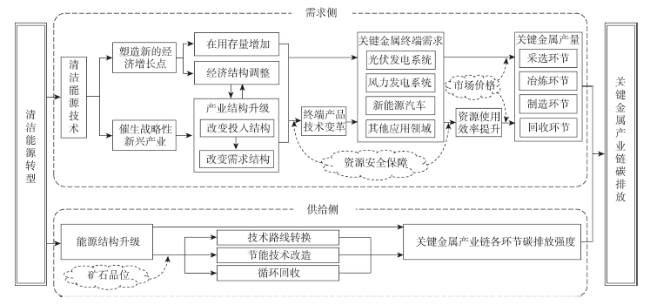
【目的】在全球碳中和背景下,清洁能源技术迎来井喷期,关键金属需求及产业链碳排放将大幅攀升。【方法】为了深入厘清清洁能源转型下关键金属产业链碳排放的驱动机理、研究方法和减排路径,本文基于系统性关联视角,站在全产业链的高度对相关研究进行了系统梳理和整合分析。【结果】研究发现:①清洁能源转型从需求侧拉动关键金属需求,从供给侧降低碳排放强度,供需双轮共同驱动关键金属产业链碳排放;②关键金属产业链碳排放核算和预测需集成多种方法模型,应根据不同的分析对象选择适配的研究方法;③现有研究重点关注关键金属冶炼和回收环节的碳减排路径,尚未从全产业链的角度识别降碳路径。【结论】未来需基于“金属-能源-碳”多要素关联视角和集成性方法进一步验证关键金属产业链碳排放的内在机理并研判其未来态势,在此基础上结合“中国因素”系统性地设计和识别关键金属全产业链碳减排路径,为达成碳中和目标提供现实依据和决策参考。
朱学红 , 李双美 , 曾安琪 . 清洁能源转型下关键金属产业链碳排放研究综述与展望[J]. 资源科学, 2023 , 45(1) : 1 -17 . DOI: 10.18402/resci.2023.01.01
[Objective] Under the background of achieving global carbon neutrality, clean energy technologies are booming and the demand for critical metals and the industrial carbon emissions will rise sharply. [Methods] To further clarify the driving mechanism, methodological framework, and carbon emission reduction pathways of the critical metal industry chain under the clean energy transition, this study systematically reviewed and integrated the relevant research from the perspectives of systematic nexus and the whole industry chain. [Results] We found that clean energy transition induces the terminal demand for critical metals from the demand side and reduces the carbon emission intensity from the supply side, which jointly drive the industrial carbon emissions; it is required to integrate a variety of methods and models to calculate and predict the carbon emissions of the critical metal industry chain, and we should select suitable research methods according to the research objects; existing research mainly focuses on carbon emission reduction pathways in the smelting and recycling stages, and has not systematically identified the pathways from the viewpoint of the whole industry chain yet. [Conclusion] In the future, based on the metal-energy-carbon nexus theory and integrated methods, it is necessary to further verify the internal mechanism and study the trends of carbon emissions in the critical metal industry chain. Furthermore, it is essential to systematically design and identify the carbon reduction pathways from the whole industry chain with the “China factor” incorporated, providing a realistic basis and decision-making reference for achieving the goal of carbon neutrality.
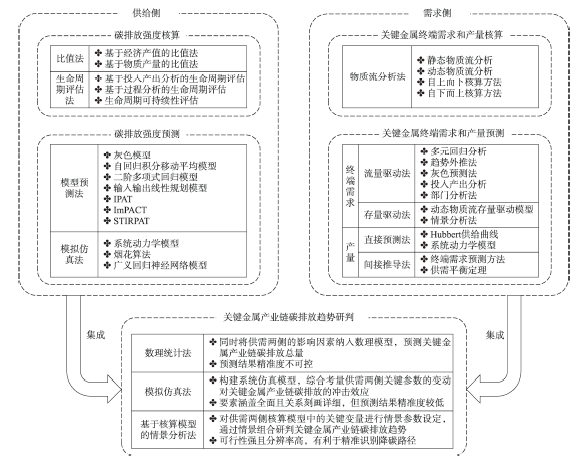
表1 关键金属碳排放强度评估和预测方法Table 1 Evaluation and prediction methods for carbon emission intensity of critical metals |
| 类别 | 方法原理 | 方法模型 | 方法适用性 | 典型文献 | |
|---|---|---|---|---|---|
| 评估方法 | 比值法 | — | 基于经济产值的比值法 基于物质产量的比值法 | 粗略刻画产业链整体碳排放强度 | Zhong等[53] Oda等[54] |
| 生命周期评估法 | 投入产出理论 | 基于投入产出分析的生命周期评估 | 精细刻画产业链整体碳排放强度 | Vendries Algarin等[58] | |
| 基于过程分析的生命周期评估 | 精细刻画产业链各环节碳排放强度 | Liu等[61] | |||
| 生命周期可持续性评估 | 刻画产业链各环节的环境、经济和社会影响 | Guinée等[63] | |||
| 预测方法 | 模型预测法 | 基于数理模型预测碳排放强度 | 灰色模型 自回归积分移动平均模型 二阶多项式回归模型 输入输出线性规划模型 IPAT ImPACT STIRPAT | 经济技术系统稳定运行情况下的碳排放强度预测 | Li等[66] Liu等[67] Kang等[68] Yue等[69] Long等[70] Xie等[71] |
| 模拟仿真法 | 基于系统建模和人工智能量化外部因素对碳排放强度的影响 | 系统动力学模型 烟花算法 广义回归神经网络模型 | 复杂系统的碳排放强度预测 | Li等[26] Niu等[72] | |
资料来源:根据相关文献整理得出。 |
表2 关键金属需求及产量核算和预测方法Table 2 Evaluation and prediction methods for critical metal demand and production volume |
| 类别 | 方法原理 | 方法模型 | 方法适用性 | 典型文献 | |
|---|---|---|---|---|---|
| 核算 方法 | 物质流分析法 | 物质守恒定理 | 静态物质流分析 | 呈现特定年份关键金属存流量“快照” | 陈伟强等[74] |
| 动态物质流分析 | 表征一段时间内关键金属存流量变化 | Liu等[75] | |||
| 自上而下核算方法 | 刻画宏观层面的关键金属终端需求和产量 | Glöser等[77] | |||
| 自下而上核算方法 | 识别微观尺度的关键金属终端需求和产量 | Duan等[79] | |||
| 终端 需求 预测 | 流量驱动法 | 基于历史流量数据和数理模型预测关键金属消费量 | 多元回归分析 趋势外推法 灰色预测法 投入产出分析 部门分析法 | 传统产业和成熟技术领域的关键金属终端需求预测 | Schipper等[83] 柳群义[84] Ma等[86] Tisserant等[87] 张若然等[88] |
| 存量驱动法 | 根据终端产品社会在用存量的预测结果和物质守恒定理,推算关键金属终端需求 | 动态物质流存量驱动模型+情景分析法 | 新兴产业和技术领域的关键金属终端需求预测 | Ren等[90] Cao等[89] Zeng等[3] | |
| 产量 预测 | 直接预测法 | 基于数学模型或仿真模型直接估测关键金属产量 | Hubbert供给曲线 系统动力学模型 | 原生关键金属产量预测 粗略预测关键金属产量 | 张亚斌等[91] Sverdrup[93] |
| 间接推导法 | 根据需求预测结果和供需平衡定理推导关键金属产量 | 前文所述的终端需求预测方法 | 精细预测关键金属产业链各环节产量 | 前文归纳的终端需求预测方法对应的文献 | |
资料来源:根据相关文献整理得出。 |
| [1] |
|
| [2] |
|
| [3] |
|
| [4] |
|
| [5] |
|
| [6] |
|
| [7] |
|
| [8] |
|
| [9] |
|
| [10] |
|
| [11] |
|
| [12] |
|
| [13] |
|
| [14] |
|
| [15] |
|
| [16] |
|
| [17] |
|
| [18] |
|
| [19] |
|
| [20] |
|
| [21] |
|
| [22] |
|
| [23] |
|
| [24] |
|
| [25] |
|
| [26] |
|
| [27] |
卢浩洁, 王婉君, 代敏, 等. 中国铝生命周期能耗与碳排放的情景分析及减排对策[J]. 中国环境科学, 2021, 41(1): 451-462.
[
|
| [28] |
曾广圆, 杨建新, 宋小龙, 等. 火法炼铜能耗与碳排放情景分析: 基于生命周期的视角[J]. 中国人口·资源与环境, 2012, 22(4): 46-50.
[
|
| [29] |
汪鹏, 王翘楚, 韩茹茹, 等. 全球关键金属-低碳能源关联研究综述及其启示[J]. 资源科学, 2021, 43(4): 669-681.
[
|
| [30] |
陈骏. 关键金属超常富集成矿和高效利用[J]. 科技导报, 2019, 37(24): 1.
[
|
| [31] |
吴巧生, 周娜, 成金华. 战略性关键矿产资源供给安全研究综述与展望[J]. 资源科学, 2020, 42(8): 1439-1451.
[
|
| [32] |
葛建平, 刘佳琦. 关键矿产战略国际比较: 历史演进与工具选择[J]. 资源科学, 2020, 42(8): 1464-1476.
[
|
| [33] |
翟明国, 吴福元, 胡瑞忠, 等. 战略性关键金属矿产资源: 现状与问题[J]. 中国科学基金, 2019, 33(2): 106-111.
[
|
| [34] |
|
| [35] |
|
| [36] |
曲永义, 贺俊, 江鸿, 等. 产业链链长的理论内涵及其功能实现[J]. 中国工业经济, 2022, (7): 5-24.
[
|
| [37] |
周娜. 中国锂产业链安全态势与治理研究[D]. 武汉: 中国地质大学, 2021.
[
|
| [38] |
|
| [39] |
|
| [40] |
|
| [41] |
杨莉莎, 朱俊鹏, 贾智杰. 中国碳减排实现的影响因素和当前挑战: 基于技术进步的视角[J]. 经济研究, 2019, 54(11): 118-132.
[
|
| [42] |
|
| [43] |
|
| [44] |
王安建, 王高尚, 陈其慎, 等. 矿产资源需求理论与模型预测[J]. 地球学报, 2010, 31(2): 137-147.
[
|
| [45] |
杨建锋, 余韵, 马腾, 等. 工业革命驱动下能源与金属资源需求演变特征与前景分析[J]. 中国人口·资源与环境, 2020, 30(12): 45-54.
[
|
| [46] |
陈其慎, 于汶加, 张艳飞, 等. 矿业发展周期理论与中国矿业发展趋势[J]. 资源科学, 2015, 37(5): 891-899.
[
|
| [47] |
陈其慎, 于汶加, 张艳飞, 等. 资源-产业“雁行式”演进规律[J]. 资源科学, 2015, 37(5): 871-882.
[
|
| [48] |
董雪松, 黄健柏, 钟美瑞, 等. 技术进步对关键金属矿产需求影响的研究综述[J]. 资源科学, 2020, 42(8): 1592-1603.
[
|
| [49] |
曾新群. 产业主导部门分析理论的发展[J]. 中国工业经济, 1988, (1): 40-46.
[
|
| [50] |
干春晖, 郑若谷, 余典范. 中国产业结构变迁对经济增长和波动的影响[J]. 经济研究, 2011, 46(5): 4-16.
[
|
| [51] |
王昶, 宋慧玲, 左绿水, 等. 国家金属资源安全研究回顾与展望[J]. 资源科学, 2017, 39(5): 805-817.
[
|
| [52] |
|
| [53] |
|
| [54] |
|
| [55] |
|
| [56] |
|
| [57] |
|
| [58] |
|
| [59] |
|
| [60] |
|
| [61] |
|
| [62] |
|
| [63] |
|
| [64] |
|
| [65] |
|
| [66] |
|
| [67] |
|
| [68] |
|
| [69] |
|
| [70] |
|
| [71] |
|
| [72] |
|
| [73] |
刘刚, 曹植, 王鹤鸣, 等. 推进物质流和社会经济代谢研究, 助力实现联合国可持续发展目标[J]. 中国科学院院刊, 2018, 33(1): 30-39.
[
|
| [74] |
陈伟强, 石磊, 钱易. 2005年中国国家尺度的铝物质流分析[J]. 资源科学, 2008, (9): 1320-1326.
[
|
| [75] |
|
| [76] |
|
| [77] |
|
| [78] |
|
| [79] |
|
| [80] |
|
| [81] |
|
| [82] |
宋慧玲, 王昶, 左绿水. 碳中和背景下清洁能源技术关键伴生金属可供性约束研究回顾与展望[J]. 中国人口·资源与环境, 2022, 32(3): 38-48.
[
|
| [83] |
|
| [84] |
柳群义. 基于“S”形模型的全球铜需求分析[J]. 中国矿业, 2019, 28(10): 61-68.
[
|
| [85] |
代涛, 陈其慎, 于汶加. 全球锌消费及需求预测与中国锌产业发展[J]. 资源科学, 2015, 37(5): 951-960.
[
|
| [86] |
|
| [87] |
|
| [88] |
张若然, 陈其慎, 柳群义, 等. 全球主要铂族金属需求预测及供需形势分析[J]. 资源科学, 2015, 37(5): 1018-1029.
[
|
| [89] |
|
| [90] |
|
| [91] |
张亚斌, 李鹏远, 李天骄, 等. 基于Hubbert模型的中国锑矿生产峰值研究[J]. 中国矿业, 2019, 28(8): 66-71.
[
|
| [92] |
李天骄, 梁海峰, 李建武, 等. 基于Hubbert峰值模型的中国有色金属产量峰值研究[J]. 中国矿业, 2019, 28(7): 75-80.
[
|
| [93] |
|
| [94] |
王昶, 秦雅, 邵留国, 等. 基于系统动力学的清洁能源技术关键伴生金属可供性研究: 以镓为例[J]. 系统工程, 2018, 36(4): 116-127.
[
|
| [95] |
|
| [96] |
|
| [97] |
|
| [98] |
|
| [99] |
|
| [100] |
|
| [101] |
|
| [102] |
|
| [103] |
|
| [104] |
|
| [105] |
|
| [106] |
|
| [107] |
|
| [108] |
|
| [109] |
|
| [110] |
|
| [111] |
|
| [112] |
|
| [113] |
|
| [114] |
|
| [115] |
王翘楚, 孙鑫, 郝瀚, 等. 锂的城市矿产利用: 前景、挑战及政策建议[J]. 科技导报, 2020, 38(15): 6-15.
[
|
| [116] |
|
| [117] |
|
| [118] |
|
| [119] |
|
| [120] |
|
/
| 〈 |
|
〉 |