1990年以来卢旺达森林转型路径及趋势模拟
|
李天润,男,河北沧州人,硕士生,研究方向为土地利用变化与资源可持续利用。E-mail: 20201210011@nuist.edu.cn |
收稿日期: 2021-07-06
修回日期: 2021-10-24
网络出版日期: 2022-05-25
基金资助
国家重点研发计划项目(2018YFE0105900)
国家自然科学基金项目(41771140)
Forest transition paths in Rwanda since 1990 and trend prediction
Received date: 2021-07-06
Revised date: 2021-10-24
Online published: 2022-05-25
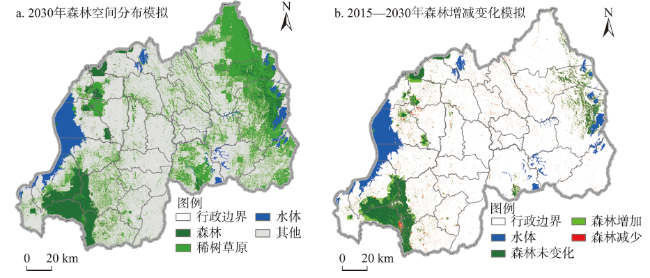
社会经济发展过程中一个国家(地区)森林面积由减少转为增加的“森林转型“内在驱动机制,是资源环境研究关注的热点。以4期卢旺达土地覆盖数据为主要信息源,分析1990—2015年该地区森林变化的趋势和时空特征。结合社会经济数据,借助森林转型的路径分析法,探究卢旺达森林面积变化的影响因素及其所遵循的转型路径。在此基础上,利用PLUS模型对卢旺达2030年的森林空间动态分布进行模拟预测,对如何继续保持良好转型态势提出相关建议。结果表明:①卢旺达森林面积在2010年开始出现净增长,由2010年的197383.2 hm2增加到2015年的213087.8 hm2,年增加率0.8%;②国家公园和保护区是森林增长主要地区,且主要来源于稀树草原和耕地,分别占森林净增加总面积的87.8%和8.8%;③转型的内在驱动机制主要是国家政策引导下发生的“国家森林政策路径”和“森林稀缺路径”,全球化路径体现在植树技术与资金支持;④对卢旺达2030年森林模拟预测显示,森林转型仍将继续,预计到2030年森林面积将净增加34065.2 hm2。为进一步提高研究区森林覆盖率,卢旺达政府部门应改善森林恢复的薄弱环节,加快农业集约化推广;通过为农村社区创造场外就业机会,引导经济和就业发生转型,从而推动基于“经济发展路径”与“农村集约化路径”的森林增加。
李天润 , 陈爽 . 1990年以来卢旺达森林转型路径及趋势模拟[J]. 资源科学, 2022 , 44(3) : 494 -507 . DOI: 10.18402/resci.2022.03.06
In the process of socioeconomic development, the internal driving mechanism of the “forest transition” in which the forest area of a country (region) changes from decreasing to increasing is a hotspot in resources and environment research. This study used Rwanda's land cover data as the main source of information to analyze the trends and temporal and spatial characteristics of forest changes in the country from 1990 to 2015. Using socioeconomic data and the path analysis method of forest transition, this study explored the influencing factors of the change in forest area in Rwanda and the transition paths that it followed. On this basis, the patch-generating land use simulation (PLUS) model was used to simulate and predict the spatial dynamics of Rwanda's forest distribution in 2030, and relevant policy recommendations on healthy forest transition was made. The results indicate that: (1) The forest area of Rwanda began to show a net increase in 2010, from 197383.2 hm2 to 213087.8 hm2, with an annual change rate of 0.8%. (2) The National parks and protected areas were the main areas of forest growth, and the growth were mainly from savanna and cropland, accounting for 87.8% and 8.8% of the total forest net increase respectively. (3) The internal driving mechanism was mainly the “national forest policy path” and the “forest scarcity path” under the guidance of national policies. The path of globalization was reflected in tree planting technology and financial assistance. (4) The simulation result shows that forest transition will continue in Rwanda by 2030. The forest area is expected to increase by 34065.2 hm2. To increase the forest coverage rate, the state should improve the weak links of forest restoration and accelerate the promotion of agricultural intensification. By creating employment opportunities for rural communities, the government can guide the transformation of the economy and employment. The state can promote the “economic development path” and “agricultural intensification path” through the above measures.
Key words: forest transition; national policy path; driving mechanism; PLUS model; Rwanda
表1 森林转型路径特征Table 1 Characteristics of forest transition pathways |
| 转型路径 | 路径基本特征解释 |
|---|---|
| 经济发展路径 | 工业化与服务业增长吸引乡村劳动力;农业经济活动效益下降;边际化土地上乡村人口与耕地的减少;废弃耕地转化为森林 |
| 国家森林政策路径 | 国家愿意实现经济现代化;整合边缘较贫困社会群体;通过绿化国家形象促进旅游业,实施修复种植树木和植树项目;间接地提供农业补贴等激励措施加大森林恢复力度 |
| 全球化路径 | 林产品国际进出口;执行与林业实践有关的国际环境协定;国际间合作资助;森林管理全球化实践 |
| 森林稀缺路径 | 森林减少造成林产品价格激增;刺激农牧业向树木种植转型;政府应对森林稀缺引起的环境恶化,实施森林恢复和种植措施 |
| 农业集约化路径 | 放弃不适于耕种的土地;改良土地和实施集约化耕作;农林业系统的扩张;废弃休耕地发生演替 |
表2 数据来源Table 2 Data sources |
| 数据类型 | 来源 | 年份 |
|---|---|---|
| 土地覆盖数据 | RCMRD( http://geoportal.rcmrd.org/) | 1990、2000、2010、2015 |
| 种植林面积 | FAO(https://www.fao.org/forest-resources-assessment/en/) | 1990、2000、2010、2015 |
| GDP | 卢旺达国家统计局网站( https://www.statistics.gov.rw/) | 1990—2015 |
| 城乡人口 | 卢旺达国家统计局网站( https://www.statistics.gov.rw/) | 1990—2015 |
| 城乡就业 | 世界银行( https://data.worldbank.org.cn/indicator) | 1990—2015 |
| 难民人口 | 世界银行( https://data.worldbank.org.cn/indicator) | 1990—2015 |
| 国际援助 | FAO数据库( http://www.fao.org/aid-monitor/en/) | 2001—2015 |
| 合作项目 | FAO数据库( http://www.fao.org/home/en/) | 2000—2015 |
| 林产品贸易 | FAO数据库( http://www.fao.org/home/en/) | 1990—2015 |
| 谷物产量 | FAO数据库( http://www.fao.org/home/en/) | 1990—2015 |
| 国家林业政策 | 卢旺达水和林业局;卢旺达自然资源局( https://www.minagri.gov.rw/)FAOLEX数据库( http://www.fao.org/faolex/zh/) | — |
表3 1990—2015年卢旺达主要土地覆盖类型的面积变化情况Table 3 Area changes of main land cover types in Rwanda, 1990-2015 |
| 类型 | 主要地类面积/hm2 | 1990—2000年 | 2000—2010年 | 2010—2015年 | |||||||||
|---|---|---|---|---|---|---|---|---|---|---|---|---|---|
| 1990年 | 2000年 | 2010年 | 2015年 | 面积变化/hm2 | 变化率/% | 面积变化/hm2 | 变化率/% | 面积变化/hm2 | 变化率/% | ||||
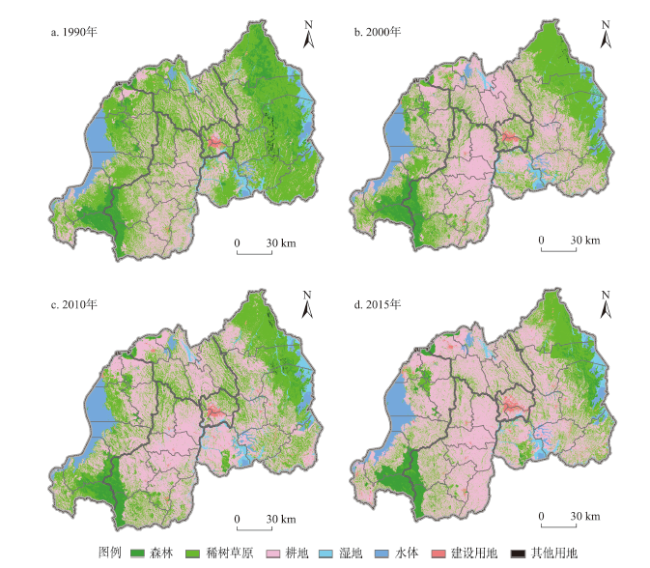
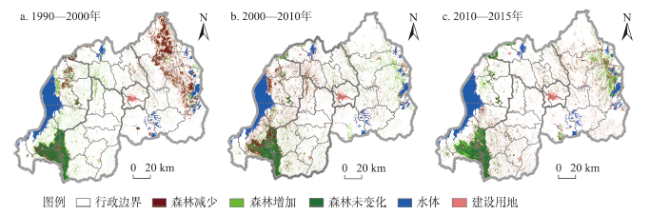
| 森林 | 230507.3 | 213930.5 | 197383.2 | 213087.8 | -16576.8 | -0.7 | -16547.3 | -0.8 | 15704.6 | 0.8 | |||
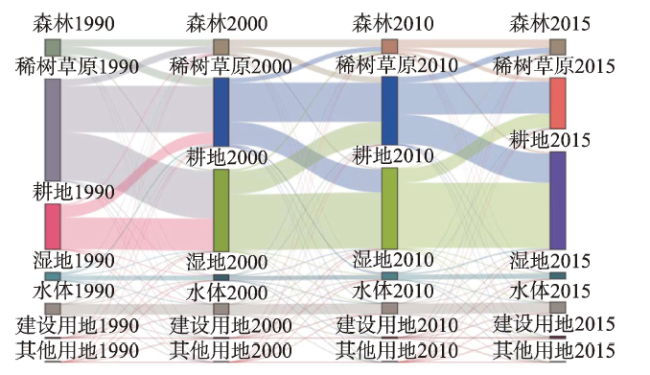
| 稀树草原 | 1403258.2 | 946770.5 | 941126.9 | 701336.5 | -456487.7 | -3.3 | -5643.6 | -0.1 | -239790.4 | -2.6 | |||
| 耕地 | 624221.5 | 1126239.5 | 1116723.6 | 1344952.2 | 502018.0 | 8.1 | -9515.9 | -0.1 | 228228.6 | 2.1 | |||
| 建设用地 | 11632.6 | 13843.1 | 20945.3 | 36343.7 | 2210.5 | 1.9 | 7102.2 | 5.1 | 15398.4 | 7.4 | |||
表4 2015—2030年Markov链模型预测地类面积 (hm2)Table 4 Land use predicted by the Markov model, 2015-2030 (hm2) |
| 类型 | 全国 | 东部省 | 西部省 | ||||||||
|---|---|---|---|---|---|---|---|---|---|---|---|
| 2015年 | 2030年 | 2015—2030年 | 2015年 | 2030年 | 2015—2030年 | 2015年 | 2030年 | 2015—2030年 | |||
| 森林 | 213087.8 | 247153.0 | 34065.2 | 47727.6 | 48989.2 | 1261.6 | 89858.5 | 121104.4 | 31245.9 | ||
| 稀树草原 | 701336.5 | 660383.1 | -40953.4 | 397828.9 | 445987.2 | 48158.3 | 113901.1 | 81972.7 | -31928.4 | ||
| 耕地 | 1344952.2 | 1345735.0 | 782.8 | 377379.2 | 342377.5 | -35001.7 | 278251.8 | 276992.2 | -1259.6 | ||
| 建设用地 | 36343.7 | 77224.3 | 40880.6 | 11514.6 | 23315.4 | 11800.8 | 5562.2 | 14780.9 | 9218.7 | ||
| 类型 | 南部省 | 北部省 | 基加利市 | ||||||||
| 2015年 | 2030年 | 2015—2030年 | 2015年 | 2030年 | 2015—2030年 | 2015年 | 2030年 | 2015—2030年 | |||
| 森林 | 56777.9 | 54739.7 | -2038.2 | 17941.5 | 22021.9 | 4080.4 | 782.3 | 297.9 | -484.4 | ||
| 稀树草原 | 112838.4 | 82847.8 | -29990.6 | 62814.7 | 40454.2 | -22360.5 | 13953.4 | 9121.1 | -4832.3 | ||
| 耕地 | 419288.1 | 450486.5 | 31198.4 | 228345.9 | 240542.5 | 12196.6 | 41687.2 | 35336.3 | -6350.9 | ||
| 建设用地 | 3977.8 | 6969.1 | 2991.3 | 2526.9 | 7924.4 | 5397.5 | 12762.3 | 24234.5 | 11472.2 | ||
| [1] |
|
| [2] |
|
| [3] |
|
| [4] |
The Food and Agriculture Organization. Forest Resources Assessment Office Report,Rwanda 2020[R/OL].(2020-08-05) [2021-10-01]. https://www.fao.org/3/ca9878fr/ca9878fr.pdf.
|
| [5] |
|
| [6] |
卢龙辉, 许月卿, 黄安, 等. “森林转型”研究进展与展望[J]. 北京大学学报(自然科学版), 2020, 56(2): 373-384.
[
|
| [7] |
|
| [8] |
|
| [9] |
|
| [10] |
|
| [11] |
|
| [12] |
|
| [13] |
|
| [14] |
National Institute of Statistics of Rwanda. Statistical Yearbook 2020[M/OL].(2021-06) [2021-10-01]. https://www.statistics.gov.rw/publication/statistical-yearbook-2020.
|
| [15] |
刘丹, 李琳娜. 1995-2015年中国北方边境样带土地利用时空格局演变及驱动因素[J]. 资源科学, 2021, 43(6): 1208-1221.
[
|
| [16] |
|
| [17] |
International Tree Foundation. Forest conservation in Rwanda[N/OL].(2011-11-08) [2021-10-01]. https://internationaltreefoundation.org/forest-conservation-rwanda/.
|
| [18] |
|
| [19] |
|
| [20] |
International Union for Conservation of Nature(IUCN). How Rwanda Became a Restoration Leader[N/OL].(2020-03-31) [2021-06-25]. https://www.arcgis.com/apps/MapJournal/index.html?appid=0c40be7f83c64bb9b7c8f3372358c6f9.
|
| [21] |
|
| [22] |
|
| [23] |
The Food and Agriculture Organization. Country Investment Statistics Profile & Forestry Production and Trade & Crops and livestock products[DB/OL]. (2019-06-19) [2021-10-01].https://www.fao.org/faostat/en/#data; https://www.fao.org/aid-monitor/identify/project-analysis/en/.
|
| [24] |
顾亚丽, 陆文明, 余跃, 等. “一带一路”倡议下林业援外的机遇与挑战[J]. 林业资源管理, 2018, (6): 1-6.
[
|
| [25] |
|
| [26] |
中华商务网. 卢旺达木材市场价格攀升[N/OL].(2006-02-13) [2021-10-01]. https://business.sohu.com/20060213/n241802666.shtml.
Chain Commodity Marketplace. Rwanda's Timber Product Prices are Rising[N/OL].(2006-02-13) [2021-10-01]. https://business.sohu.com/20060213/n241802666.shtml.
|
| [27] |
|
| [28] |
|
| [29] |
|
| [30] |
United Nations Environment Programme(UNEP). In Rwanda, a Sweet Alternative to Deforestation[N/OL].(2018-05-02) [2021-06-25]. https://www.unep.org/news-and-stories/story/rwanda-sweet-alternative-deforestation.
|
| [31] |
Allafrica. Rwanda: Environment Wins as Local Investor Produces Affordable Cooking Energy[N/OL].(2021-09-03) [2021-10-01]. https://allafrica.com/stories/202109130176. html#:-:text=A%20Rwandan%20company%2C%20OAK%20Investments,use%20of%20charcoal%20and%20firewood.
|
| [32] |
王晓青, 濮励杰. 国内外自然资源分类体系研究综述[J]. 资源科学, 2021, 43(11): 2203-2214.
[
|
| [33] |
|
| [34] |
|
| [35] |
Wcs News Release. Reforesting Project In Rwanda Sees Regrowth Within a Year: Despite Lockdown Interruptions[N/OL].(2021-02-23) [2021-10-01]. https://newsroom.wcs.org/News-Releases/articleType/ArticleView/articleId/15833/Reforesting-project-in-Rwanda-sees-regrowth-within-a-year-despite-lockdown-interruptions.aspx.
|
| [36] |
|
| [37] |
廖世容. 卢旺达政府呼吁私人投资林业[N]. 国际新闻, 2016-08-24(3).
[
|
| [38] |
Inter Press Service. Rwanda: Forest Conservation Calls for Carrot and Stick[N/OL].(2011-01-21) [2021-10-01]. http://www.ipsnews.net/2011/01/rwanda-forest-conservation-calls-for-carrot-and-stick/.
|
| [39] |
|
| [40] |
|
| [41] |
|
| [42] |
刘晶, 刘璨, 杨红强, 等. 林地细碎化程度对农户营林积极性的影响[J]. 资源科学, 2018, 40(10): 2029-2038.
[
|
| [43] |
|
| [44] |
赵宇鸾, 葛玉娟, 旷成华, 等. 乡村振兴战略下贵州山区森林转型路径研究[J]. 贵州师范大学学报(自然科学版), 2018, 36(1): 1-7.
|
| [45] |
王宏, 阎建忠, 李惠莲. 中国14个连片特困地区的森林转型及其解释[J]. 地理学报, 2018, 73(7): 1253-1267.
[
|
| [46] |
|
| [47] |
|
| [48] |
|
| [49] |
|
| [50] |
|
| [51] |
黄萍, 卢远, 王丹媛, 等. 广西森林转型与森林扰动遥感监测研究[J]. 山地学报, 2019, 37(1): 118-128.
[
|
| [52] |
杨小艳, 凌宇, 李龙, 等. 基于最坏情景理论的连云港土地利用变化情景模拟[J]. 资源科学, 2019, 41(6): 1082-1092.
[
|
| [53] |
田明华, 万莉. 经济发展、林产品贸易对木材消耗的影响研究[J]. 资源科学, 2015, 37(3): 522-533.
[
|
| [54] |
|
| [55] |
金芳芳, 辛良杰. 中国闲置耕地的区域分布及影响因素研究[J]. 资源科学, 2018, 40(4): 719-728.
[
|
| [56] |
|
| [57] |
杨子生, 杨诗琴, 杨人懿, 等. 基于利用视角的土地资源分类方法探讨[J]. 资源科学, 2021, 43(11): 2173-2191.
[
|
| [58] |
|
| [59] |
|
| [60] |
李凌超, 刘金龙, 程宝栋, 等. 中国劳动力转移对森林转型的影响[J]. 资源科学, 2018, 40(8): 1526-1538.
[
|
/
| 〈 |
|
〉 |