宅基地多功能演变与形成机理
|
赵庆磊,男,山东新泰人,讲师,从事土地评价、规划与整治研究。E-mail: zqlsdxt05@163.com |
收稿日期: 2021-04-21
要求修回日期: 2021-08-11
网络出版日期: 2021-08-27
基金资助
国家社会科学基金重大项目(20&ZD090)
国家自然科学基金项目(42071249)
国家自然科学基金项目(42001199)
第二次青藏高原综合科学考察研究项目(2019QZKK0405)
版权
Multifunctional evolution and formation mechanism of rural homestead
Received date: 2021-04-21
Request revised date: 2021-08-11
Online published: 2021-08-27
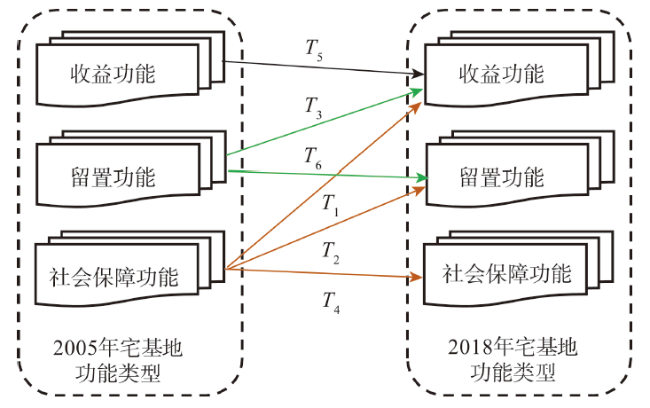
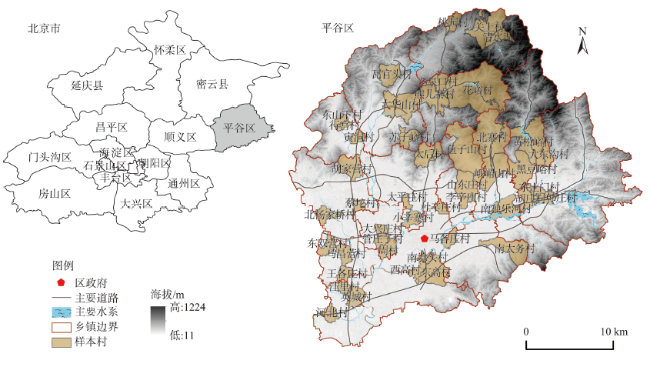
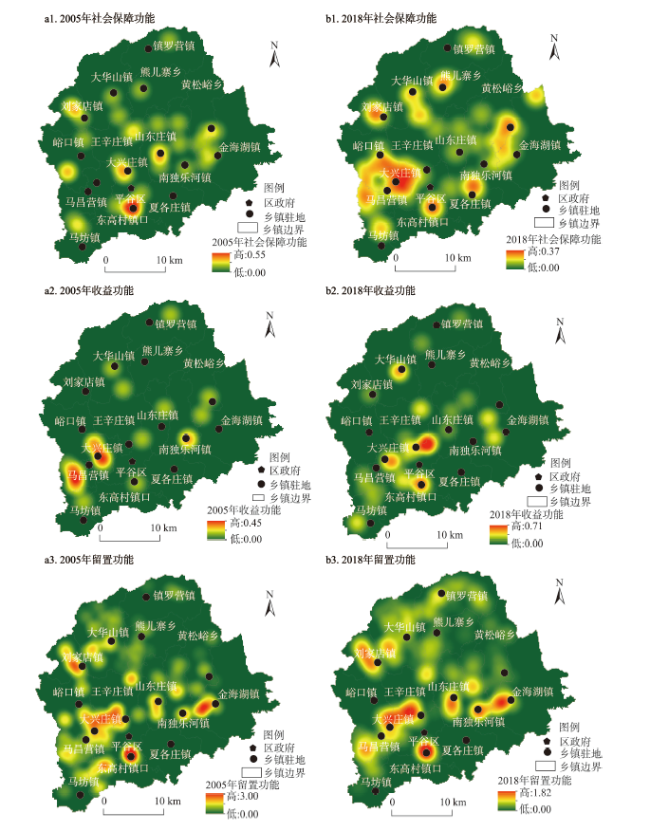
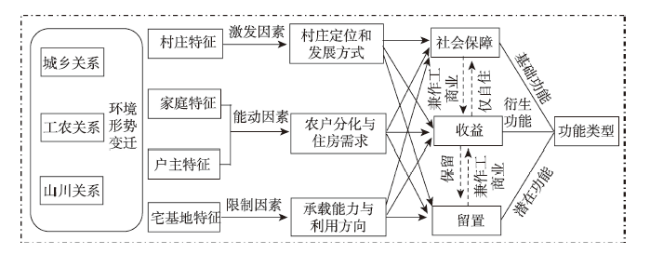
探索宅基地功能变化规律可深化土地利用多功能研究,为制定切实有效的宅基地管理制度提供科学依据。本文构建了“社会保障—收益—留置”宅基地多功能分类体系,基于613处样本宅基地调查资料,运用核密度法和多分类Logistic回归模型分析了北京市平谷区宅基地多功能演变特征,揭示“农户—宅基地—村庄”多要素综合作用下宅基地功能形成机理。结果表明:①2005—2018年,宅基地社会保障功能呈显著弱化趋势,收益功能和留置功能则显示出增强态势,功能结构由83.2%:6.9%:9.9%变为71.8%:10.6%:17.6%。②社会保障功能在经济落后山区较强,空间形态由条—带状向片—面状集聚分布演变,体现出区域农户对其居住保障性的依赖;收益功能集聚在经济较好平原区及近郊半山区,分布格局由点状演化为点—带状扩展态势,以适应休闲农业、旅游等需要;而留置功能则在经济中等半山区强化,形态由片—面状向点—带状分散化布局,反映区域农户在外工作增多与对宅基地潜在价值的期望。③基于农户视角,区位、经济、地形等村庄特征是宅基地多功能形成的激发因素,家庭人口、收入的规模和结构等农户特征是宅基地功能形成的能动因素,宅基地位置、规模、建造年代等是宅基地功能发挥的限制因素。新型农村社区建设和宅基地制度改革中,应遵循宅基地功能演变与分化规律,按照农户—宅基地—村庄综合特征的差异分类施策。
赵庆磊 , 马雯秋 , 曲衍波 , 姜广辉 . 宅基地多功能演变与形成机理[J]. 资源科学, 2021 , 43(7) : 1454 -1466 . DOI: 10.18402/resci.2021.07.14
Exploring the function change law of rural homestead can deepen the study of land use function change and provide a scientific basis for formulating an effective rural homestead management system. This paper constructs a multi-function classification system of “social security—profit—retention” for rural homestead. Based on the two-phase survey data of 613 typical farmer households, the kernel density method and multivariate logistic regression model are used to analyze the multifunction characteristics of rural homestead in typical counties in metropolitan suburbs. The formation of key factors reveals the formation mechanism of the function of rural homestead under the comprehensive action of "farmers-rural homestead-village". Research shows: (1) From 2005 to 2018, the social security function of rural homestead showed a significant weakening trend, while the profit function and retention function showed an increasing trend, the functional structure changed from 83.2%:6.9%:9.9% to 71.8%:10.6%:17.6. (2) The social security function has been continuously strengthened in the economically backward mountainous areas, it reflects the dependence of regional farmers on their residential security, and the spatial form has evolved from strip-band to patch-area. In order to meet the needs of leisure agriculture and tourism, the income function is concentrated in the plain area with good economy and the suburban mid-level mountains, and the distribution pattern evolves from point to point to strip expansion. However, the retention function is strengthened in mid-level mountainous areas, and the form is decentralized from piece-plane to point-band, which reflects the increase of rural households' working outside and their expectation on the potential value of rural homestead. (3) From the perspective of farmers household, village characteristics such as location, economy and terrain are the triggering factors of multifunctional formation of rural homestead; farmer households characteristics such as family members, the size and structure of revenue are active factors for multifunctional formation of rural homestead; the characteristics of rural homestead such as location, size and construction age are restrictive factors, which affect the degree and direction of the multifunctional evolution. In the construction of new rural communities and the reform of rural homestead system, it should follow the law of the evolution and differentiation of rural homestead, and take measures according to the difference system of the comprehensive characteristics of village-peasant household and rural homestead.
表1 宅基地功能分类及识别方法Table 1 Function classification and identification method of rural homestead |
| 功能类型 | 识别方法及说明 |
|---|---|
| 社会保障功能 (SSF) | 村集体依据法律给本集体经济组织成员无偿分配宅基地,用于其建造住房,保障农民居住权。农户仅有一处宅基地,且用于自住,包括虽然在城中租房居住而使宅基地周期性闲置,但城中无房产的情况 |
| 收益功能(PF) | 农户宅基地存在流转或者兼作工商业活动,即宅基地使用权人通过出售、出租、经营等方式获取宅基地的级差收益 |
| 留置功能(RF) | 农户有两处及以上宅基地,或者已在城中买房,从而导致至少有一处宅基地为闲置状态。但由于个人对宅基地感情、潜在资产价值实现期望以及宅基地退出机制缺失而宁愿保留的情况 |
表2 平谷区宅基地功能总体特征变化Table 2 The overall functional characteristics of rural homestead in Pinggu District |
| 年份 | 区域 | 社会保障功能/处 | 强度/% | 收益功能/处 | 强度/% | 留置功能/处 | 强度/% |
|---|---|---|---|---|---|---|---|
| 2005 | 全区 | 510 | 83.2 | 42 | 6.9 | 61 | 9.9 |
| 平原区 | 103 | 78.0 | 14 | 10.6 | 15 | 11.4 | |
| 半山区 | 309 | 85.3 | 22 | 6.1 | 31 | 8.6 | |
| 山区 | 98 | 82.4 | 6 | 5.0 | 15 | 12.6 | |
| 2018 | 全区 | 440 | 71.8 | 65 | 10.6 | 108 | 17.6 |
| 平原区 | 97 | 73.5 | 21 | 15.9 | 14 | 10.6 | |
| 半山区 | 251 | 69.3 | 31 | 8.6 | 80 | 22.1 | |
| 山区 | 92 | 77.3 | 13 | 10.9 | 14 | 11.8 |
表3 宅基地功能演变类型与村庄区位的关系Table 3 The relationship between the conversion type of rural homestead function and village location |
| 村庄区位 | T1 | T2 | T3 | T4 | T5 | T6 | ||||||||||||
|---|---|---|---|---|---|---|---|---|---|---|---|---|---|---|---|---|---|---|
| 数量 | 比例/% | 数量 | 比例/% | 数量 | 比例/% | 数量 | 比例/% | 数量 | 比例/% | 数量 | 比例/% | |||||||
| 村委会到区政府距离/km | (0, 5] | 9 | 40.9 | 3 | 6.1 | 1 | 50 | 40 | 9.1 | 12 | 28.6 | 12 | 20.2 | |||||
| (5, 10] | 3 | 13.7 | 5 | 10.2 | 0 | 0 | 57 | 13.0 | 11 | 26.2 | 9 | 15.3 | ||||||
| (10, 20] | 7 | 31.8 | 6 | 12.3 | 1 | 50 | 120 | 27.3 | 7 | 16.7 | 21 | 35.6 | ||||||
| (20, 30] | 2 | 9.1 | 23 | 46.9 | 0 | 0 | 141 | 32.1 | 7 | 16.6 | 8 | 13.6 | ||||||
| (30, 40] | 1 | 4.5 | 12 | 24.5 | 0 | 0 | 81 | 18.5 | 5 | 11.9 | 9 | 15.3 | ||||||
注:T1、T2、T3、T4、T5、T6类型的单位为“处”。 |
表4 平谷区宅基地功能演变类型与农户特征关系Table 4 The relationship between the conversion type of rural homestead function and the characteristics of farmers in Pinggu District |
| 农户类型 | 划分标准 | 比例/% | 宅基地功能演变类型/处 | ||||||
|---|---|---|---|---|---|---|---|---|---|
| 兼业收入差 | 非农劳动收入 | T1 | T2 | T3 | T4 | T5 | T6 | ||
| 农业主导型 | – | 0~20% | 39.15 | 2 | 4 | 0 | 219 | 3 | 12 |
| 农工兼具型 | + | >20%~50% | 36.05 | 5 | 13 | 1 | 160 | 24 | 18 |
| 非农主导型 | + | >20%~50% | 24.80 | 15 | 32 | 1 | 60 | 15 | 29 |
注:兼业收入差=非农收入-农业收入。 |
表5 农村宅基地功能形成的影响因素Table 5 Influencing factors on function formation of rural homestead |
| 影响因素 | 变量描述 | 收益功能 | 留置功能 | ||||
|---|---|---|---|---|---|---|---|
| 村庄 | 村庄区位I11/(1/km) | 村委会到区委政府测量距离的倒数 | 4.14 | 62.77*** | 0.30 | 0.74 | |
| 村庄经济I12/万元 | 近3年村集体的平均收入 | 0.34 | 1.40* | -0.13 | 0.88* | ||
| 地形I13 | 平原=3,半山区=2,山区=1 | -0.02 | 0.98* | -6.21 | 0.002* | ||
| 宅基地 | 宅基地位置I21 | 主路=4,一般道路=3,村庄内部=2,村庄边缘=1 | 0.54 | 1.72*** | -0.92 | 0.40 | |
| 宅基地面积I22/m2 | 农户宅基地总面积 | 1.47 | 4.33* | 0.39 | 1.47 | ||
| 建设年代I23/年 | (0, 5]=1,(5, 10]=2,(10, 20]=3,(20, 30]=4,(30, 40]=5 | -0.19 | 0.83 | 1.00 | 2.71* | ||
| 家庭 | 非农收入比重I31/% | 非农收入在农户家庭总收入中比重 | 1.54 | 4.67 | 0.58 | 1.78** | |
| 实际耕种面积I32/hm2 | 实际耕种的农地面积 | -2.12 | 0.12* | -0.40 | 0.67 | ||
| 户主 | 年龄I41/岁 | (0, 30]=1,(30, 45]=2,(45, 60]=3,(60, 100]=4 | 0.29 | 1.33 | -0.24 | 0.79* | |
| 受教育水平I42 | 小学及以下=1,初中=2,高中或职业学校=3,大学及以上=4 | 0.39 | 1.47 | 0.55 | 1.74* | ||
| 职业I43 | 无业=1,务农=2,兼农=3,临时工=4,个体经营=5,正式工作=6 | -1.24 | 0.29* | 1.23 | 3.42*** | ||
注:***、**、*分别代表在1%、5%、10%显著性水平上显著。 |
| [1] |
龙花楼, 陈坤秋. 基于土地系统科学的土地利用转型与城乡融合发展[J]. 地理学报, 2021, 76(2):295-309.
[
|
| [2] |
张涵, 李阳兵. 城郊土地利用功能演变: 以贵州省惠水县乡村旅游度假区好花红村为例[J]. 地理科学进展, 2020, 39(12):1999-2012.
[
|
| [3] |
梁小英, 段宁, 刘康. 土地利用功能变化与农户响应研究进展[J]. 干旱区地理, 2019, 42(2):385-391.
[
|
| [4] |
齐琪, 徐小峰, 杨春梅, 等. 乡村振兴背景下宅基地功能转型机理与模式研究: 基于典型村庄的案例分析[J]. 中国土地科学, 2020, 34(6):84-93.
[
|
| [5] |
姜广辉, 张凤荣, 周丁扬, 等. 北京市农村居民点用地内部结构特征的区位分析[J]. 资源科学, 2007, 29(2):109-116.
[
|
| [6] |
|
| [7] |
|
| [8] |
|
| [9] |
|
| [10] |
宋伟. 农村住宅功能的区域分异规律研究[J]. 中国农学通报, 2012, 28(20):198-203.
[
|
| [11] |
|
| [12] |
刘守英, 熊雪锋. 经济结构变革、村庄转型与宅基地制度变迁: 四川省泸县宅基地制度改革案例研究[J]. 中国农村经济, 2018, (6):2-20.
[
|
| [13] |
|
| [14] |
|
| [15] |
张德元. 农村宅基地的功能变迁研究[J]. 调研世界, 2011, (11):21-23.
[
|
| [16] |
张克俊, 付宗平. 基于功能变迁的宅基地制度改革探索[J]. 社会科学研究, 2017, (6):47-53.
[
|
| [17] |
瞿理铜. 基于功能变迁的农村宅基地制度改革研究[D]. 北京: 中国农业大学, 2016.
[
|
| [18] |
|
| [19] |
贺雪峰. 论农村宅基地中的资源冗余[J]. 华中农业大学学报(社会科学版), 2018, (4):1-7.
[
|
| [20] |
|
| [21] |
|
| [22] |
袁明宝, 朱启臻. 城镇化背景下农村院落的价值和功能探析[J]. 民俗研究, 2013, (6):121-126.
[
|
| [23] |
林超, 郭彦君. 农村宅基地功能研究述评及对乡村振兴启示[J]. 经济体制改革, 2020, (4):194-199.
[
|
| [24] |
刘丹, 巩前文. 功能价值视角下农民宅基地自愿有偿退出补偿标准测算方法[J]. 中国农业大学学报, 2020, 25(12):173-183.
[
|
| [25] |
刘彦随, 刘玉. 中国农村空心化问题研究的进展与展望[J]. 地理研究, 2010, 29(1):35-42.
[
|
| [26] |
龙花楼. 中国农村宅基地转型的理论与证实[J]. 地理学报, 2006, 61(10):1093-1100.
[
|
| [27] |
商冉, 曲衍波, 姜怀龙. 人地关系视角下农村居民点转型的时空特征与形成机理[J]. 资源科学, 2020, 42(4):672-684.
[
|
| [28] |
郭贯成, 李学增, 王茜月. 新中国成立70年宅基地制度变迁、困境与展望: 一个分析框架[J]. 中国土地科学, 2019, 33(12):1-9.
[
|
| [29] |
杨丽霞, 李胜男, 苑韶峰, 等. 宅基地多功能识别及其空间分异研究: 基于嘉兴、义乌、泰顺的典型村域分析[J]. 中国土地科学, 2019, 33(2):49-56.
[
|
| [30] |
|
| [31] |
苑韶峰, 张晓蕾, 李胜男, 等. 基于地域和村域区位的宅基地价值测算及其空间分异特征研究: 以浙江省典型县市为例[J]. 中国土地科学, 2021, 35(2):31-40.
[
|
| [32] |
|
| [33] |
|
| [34] |
夏金山. 农村宅基地功能演变及影响机制研究: 以山东省典型村庄为例[D]. 泰安: 山东农业大学, 2017.
[
|
| [35] |
丛丽, 吴必虎, 寇昕. 北京市会议产业空间格局及其影响因素研究[J]. 经济地理, 2013, 33(5):77-83.
[
|
| [36] |
田媛, 许月卿, 郭洪峰, 等. 基于多分类Logistic回归模型的张家口市农用地格局模拟[J]. 资源科学, 2012, 34(8):1493-1499.
[
|
| [37] |
高阳. 基于结构与功能演变规律的农村居民点更新研究: 基于结构与功能演变规律的农村居民点更新研究[D]. 北京:中国农业大学, 2017.
[
|
| [38] |
|
| [39] |
|
| [40] |
|
| [41] |
胡银根, 杨春梅, 董文静, 等. 基于感知价值理论的农户宅基地有偿退出决策行为研究: 以安徽省金寨县典型试点区为例[J]. 资源科学, 2020, 42(4):685-695.
[
|
| [42] |
李敏, 陈尧, 唐鹏, 等. 家庭生命周期对农户宅基地退出意愿的影响[J]. 资源科学, 2020, 42(9):1692-1703.
[
|
| [43] |
曲衍波, 赵丽鋆, 柴异凡, 等. 乡村振兴视角下空心村多维形态识别与分类治理: 以山东省禹城市房寺镇为例[J]. 资源科学, 2021, 43(4):776-789.
[
|
/
| 〈 |
|
〉 |