再生水补给河道周边水体特征——以北京潮白河顺义段为例
|
姜瑞雪,女,安徽天长人,硕士生,研究方向为再生水利用与地下水补给过程。E-mail: jiangrx.18s@igsnrr.ac.cn |
收稿日期: 2019-12-31
要求修回日期: 2020-05-26
网络出版日期: 2021-02-25
基金资助
国家自然科学基金重点项目(41730749)
版权
Impacts of reclaimed water recharge to a river channel on ambient water bodies: A case study of the Chaobai River in Beijing
Received date: 2019-12-31
Request revised date: 2020-05-26
Online published: 2021-02-25
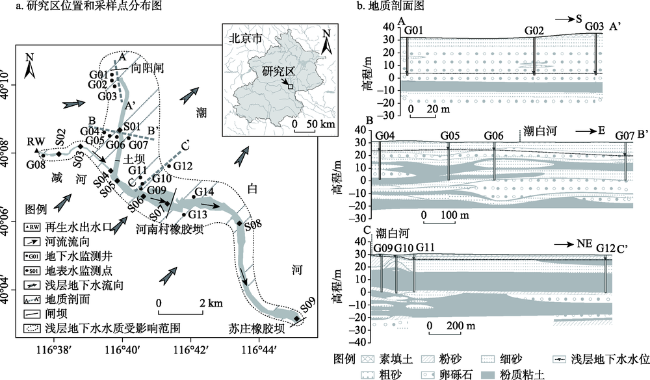
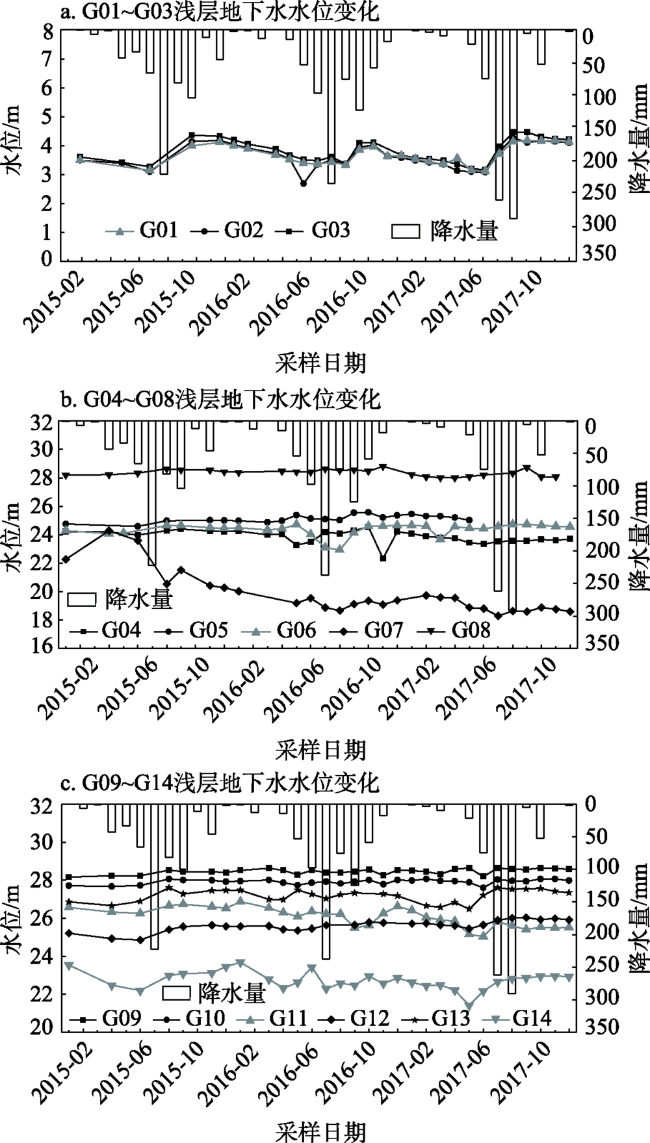
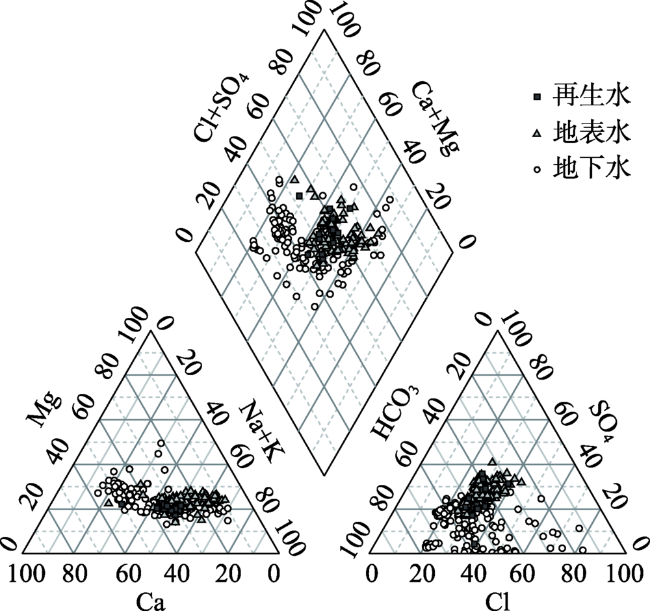
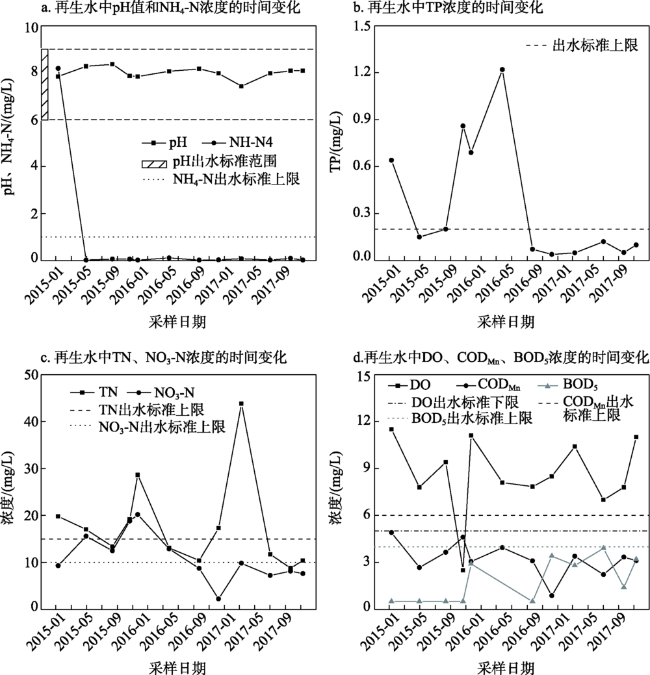
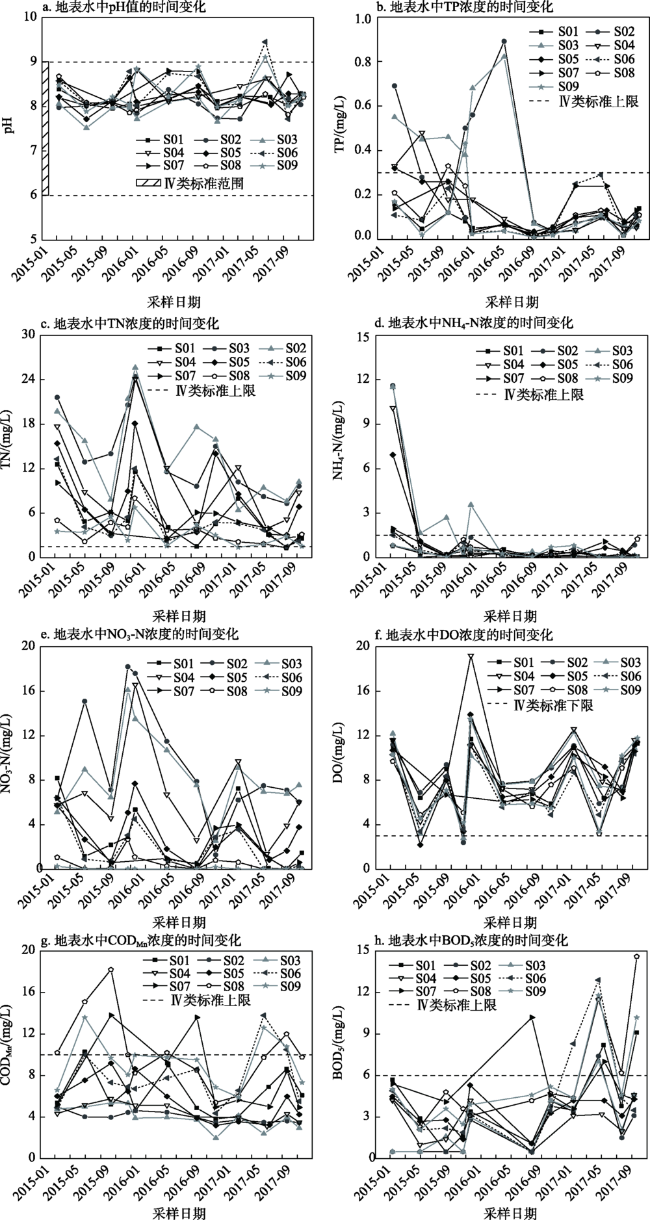
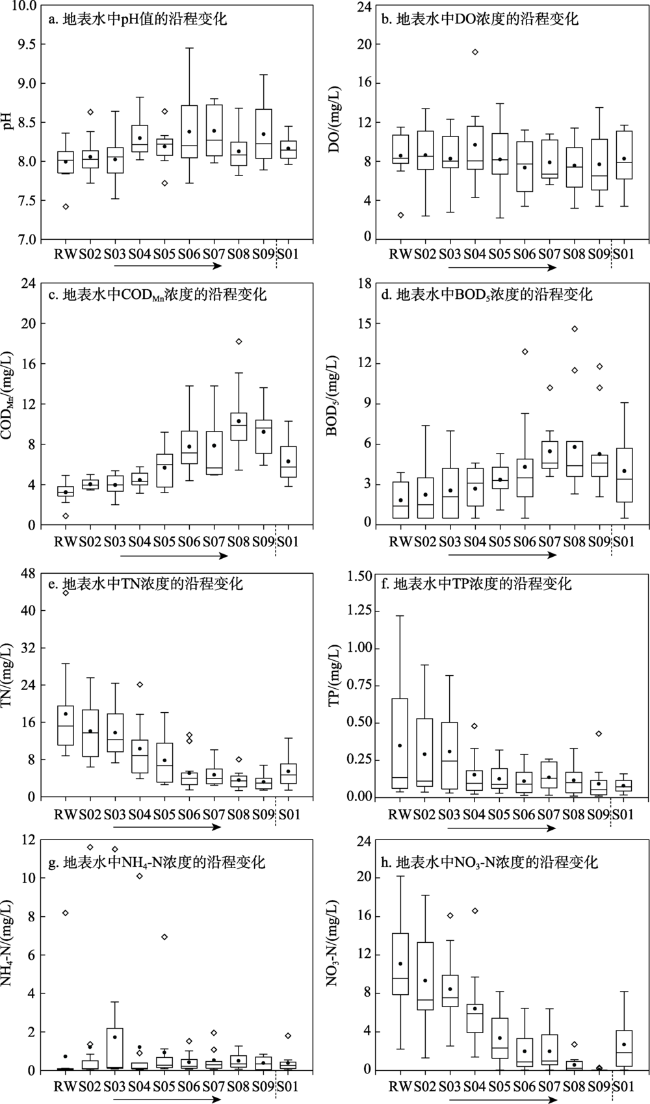
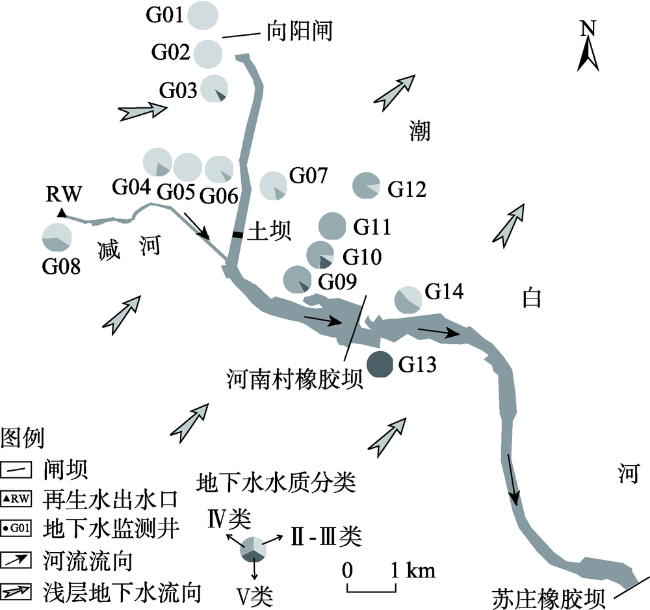
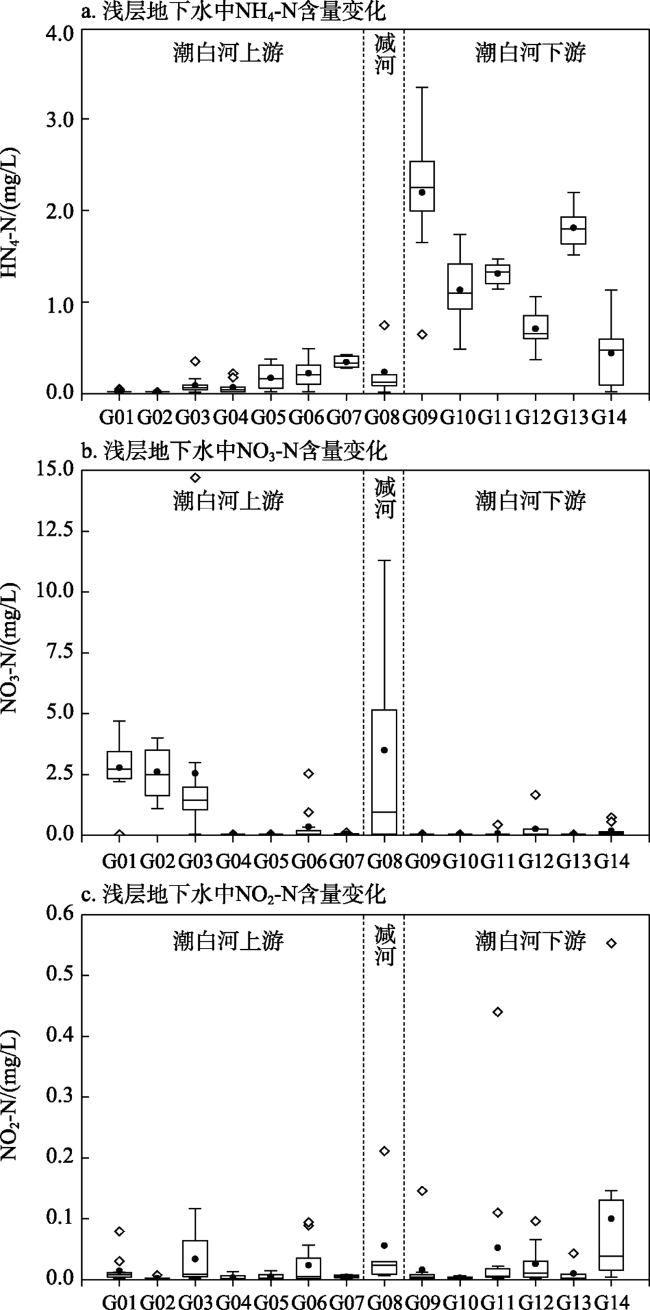
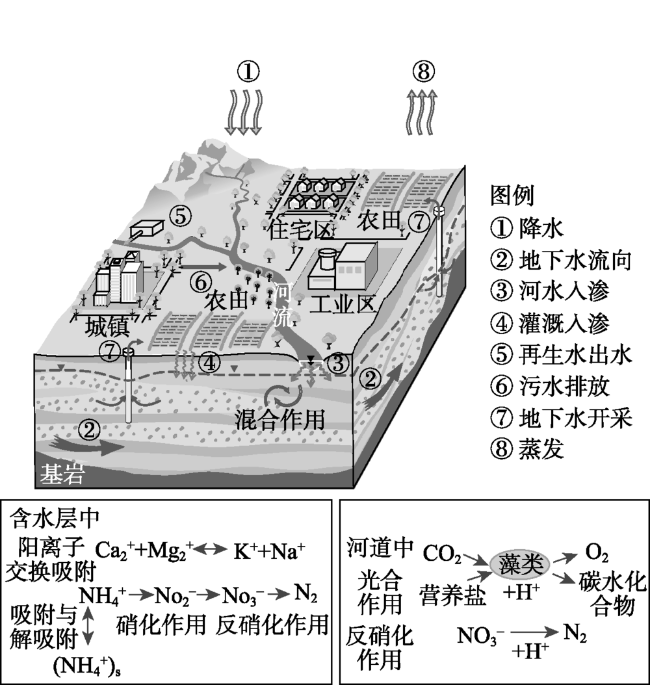
北京市再生水主要用于河湖补水,但再生水中污染物本底值较高,对周边水体产生了一定影响。本文基于2015—2017年北京潮白河顺义段再生水、地表水和浅层地下水的水位、水质监测数据,运用数理统计和水化学分析等方法,研究了再生水长期补给河道后周边水体的特征。结果表明:①受再生水水质影响,再生水补给河道的地表水总氮在所有监测点均出现超标;河道沿程氮、磷含量降低,pH值升高,夏季更为显著,与藻类光合作用和反硝化作用等因素有关。②周边浅层地下水水位稳定,仅存在季节变化;水化学类型以HCO3·Cl-Na·Ca型为主,与再生水相似;140个水样中120个符合地下水Ⅳ类及以上标准,沿地下水流向水质有变好趋势;19个水样氨氮超标,主要出现在河南村橡胶坝附近,氮素可能来源于周边农、林地土壤氮素和灌溉施肥输入。③浅层地下水与地表水的主要水化学组分存在差异,与入渗过程中发生阳离子交换吸附作用和混合作用有关;河流渗漏影响到了距离河道中心约425 m的浅层地下水水质。本文可为进一步改善潮白河及其周边地下水水质和提高再生水利用率提供参考。
姜瑞雪 , 韩冬梅 , 宋献方 , 杨丽虎 , 李炳华 . 再生水补给河道周边水体特征——以北京潮白河顺义段为例[J]. 资源科学, 2020 , 42(12) : 2419 -2433 . DOI: 10.18402/resci.2020.12.13
Reclaimed water is used primarily for replenishing rivers and lakes in Beijing, but the impact of reclaimed water on ambient water environment has also been a concern. This research monitored the water quality of the reclaimed water, surface water, and shallow groundwater in the Chaobai River in Beijing from 2015 to 2017. This study used mathematical statistics and hydrochemical analysis to investigate the characteristics of the ambient water bodies under long-term reclaimed water recharge to the river. The results show that the total nitrogen in surface water exceeded the quality standard at all monitoring points because the reclaimed water had a high nutrient content. The concentration of nitrogen and phosphorus decreased and the pH value increased along the river, which was more significant in the summer. This is related to photosynthesis and denitrification. The surrounding shallow groundwater level showed seasonal variation only. The hydrochemical type of shallow groundwater was mainly HCO3·Cl-Na·Ca type, which was similar to the reclaimed water. But the main ion concentrations in different water bodies were different due to cation exchange and absorption during the infiltration process and mixing. The maximum distance of the reclaimed water impact on shallow groundwater quality was about 425 m away from the center of the river course. Of the 140 water samples, 120 met the class Ⅱ to IV groundwater quality standard, and the groundwater quality tended to get better along the groundwater flow direction. The ammonia nitrogen concentration of 19 water samples exceeded the quality standard. It mainly occurred near the Henan Village dam. Nitrogen might have come from soil nitrogen, irrigation, and fertilization input in the surrounding agricultural and forestry lands. This study provided important references for improving the water quality of the ambient water bodies in the Chaobai River and increasing the utilization of reclaimed water.
Key words: reclaimed water; surface water; groundwater; water quality; water level; Chaobai River
表1 再生水、地表水和浅层地下水水样的水化学参数统计Table 1 Statistics of hydrochemical parameters of reclaimed water, surface water, and shallow groundwater |
| pH | TDS /(mg/L) | TH /(mg/L) | K+ /(mg/L) | Na+ /(mg/L) | Ca2+ /(mg/L) | Mg2+ /(mg/L) | Cl- /(mg/L) | SO42- /(mg/L) | HCO3- /(mg/L) | |
|---|---|---|---|---|---|---|---|---|---|---|
| 再生水 | ||||||||||
| 极小值 | 7.4 | 407.0 | 207.0 | 2.4 | 54.4 | 45.2 | 18.4 | 69.5 | 12.2 | 164.0 |
| 极大值 | 8.4 | 624.0 | 306.0 | 20.3 | 118.0 | 87.4 | 24.6 | 122.0 | 150.0 | 299.0 |
| 均值 | 8.0 | 566.2 | 242.8 | 13.5 | 87.6 | 60.7 | 22.0 | 91.7 | 96.9 | 225.0 |
| 标准差 | 0.2 | 61.0 | 24.3 | 4.2 | 15.5 | 10.5 | 2.0 | 14.4 | 36.8 | 39.1 |
| 变异系数/% | 3.1 | 10.8 | 10.0 | 30.9 | 17.7 | 17.3 | 9.1 | 15.7 | 37.9 | 17.4 |
| 地表水 | ||||||||||
| 极小值 | 7.5 | 235.0 | 95.8 | 1.8 | 22.9 | 14.7 | 10.8 | 27.0 | 45.7 | 73.2 |
| 极大值 | 9.5 | 639.0 | 287.0 | 20.3 | 125.0 | 84.2 | 29.5 | 113.0 | 171.0 | 336.0 |
| 均值 | 8.2 | 485.5 | 189.0 | 13.0 | 80.0 | 41.3 | 20.0 | 83.0 | 98.8 | 193.9 |
| 标准差 | 0.3 | 94.0 | 48.9 | 3.8 | 18.8 | 16.8 | 3.6 | 15.4 | 22.3 | 53.4 |
| 变异系数/% | 4.0 | 19.4 | 25.9 | 29.6 | 23.5 | 40.5 | 18.0 | 18.5 | 22.5 | 27.6 |
| 浅层地下水 | ||||||||||
| 极小值 | 7.1 | 210.0 | 50.9 | 0.8 | 35.1 | 8.5 | 7.9 | 50.2 | 0.1 | 36.8 |
| 极大值 | 8.8 | 1020.0 | 683.0 | 19.2 | 120.0 | 184.0 | 52.4 | 130.0 | 186.0 | 554.0 |
| 均值 | 7.9 | 455.2 | 231.5 | 3.7 | 65.2 | 56.0 | 21.7 | 84.5 | 53.7 | 269.7 |
| 标准差 | 0.4 | 131.3 | 105.6 | 3.4 | 16.9 | 29.5 | 8.8 | 16.0 | 38.3 | 104.4 |
| 变异系数/% | 4.7 | 28.8 | 45.6 | 92.8 | 25.9 | 52.7 | 40.6 | 19.0 | 71.3 | 38.7 |
表2 再生水、地表水和地下水的部分水质标准Table 2 Quality standards for reclaimed water, surface water, and groundwater |
| 指标 | 单位 | 工程设计出水水质 | 地表水环境质量标准(GB 3838—2002) | 地下水质量标准(GB/T 14848—2017) | ||||||
|---|---|---|---|---|---|---|---|---|---|---|
| Ⅲ类 | Ⅳ类 | Ⅰ类 | Ⅱ类 | Ⅲ类 | Ⅳ类 | Ⅴ类 | ||||
| pH | 无量纲 | 6~9 | 6~9 | 6~9 | 6.5~8.5 | 5.5~6.5,8.5~9 | <5.5,>9 | |||
| DO | mg/L | ≥5 | ≥5 | ≥3 | — | — | — | — | — | |
| CODMn | mg/L | ≤6 | ≤6 | ≤10 | ≤1 | ≤2 | ≤3 | ≤10 | ≤10 | |
| BOD5 | mg/L | ≤4 | ≤4 | ≤6 | — | — | — | — | — | |
| TP | mg/L | ≤0.2 | ≤0.2 | ≤0.3 | — | — | — | — | — | |
| TN | mg/L | ≤15 | ≤1 | ≤1.5 | — | — | — | — | — | |
| TH | mg/L | — | — | — | ≤150 | ≤300 | ≤450 | ≤650 | >650 | |
| TDS | mg/L | — | — | — | ≤300 | ≤500 | ≤1000 | ≤2000 | >2000 | |
| NO3-N | mg/L | ≤10 | ≤10 | — | ≤2.0 | ≤5.0 | ≤20 | ≤30 | >30 | |
| NO2-N | mg/L | — | — | — | ≤0.01 | ≤0.1 | ≤1 | ≤4.8 | >4.8 | |
| NH4-N | mg/L | ≤1 | ≤1 | ≤1.5 | ≤0.02 | ≤0.1 | ≤0.5 | ≤1.5 | >1.5 | |
| SO42- | mg/L | — | — | — | ≤50 | ≤150 | ≤250 | ≤350 | >350 | |
| Cl- | mg/L | — | — | — | ≤50 | ≤150 | ≤250 | ≤350 | >350 | |
| Na+ | mg/L | — | — | — | ≤100 | ≤150 | ≤200 | ≤400 | >400 | |
注:地表水环境质量分类:Ⅲ类:主要适用于集中式生活饮用水地表水源地二级保护区、鱼虾类越冬场、洄游通道、水产养殖区等渔业水域及游泳区;Ⅳ类:主要适用于一般工业用水区及人体非直接接触的娱乐用水区。地下水质量分类:Ⅰ类:地下水化学组分含量低,适用于各种用途;Ⅱ类:地下水化学组分含量较低,适用于各种用途;Ⅲ类:地下水化学组分含量中等,以GB 5749—2006为依据,主要适用于集中式生活饮用水水源及工农业用水;Ⅳ类:地下水化学组分含量较高,以农业和工业用水质量要求以及一定水平的人体健康风险为依据,适用于农业和部分工业用水,适当处理后可作生活饮用水;V类:地下水化学组分含量高,不宜作为生活饮用水水源,其他用水可根据使用目的选用。 |
表3 浅层地下水中氯离子初始浓度与2015—2017年监测值Table 3 Initial concentration of chloride ion and monitored data from 2015 to 2017 in shallow groundwater |
| G01 | G02 | G03 | G04 | G05 | G06 | G07 | G09 | G10 | G11 | G12 | G13 | ||
|---|---|---|---|---|---|---|---|---|---|---|---|---|---|
| 2015—2017年监测值/(mg/L) | 极大值 | 73.8 | 79.0 | 100.0 | 130.0 | 120.0 | 114.0 | 94.2 | 108.0 | 108.0 | 86.9 | 110.0 | 94.8 |
| 极小值 | 50.2 | 63.8 | 59.0 | 73.6 | 94.7 | 76.4 | 76.8 | 85.4 | 84.6 | 72.3 | 67.6 | 74.0 | |
| 平均值 | 61.8 | 70.2 | 71.0 | 106.6 | 104.5 | 86.4 | 88.2 | 97.6 | 94.4 | 80.7 | 88.5 | 86.6 | |
| 初始浓度[20]/(mg/L) | 27.9 | 28.7 | 40.6 | 75.7 | 66.6 | 46.3 | 68.9 | 31.4 | 28.5 | 23.9 | 140.8 | 23.5 | |
表4 部分地表水和浅层地下水的三氮含量Table 4 Nitrogen concentrations in part of surface water and shallow groundwater |
| NO3-N/ (mg/L) | NO2-N/ (mg/L) | NH4-N/ (mg/L) | ||
|---|---|---|---|---|
| 受水前[17] | G06 | 0.50 | 0.013 | 0.80 |
| 受水后 | S01 | 2.69 | 0.05 | 0.38 |
| G04 | 0.03 | 0.003 | 0.07 | |
| G05 | 0.03 | 0.004 | 0.17 | |
| G06 | 0.34 | 0.02 | 0.23 | |
| G07 | 0.05 | 0.005 | 0.35 | |
| RW | 11.09 | 0.05 | 0.73 | |
| G08 | 3.49 | 0.06 | 0.24 | |
| S06 | 1.98 | 0.10 | 0.42 | |
| G09 | 0.03 | 0.02 | 2.21 | |
| G10 | 0.03 | 0.003 | 1.14 | |
| G11 | 0.06 | 0.05 | 1.32 | |
| G12 | 0.26 | 0.03 | 0.71 | |
| S07 | 1.97 | 0.07 | 0.53 | |
| G13 | 0.03 | 0.01 | 1.82 | |
| G14 | 0.18 | 0.10 | 0.44 |
| [1] |
|
| [2] |
付汉良, 刘晓君. 再生水回用公众心理感染现象的验证及影响策略[J]. 资源科学, 2018,40(6):1222-1229.
[
|
| [3] |
北京市水务局. 北京市水资源公报(2019年度)[R]. 北京: 北京市水资源公报, 2020.
[ Beijing Water Authority. Beijing Water Resources Bulletin (2019)[R]. Beijing: Beijing Water Resources Bulletin, 2020.]
|
| [4] |
北京市水务局. 2019北京市水务统计年鉴[R]. 北京: 北京市水务统计年鉴, 2020.
[ Beijing Water Authority. Beijing Water Authority. Beijing Water Statistical Yearbook (2019)[R]. Beijing: Beijing Water Authority. Beijing Water Statistical Yearbook, 2020.]
|
| [5] |
北京市水务局. 政民互动[EB/OL]. (2020-08-19) [ 2020-12-24]. http://www.beijing.gov.cn/hudong/yonghu/static/swj/zixun/detail.html?searchCode=swj15973957630311214238.
[ Beijing Water Authority. Q & A Services[EB/OL]. (2020-08-19) [ 2020-12-24] . http://www.beijing.gov.cn/hudong/yonghu/static/swj/zixun/detail.html?searchCode=swj15973957630311214238.]
|
| [6] |
王茜, 郇环, 王红瑞, 等. 再生水利用对土壤和地下水的影响研究综述[J]. 南水北调与水利科技, 2018,16(4):104-113.
[
|
| [7] |
|
| [8] |
于一雷, 谷洪彪, 张佳佳. 再生水补水后永定河水化学特征及其形成作用[J]. 干旱区资源与环境, 2017,31(8):108-115.
[
|
| [9] |
黄伟伟, 郑兴灿, 廖飞凤, 等. 再生水景观水体富营养化因素的垂直变化特征[J]. 中国给水排水, 2008,24(1):65-68.
[
|
| [10] |
赵立新, 许志兰, 胡秀琳, 等. 再生水回用于城市景观水体水质变化规律及水华防治措施研究[J]. 北京水务, 2014, (2):11-13.
[
|
| [11] |
孟庆义, 吴晓辉, 赵立新, 等. 再生水回用于北京景观水体引起的水质变化及其改善措施[J]. 水资源保护, 2011,27(1):51-54.
[
|
| [12] |
|
| [13] |
|
| [14] |
郑跃军, 李文鹏, 王瑞久, 等. 潮白河冲洪积扇地下水循环演化特征[J]. 人民长江, 2012,43(15):43-46.
[
|
| [15] |
|
| [16] |
|
| [17] |
刘立才, 单悦, 黄俊雄, 等. 河道再生水入渗的水岩相互作用机理研究[J]. 水资源保护, 2018,34(1):31-35.
[
|
| [18] |
宋献方, 李发东, 于静洁, 等. 基于氢氧同位素与水化学的潮白河流域地下水水循环特征[J]. 地理研究, 2007, (1):11-21.
[
|
| [19] |
|
| [20] |
北京市水科学技术研究院. 引温济潮工程受水区地表地下水环境监测评价(2017年度)[R]. 北京: 引温济潮工程受水区地表地下水环境监测评价, 2017.
[ Beijing Water Science and Technology Institution. Environmental Monitoring and Assessment of Surface Water and Groundwater in the Water Receiving Area of the “Yin Wen Ji Chao” Project (2017)[R]. Beijing: Environmental Monitoring and Assessment of Surface Water and Groundwater in the Water Receiving Area of the “Yin Wen Ji Chao” Project, 2017.]
|
| [21] |
国家气象科学数据中心. 北京地面气候资料月值数据集[DB/OL]. (2019-04) [2019- 12- 31]. http://data.cma.cn/data/cdcdetail/dataCode/SURF_CLI_CHN_MUL_MON.html.
[ China Meteorological Administration Data Center. Monthly Data Set of Surface Climatological Data for Beijing[DB/OL]. (2019-04) [2019- 12- 31]. http://data.cma.cn/data/cdcdetail/dataCode/SURF_CLI_CHN_MUL_MON.html.]
|
| [22] |
国家环境保护总局. 水和废水监测分析方法[M]. 北京: 中国环境科学出版社, 2009.
[ State Environmental Protection Administration. Monitoring and Analysis Method of Water and Waste Water[M]. Beijing: Chinese Environment Science Press, 2009.]
|
| [23] |
|
| [24] |
北京市生态环境局. 潮白河水系[EB/OL]. (2009-11-01) [2019-12-31]. http://sthjj.beijing.gov.cn/bjhrb/index/xxgk69/sthjlyzwg/1718880/1718884/hjgnqh/307587/index.html.
[ Beijing Municipal Ecology and Environment Bureau. Chaobai River[EB/OL]. (2009-11-01) [2019-12-31]. http://sthjj.beijing.gov.cn/bjhrb/index/xxgk69/sthjlyzwg/1718880/1718884/hjgnqh/307587/index.html.]
|
| [25] |
|
| [26] |
何宝南, 何江涛, 王健, 等. 顺义潮白河再生水受水区反硝化作用初探[J]. 农业环境科学学报, 2016,35(8):1565-1572.
[
|
| [27] |
|
| [28] |
马培, 李新艳, 王华新, 等. 河流反硝化过程及其在河流氮循环与氮去除中的作用[J]. 农业环境科学学报, 2014,33(4):623-633.
[
|
| [29] |
沈晓强, 彭雪媛, 孔祥雨. 潮白河再生水利用河道沿程水质变化特征[J]. 北京水务, 2018, (1):21-23.
[
|
| [30] |
|
| [31] |
|
| [32] |
|
| [33] |
|
| [34] |
|
| [35] |
许谦. 再生水入渗回补过程中渗流带堵塞作用研究: 以潮白河受水段为例[D]. 北京: 中国地质大学, 2018.
[
|
| [36] |
郑凡东. 再生水作为河湖景观用水的地下水环境效应研究[D]. 北京: 中国地质大学, 2012.
[
|
| [37] |
陈英硕. 再生水补水的潮白河水环境特征及变化趋势研究[D]. 北京: 中国地质大学, 2015.
[
|
| [38] |
王健, 何江涛, 刘玉梅, 等. 潮白河再生水受水区水质变化特征多元统计分析[J]. 环境科学与技术, 2014,37(6):171-176.
[
|
| [39] |
|
| [40] |
|
| [41] |
吴晓辉, 许志兰, 赵立新, 等. 再生水补水的潮白河顺义段水体中内分泌干扰物的时空分布特征[J]. 安全与环境学报, 2014,14(3):308-312.
[
|
| [42] |
|
| [43] |
|
| [44] |
|
| [45] |
于一雷. 河道景观再生水对地下水影响研究: 以潮白河北京段为例[D]. 北京: 中国科学院大学, 2013.
[
|
| [46] |
吴苗苗. 再生水回灌过程中典型磺胺类抗生素的行为特性研究[D]. 北京: 清华大学, 2015.
[
|
| [47] |
|
| [48] |
|
/
| 〈 |
|
〉 |