城市居民低碳行为认知失调的成因——“知识—行为”的双中介模型
作者简介:芈凌云,女,江苏徐州人,博士,副教授,主要研究方向为资源环境行为管理。E-mail: milingyun@126.com
收稿日期: 2018-11-05
要求修回日期: 2018-12-16
网络出版日期: 2019-05-25
基金资助
中国矿业大学双一流建设文化传承专项“能源矿业经济智库”项目(2018WHCC01)
Why urban residents’ deeds do not match their attitude?A dual mediation model of knowledge-behavior in low-carbon consumption
Received date: 2018-11-05
Request revised date: 2018-12-16
Online published: 2019-05-25
Copyright
为了探究居民低碳行为的“认知失调”的原因,将低碳知识分为系统知识、行动知识和效力知识3类,然后扩展“知识—态度—行为”理论,在“低碳意愿”的基础上引入“低碳能力”,建立了不同低碳知识对低碳行为作用机理的双中介模型,并运用结构方程模型进行实证检验。结果显示:①不同低碳知识对低碳行为的作用机理差异是引发“认知失调”的原因之一。行动知识能直接驱动2类低碳行为,而系统知识和效力知识只能由低碳意愿或低碳能力对低碳行为起间接作用;②意愿与能力共同驱动居民低碳行为,系统知识驱动的低碳意愿更多地影响低碳购买行为,而效力知识驱动的低碳能力则更多地转化为低碳习惯行为;③性别、婚姻状况、年龄、受教育程度、个人月可支配收入5个人口特征因素对行动知识与2类低碳行为之间的路径关系具有显著的调节作用。宣传教育工作需要根据不同知识的作用机制减少居民低碳行为的认知失调。
芈凌云 , 丛金秋 , 丁超琼 , 乔丽洁 , 许婷 . 城市居民低碳行为认知失调的成因——“知识—行为”的双中介模型[J]. 资源科学, 2019 , 41(5) : 908 -918 . DOI: 10.18402/resci.2019.05.08
In order to explore the reasons that urban residents’ attitude are not matched by their actions and promote the implementation of low-carbon behavior, this empirical research examined what kind of low-carbon knowledge is more conducive to residents’ low-carbon behavior. First, low-carbon knowledge was classified as system knowledge, action knowledge, and effective knowledge. Then, by extending the knowledge-attitude-behavior theory and introducing low-carbon capability (LCC) as a variable on the basis of low-carbon intention (LCI), a dual mediation model for the mechanism of low-carbon knowledge on low carbon behavior was established. Finally, 1339 valid questionnaires were obtained and analyzed using structural equation model. A multiple group analysis was used to test the moderating effect of demographics. The results indicate that: (1) The difference of mechanism between the three types of low-carbon knowledge and low-carbon behaviors is one of the reasons that why urban residents’ attitude are not matched by their actions. LCI and LCC have significant moderating effects on the relationship between system knowledge and residents’ low-carbon behavior. Meanwhile, action knowledge can directly influence two kinds of low carbon behaviors or affect them indirectly through LCI. LCI is not affected by effective knowledge, but effective knowledge indirectly drives two kinds of low-carbon behaviors through LCC. (2) LCI driven by low-carbon knowledge is more often transformed into low-carbon purchasing behavior, while LCC is more often affected by low-carbon habitual behavior. Therefore, in order to form a long-term mechanism of low-carbon consumption and reduce the “rebound effect” of energy efficiency improvement, it is necessary to pay attention to the cultivation of low-carbon capability. (3) Gender, marital status, age, education level, and personal monthly disposable income have significant moderating effects on the relationship between action knowledge and two types of low-carbon behaviors. Relevant government agencies need to guide and promote the integration of knowledge and behavior among residents in low-carbon comsumption according to the mechanism of different low-carbon knowledge.
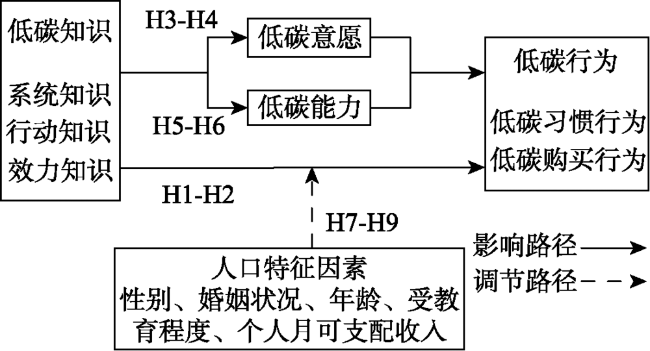
Figure 1 Conceptual model (M) of the mechanism of action for different types of low-carbon knowledge on low-carbon behavior of residents图1 不同类型低碳知识对居民低碳行为的作用机理概念模型M |
Table 1 Descriptive statistics of the samples表1 样本结构特征描述 |
| 人口统计变量 | 项目 | 人数 | 百分比/% | 人口统计变量 | 项目 | 人数 | 百分比/% |
|---|---|---|---|---|---|---|---|
| 性别 | 男 | 783 | 58.4 | 受教育 水平 | 初中及以下 | 39 | 2.9 |
| 女 | 556 | 41.6 | 高中、中专或技校 | 98 | 7.4 | ||
| 年龄/岁 | ≤20 | 8 | 0.6 | 大专或本科 | 759 | 56.7 | |
| 21~30 | 553 | 41.3 | 研究生(硕士或博士) | 441 | 32.9 | ||
| 31~40 | 461 | 34.4 | 缺失 | 2 | 0.1 | ||
| 41~50 | 245 | 18.3 | 职业 类型 | 政府部门工作人员 | 112 | 8.4 | |
| 51~60 | 56 | 4.2 | 一般工人或服务人员 | 182 | 13.6 | ||
| >60 | 15 | 1.1 | 企业管理人员 | 406 | 30.3 | ||
| 缺失 | 1 | 0.1 | 工程技术人员 | 198 | 14.8 | ||
| 婚姻 状况 | 已婚 | 939 | 70.1 | 科教和环卫领域的人员 | 219 | 16.4 | |
| 未婚 | 383 | 28.6 | 退休及家庭主妇 | 40 | 3.0 | ||
| 缺失 | 17 | 1.3 | 其他 | 176 | 13.1 | ||
| 缺失 | 6 | 0.4 |
Table 2 Measured indicators and reliability and validity tests of the formal scale表2 正式量表的测量指标及信效度检验 |
| 变量 | 测量指标 | 因子载荷 | Cronbach’s α |
|---|---|---|---|
| 系统知识(SK) | CO2等温室气体的过度排放是全球气候变暖的主要原因之一 | 0.794 | 0.881 |
| “低碳经济”是一种以“低排放、低能耗、低污染”为特征的经济发展模式 | 0.865 | ||
| 煤、石油、天然气等的大量消耗使大气中的CO2浓度不断上升 | 0.871 | ||
| 行动知识(AK) | 频繁开关冰箱门,会增加冰箱的耗电量 | 0.875 | 0.848 |
| 家电处于待机模式依然耗电 | 0.844 | ||
| 效力知识(EK) | 住宅门窗使用双层玻璃或中空玻璃,比用普通玻璃更节能 | 0.801 | 0.778 |
| 节能灯比白炽灯省电60%~80% | 0.798 | ||
| 低碳意愿(LCI) | 今后,我会注意电器不用时关掉电源,而不是让其待机 | 0.647 | 0.805 |
| 明年,我也会参加“地球一小时”的全球熄灯一小时活动 | 0.825 | ||
| 我愿意成为社区的低碳节能宣传志愿者 | 0.826 | ||
| 低碳能力(LCC) | 对于低碳节能的新知识,我很快就知道该如何应用 | 0.833 | 0.844 |
| 对别人介绍的低碳节能小窍门,我能很好地应用于自己的生活当中 | 0.875 | ||
| 我会自己开发出一些可以节能减排的生活小窍门 | 0.742 | ||
| 低碳习惯行为(LCHB) | 离开房间时,随手关灯 | 0.603 | 0.638 |
| 家电不使用的时候,主动关闭电源(关掉开关) | 0.740 | ||
| 使用空调时,夏季温度设定不低于26℃,冬季温度设定在不高于20℃,以节约用电 | 0.523 | ||
| 低碳购买行为(LCPB) | 根据能耗等级购买节能家电 | 0.636 | 0.604 |
| 在住宅的装饰、装修中,尽量选择节能环保型材料 | 0.559 | ||
| 在购买住宅时,我很看中有低碳节能设计的(如集中采暖、自然采光通风等) | 0.531 |
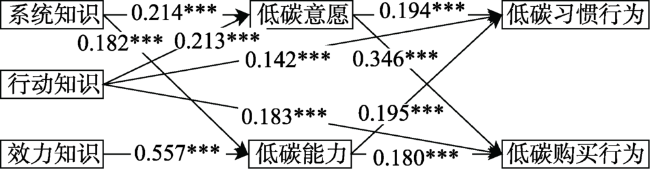
Figure 2 Structural equation model (M1) and standardized estimates图2 结构方程模型M1及标准化估计值 |
Table 3 Test results of the effect of population characteristic factors表3 人口特征因素的调节作用检验结果 |
| 群组 | 性别 | 婚否 | 学历 | 年龄 | 收入 | |||||||||
|---|---|---|---|---|---|---|---|---|---|---|---|---|---|---|
| 男 | 女 | 已婚 | 未婚 | 低学历 | 高学历 | 年轻人 | 年长者 | 低收入 | 高收入 | |||||
| AK-LCHB | 0.222*** | 0.055* | 0.187*** | 0.018* | 0.317* | 0.106*** | 0.117* | 0.204* | 0.067* | 0.198*** | ||||
| AK-LCPB | 0.267*** | 0.109* | 0.180** | 0.244* | 0.260* | 0.179* | 0.165** | 0.189* | 0.199* | 0.176** | ||||
注:*、**、***分别表示在5%、1%和0.1%的水平上显著。 |
The authors have declared that no competing interests exist.
| [1] |
上海交通大学民意与舆情调查研究中心. 中国城市居民环保意识调查[EB/OL]. (2017-09-19)[2018-08-11].
[Shanghai Jiaotong University Public Opinion and Public Opinion Research Center. Environmental Awareness Survey of Chinese Urban Residents[EB/OL]. (2017-09-19)[2018-08-11].
|
| [2] |
中国环境文化促进会. 公民环保行为调查报告[EB/OL]. (2018-06-06)[2018-08-11].
[China Environmental Culture Promotion Association. Survey Report on Citizen’s Environmental Behavior[EB/OL]. (2018-06-06)[2018-08-11].
|
| [3] |
[
|
| [4] |
[
|
| [5] |
[
|
| [6] |
|
| [7] |
[
|
| [8] |
|
| [9] |
|
| [10] |
|
| [11] |
[
|
| [12] |
|
| [13] |
|
| [14] |
|
| [15] |
|
| [16] |
[
|
| [17] |
[
|
| [18] |
[
|
| [19] |
|
| [20] |
|
| [21] |
[
|
| [22] |
[
|
| [23] |
|
| [24] |
|
| [25] |
|
| [26] |
|
| [27] |
|
| [28] |
[
|
| [29] |
|
| [30] |
|
| [31] |
|
| [32] |
[
|
| [33] |
[
|
| [34] |
|
| [35] |
|
| [36] |
|
| [37] |
|
| [38] |
[
|
| [39] |
[
|
| [40] |
|
| [41] |
|
| [42] |
|
| [43] |
|
| [44] |
|
| [45] |
|
| [46] |
|
| [47] |
|
| [48] |
|
| [49] |
|
| [50] |
|
| [51] |
[
|
| [52] |
|
| [53] |
中华人民共和国科学技术部. 全民节能减排手册[EB/OL]. (2007-09-01)[2018-08-11].
[Ministry of Science and Technology of the People’s Republic of China. The National Energy Conservation and Emission Reduction Manual[EB/OL]. (2007-09-01)[2018-08-11].
|
| [54] |
[
|
/
| 〈 |
|
〉 |