Characteristics and challenges of air-ground coordination for low-altitude drone delivery: A case study of Shenzhen
Received date: 2025-05-12
Revised date: 2025-07-26
Online published: 2025-09-09
[Objective] As an important application scenario of the low-altitude economy, drone delivery has been developing rapidly, placing higher demands on the integrated utilization of air and ground resources. Therefore, it is necessary to identify the organizational characteristics and key challenges of air-ground coordination based on practical cases, providing references for the coordination and shared use of airspace resources. [Methods] This study took Shenzhen as a case study, selecting two representative companies, S and M. Through continuous field surveys and in-depth interviews conducted from July 2024 to April 2025, it systematically analyzed their operational models, spatial layouts, and flight route planning. [Results] (1) The existing air-ground coordination operational models were shaped by business model requirements, forming two distinct models: an interconnected direct model anchored at network nodes, and an end-responsive model anchored at commercial districts. (2) The different operational models led to significant differences in air-ground coordination layouts: Company S established a multi-node, coordinated, and large-scale transport network by relying on self-operated distribution centers and delivery outlets, while Company M developed a dense, single-center service system focused on commercial districts. (3) Differences in spatial layout further influenced the interaction between flight routes and ground networks. Company S generally located its facilities in open areas such as logistics parks, resulting in higher flexibility in flight route planning. Company M operated at altitudes lower than densely built urban high-rise buildings, facing more complex spatial constraints. [Conclusion] Low-altitude delivery systems effectively leverage the flexibility and efficiency of drones, expanding service coverage and improving overall delivery efficiency through integration with ground transportation systems. In the future, it is essential to enhance the coordination and shared use of airspace resources, advance the deep integration of drone delivery with ground transportation infrastructure, and address coordination and connectivity challenges such as gaining access to communities and buildings.
XIAO Zuopeng , ZHANG Weicong , LI Yiyang , ZHANG Chengbo , SUN Xixiong . Characteristics and challenges of air-ground coordination for low-altitude drone delivery: A case study of Shenzhen[J]. Resources Science, 2025 , 47(8) : 1663 -1674 . DOI: 10.18402/resci.2025.08.05
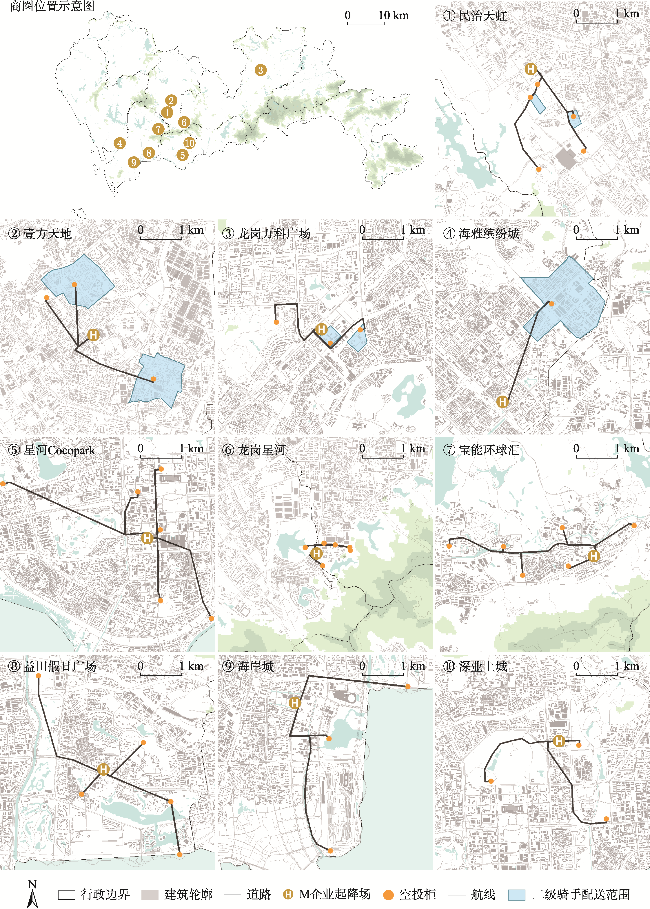
图3 M企业在深圳开展无人机配送的航线及起降场注:基于广东省自然资源厅标准地图服务网站下载的审图号为粤S(2023)117号的标准地图制作,底图无修改。 Figure 3 Flight routes and take-off/landing sites of drone delivery services provided by Company M in Shenzhen |
表1 M企业在深圳开展无人机配送服务的基本情况Table 1 Basic information of drone delivery services provided by Company M in Shenzhen |
| 序号 | 商圈 | 区域 | 空投柜数量/个 | 平均航距/m | 平均配送时间/min |
|---|---|---|---|---|---|
| 1 | 民治天虹 | 龙华 | 5 | 2036 | 27 |
| 2 | 壹方天地 | 龙华 | 3 | 1755 | 39 |
| 3 | 龙岗万科广场 | 龙岗 | 3 | 761 | 32 |
| 4 | 海雅缤纷城 | 宝安 | 1 | 2472 | 35 |
| 5 | 星河Cocopark | 福田 | 6 | 1707 | 30 |
| 6 | 龙岗星河 | 龙岗 | 6 | 483 | 28 |
| 7 | 宝能环球汇 | 南山 | 6 | 1609 | 28 |
| 8 | 益田假日广场 | 南山 | 5 | 1829 | 37 |
| 9 | 海岸城 | 南山 | 3 | 2476 | 34 |
| 10 | 深业上城 | 福田 | 3 | 1430 | 33 |
| 平均值 | 4 | 1656 | 32 | ||
表2 深圳市M企业无人机空投柜的服务类型Table 2 Service types of drone delivery lockers operated by Company M in Shenzhen |
| 服务类型 | 空投柜数量/个 | 占比/% |
|---|---|---|
| 公园景区 | 16 | 39.0 |
| 社区住宅 | 9 | 22.0 |
| 写字楼 | 8 | 19.5 |
| 高校教育 | 4 | 9.7 |
| 交通枢纽 | 2 | 4.9 |
| 图书馆 | 2 | 4.9 |
| 总数 | 41 | 100.0 |
表3 深圳市低空飞行高度分层建议Table 3 Recommended altitude stratification for low-altitude flight in Shenzhen |
| 飞行高度/m | 障碍物比例/% | 主要运行航空器 | 应用场景 |
|---|---|---|---|
| (0, 120] | 84.6 | 消费级无人机 | 个人航拍 |
| (120, 200] | 6.5 | 短途配送无人机 | 即时配送、应急医疗、样本转运 |
| (200, 300] | 4.7 | 城际/区域配送无人机 | 快递物流 |
| (300, 600] | 0.9 | 直升机、eVTOL | 城市空中交通、应急救援 |
注:深圳市600 m以上空域为机场特殊用途区域,其他未设限制的城市,直升机等飞行器可在空管许可下拓展运行高度至1000 m。 |
| [1] |
新华社. 中共中央国务院印发《国家综合立体交通网规划纲要》[EB/OL]. (2021-02-24) [2025-03-27]. https://www.gov.cn/zhengce/2021-02/24/content_5588654.htm.
[The Xinhua News Agency. The Central Committee of the Communist Party of China and the State Council Unveils Guidelines on Developing Comprehensive Transport Network[EB/OL]. (2021-02-24) [2025-03-27]. https://www.gov.cn/zhengce/2021-02/24/content_5588654.htm.]
|
| [2] |
中国民用航空局. 低空空域使用管理规定(试行)(征求意见稿)[EB/OL]. (2014-07-23) [2025-05-08]. https://www.ccaonline.cn/news/hot/10274.html.
[The Civil Aviation Administration of China. Regulations on the Usage and Management of Low-altitude Airspace[EB/OL]. (2014-07-23) [2025-05-08]. https://www.ccaonline.cn/news/hot/10274.html.]
|
| [3] |
新华社. 《关于促进通用航空业发展的指导意见》[EB/OL]. (2016-05-17) [2025-03-27]. https://www.gov.cn/xinwen/2016-05/17/content_5074151.htm.
[The Xinhua News Agency. Guiding Opinions on Promoting the Development of General Aviation Industry[EB/OL]. (2016-05-17) [2025-03-27]. https://www.gov.cn/xinwen/2016-05/17/content_5074151.htm.]
|
| [4] |
黄贤金. 自然资源统一管理: 新时代、新特征、新趋向[J]. 资源科学, 2019, 41(1): 1-8.
[
|
| [5] |
廖小罕, 黄耀欢, 徐晨晨. 面向无人机应用的低空空域资源研究探讨[J]. 地理学报, 2021, 76(11): 2607-2620.
[
|
| [6] |
廖小罕, 张捷, 黄耀欢. 浅析低空地理学的特征及其对地理学的拓展[J]. 地理学报, 2024, 79(3): 551-564.
[
|
| [7] |
刘洁敏, 苏雪娇, 沈振江. 无人机交通治理导向的城市低空空域与地上地下空间协同开发模式探析[J/OL]. 国际城市规划, (2024-11-04) [2025-05-08]. https://doi.org/10.19830/j.upi.2024.236.
[
|
| [8] |
赵光辉. 低空经济与现代物流协同发展的关键议题与发展路径[J/OL]. 物流研究, (2025-03-31) [2025-05-08]. https://link.cnki.net/urlid/10.1700.F2.20250331.1455.002.
[
|
| [9] |
郭庆华, 胡天宇, 刘瑾, 等. 轻小型无人机遥感及其行业应用进展[J]. 地理科学进展, 2021, 40(9): 1550-1569.
[
|
| [10] |
陈瑶瑶, 刘泉, 洪晓苇, 等. 面向TOD的小型无人机配送服务空间模式: 以深圳美团试点为例[J]. 城市发展研究, 2025, 32(4): 22-30.
[
|
| [11] |
张洪海, 夷珈, 李姗, 等. 低空空域容量评估研究综述[J]. 交通运输工程学报, 2023, 23(6): 78-93.
[
|
| [12] |
刘泉, 陈瑶瑶, 洪晓苇, 等. 面向无人机的城市低空空域规划的国际经验[J]. 城市规划学刊, 2024, (5): 64-70.
[
|
| [13] |
|
| [14] |
|
| [15] |
|
| [16] |
廖小罕, 屈文秋, 徐晨晨, 等. 城市空中交通及其新型基础设施低空公共航路研究综述[J]. 航空学报, 2023, 44(24): 6-34.
[
|
| [17] |
廖小罕, 屈文秋. 低空经济时代城市空中交通公共航路发展思考[J]. 城市交通, 2025, 23(2): 20-28.
[
|
| [18] |
徐晨晨, 廖小罕, 岳焕印, 等. 基于改进蚁群算法的无人机低空公共航路构建方法[J]. 地球信息科学学报, 2019, 21(4): 570-579.
[
|
| [19] |
|
| [20] |
|
| [21] |
张洲宇, 曹云峰, 范彦铭. 低空小型无人机空域冲突视觉感知技术研究进展[J]. 航空学报, 2022, 43(8): 197-220.
[
|
| [22] |
|
| [23] |
|
| [24] |
|
| [25] |
|
| [26] |
|
| [27] |
|
| [28] |
|
| [29] |
|
| [30] |
|
| [31] |
李翔, 甘惟, 申程, 等. 低空经济视阈下城市空中交通的影响评估与设施更新[J]. 规划师, 2025, 41(3): 33-41.
[
|
| [32] |
|
| [33] |
|
| [34] |
|
| [35] |
|
| [36] |
|
| [37] |
|
| [38] |
|
| [39] |
|
| [40] |
|
| [41] |
|
| [42] |
|
| [43] |
|
| [44] |
|
| [45] |
发展改革委, 商务部. 关于深圳建设中国特色社会主义先行示范区放宽市场准入若干特别措施的意见[EB/OL]. (2022-01-24) [2025-03-27]. https://www.gov.cn/zhengce/zhengceku/2022-01/26/content_5670555.htm.
[ Development and
|
| [46] |
深圳市交通运输局. 深圳低空经济加速飞向新高度[N/OL]. (2024-08-02) [2025-05-08]. https://jtys.sz.gov.cn/gkmlpt/content/11/11481/post_11481377.html#1514.
[Transport Bureau of Shenzhen Municipality. Shenzhen’s Low-altitude Economy Accelerates to New Heights[N/OL]. (2024-08-02) [2025-05-08]. https://jtys.sz.gov.cn/gkmlpt/content/11/11481/post_11481377.html#1514.]
|
| [47] |
深圳特区报. 2024年深圳低空经济大事[N/OL]. (2024-01-17) [2025-05-09]. https://www.sz.gov.cn/cn/xxgk/zfxxgj/zwdt/content/post_11964163.html.
[Shenzhen Special Zone Daily. Major Events in Shenzhen’s Low-altitude Economy in 2024[N/OL]. (2024-01-17) [2025-05-09]. https://www.sz.gov.cn/cn/xxgk/zfxxgj/zwdt/content/post_11964163.html.
|
| [48] |
深圳市交通运输局. 《深圳市低空经济标准体系建设指南1.0》[EB/OL]. (2024-12-25) [2025-05-08]. https://jtys.sz.gov.cn/zwgk/jtzx/tzgg/content/post_11921023.html.
[Transport Bureau of Shenzhen Municipality. Guidelines for the Construction of Low-altitude Economic Standard System in Shenzhen 1.0[EB/OL]. (2024-12-25) [2025-05-08]. https://jtys.sz.gov.cn/zwgk/jtzx/tzgg/content/post_11921023.html.]
|
| [49] |
沈运华, 张秀荣, 刘晓煌, 等. 天空地一体化自然资源要素监测体系及其应用[J]. 资源科学, 2022, 44(8): 1696-1706.
[
|
/
| 〈 |
|
〉 |