Special Column: Waste Resource Utilization towards the “Dual Carbon” Goal

Review of research on coupling of climate change mitigation and circular economy

  • ZHANG Chenyi , 1 ,
  • DONG Huijuan , 2, 3 ,
  • GENG Yong 2, 3, 4 ,
  • ZHUANG Mufan 5
Expand
  • 1. International Business Strategy Institute, University of International Business and Economics, Beijing 100029, China
  • 2. School of Environmental Science and Engineering, Shanghai Jiao Tong University, Shanghai 200240, China
  • 3. Shanghai Engineering Research Center of Solid Waste Treatment and Resource Recovery, Shanghai Jiao Tong University, Shanghai 200240, China
  • 4. School of International and Public Affairs, Shanghai Jiao Tong University, Shanghai 200230, China
  • 5. Institute of Ecology and Sustainable Development, Shanghai Academy of Social Sciences, Shanghai 200020, China

Received date: 2024-08-20

  Revised date: 2024-10-23

  Online published: 2025-06-17

Abstract

[Objective] With the intensification of climate change, countries worldwide have committed to achieving carbon neutrality to meet the temperature control targets set by the Paris Agreement. The circular economy, as a sustainable development model, is playing an increasingly prominent role in climate change mitigation. However, studies focusing on the coupling of climate change mitigation and circular economy have not yet been systematically summarized. [Methods] Based on the literature indexed in the Web of Science database, this study conducts a bibliometric analysis to summarize the research progress, current status, and hotspots in the coupling of climate change mitigation and the circular economy from 1991 to 2024, thereby providing theoretical support and practical guidance for their integration. [Results] (1) Research on the coupling of climate change mitigation and the circular economy began in 1991 and has gone through three stages: initial exploration, steady development, and rapid growth, with research content expanding from solid waste management and recycling to more industries. (2) Globally, a total of 9520 papers have been published on the coupling of climate change mitigation and circular economy, with Chinese scholars contributing the most. Chinese research institutions serve as pivotal hubs in the international collaboration network, highlighting China’s research strength and international influence in this field. (3) The research on the coupling of climate change mitigation and circular economy focuses on four key areas: climate change, circular economy, waste management, and life cycle assessment. Future research trends are expected to focus on carbon neutrality and zero-carbon goals, renewable energy scenarios, digital and intelligent technologies, and multi-method integration. [Conclusion] In the future, it is necessary to strengthen international cooperation, promote interdisciplinary exchange, and advance technological innovation, while leveraging opportunities presented by digital and intelligent development to further promote synergistic development between climate change mitigation and the circular economy.

Cite this article

ZHANG Chenyi , DONG Huijuan , GENG Yong , ZHUANG Mufan . Review of research on coupling of climate change mitigation and circular economy[J]. Resources Science, 2025 , 47(5) : 907 -921 . DOI: 10.18402/resci.2025.05.01

1 引言

气候变化日益加剧,成为威胁人类生存的重大挑战。《巴黎协定》提出将全球温升控制在2 ℃以内,并努力限制在1.5 ℃的长期目标[1]。这需要各国共同提高国家自主贡献的温室气体减排力度。当前碳中和(即净零排放)目标已成为全球应对气候变化的核心议题。英国、中国和印度等主要经济体先后作出碳中和承诺,通过多方面努力减少温室气体排放,并分别力争于2050、2060和2070年前实现碳中和转型[2]。目前,已有150余个国家制定了详细的碳中和路线图和政策框架[3]。碳中和实现路径涵盖能源、工业、建筑和交通等多个领域,其中,能源系统的绿色低碳转型是实现温室气体减排的关键[4,5]。但研究表明,能源系统转型对减缓气候变化并不全面,只能解决全球约55%的温室气体排放问题[6]
循环经济在温室气体减排中的作用日益显著。通过可持续的废弃物管理,循环经济打破了传统线性经济的单向流通模式,转而构建闭环供应链系统,提高资源效率和再生资源的利用水平[7]。这种闭环系统不仅能够延长产品生命周期,减少新产品生产和末端处理(如填埋、焚烧)过程中的温室气体排放,还能通过减少原生资源的开采和利用,缓解碳中和目标下的资源压力[8]
在气候变化减缓领域,学者尤其关注碳中和研究,并通过文献计量方法系统梳理研究现状、研究热点、发展趋势和未来方向。Zhang等[9]指出碳中和是一个以政策为导向、以技术为驱动的复杂过程,减排和碳汇是碳中和的基础,碳市场、负碳技术、绿色能源及循环经济是未来的研究重点;Tan等[10]则强调应聚焦于碳排放控制、清洁能源利用及其环境、社会和经济影响;Xu等[11]不仅总结了碳中和研究的发文趋势、主题特征,还探讨了其与人工智能、后疫情时代、元宇宙等新兴议题的交叉融合;Liu等[12]以交通运输为切入点,提出了由核算方法、作用机理与低碳路径构成的研究框架。在循环经济领域,文献计量研究不仅关注核心概念,也深入探讨政策实践与技术演进。Saavedra等[13]从概念、技术与政策3个层面,梳理了产业生态学对循环经济的推动作用;Norouzi等[14]总结了建筑领域的研究热点,提出未来应聚焦替代材料、商业模式、智慧城市及工业4.0等方向;Scandurra等[15]从环境、社会和经济维度出发,探讨了农业食品部门的循环经济实践,并指出其与产业共生及可持续发展密切相关;Xue等[16]以供应链为视角,总结了全球农食废弃物处理的环境影响与资源化潜力。由此可见,现有文献已分别对气候变化减缓与循环经济的发展脉络进行回顾。然而,关于气候变化减缓与循环经济之间的协同机制与融合路径,尚缺乏综合性、系统化的梳理与总结。
在此背景下,本文基于Web of Science数据库中1991—2024年收录的相关文献,运用文献计量学方法,系统分析气候变化减缓与循环经济耦合研究的发展历程、研究现状和热点话题,以期为未来气候变化减缓与循环经济研究的有机结合,提供更多启发和指导。

2 研究方法与数据来源

2.1 研究方法

文献计量学是一种定量的文献梳理和政策分析方法,可用于探索特定领域的文献研究情况。主流文献计量分析软件包括CiteSpace、VOSviewer、Bibliometrix、Ucinet、SATI,各软件的分析方法和内容各有侧重[17]。根据研究需要,本文采用VOSviewer和CiteSpace软件完成文献计量分析。VOSviewer用于分析发文国家、作者、机构、期刊、合作网络以及关键词聚类网络,CiteSpace用于绘制时间线图。

2.2 数据来源

以Web of Science (WoS)核心集合为数据来源,围绕气候变化减缓、循环经济两个关键词进行拓展,将检索条件设定为TS=((“climate change”OR“low carbon”OR“carbon emission*”OR“CO2 emission*”OR“greenhouse gas emission*”OR“carbon neutral*”OR “net-zero emission*”)And(“circular economy”OR“industrial symbiosis”OR“urban symbiosis”OR“recycling”))。文献类型限定为“Article”和“Review Article”,起止时间分别设定为1900年1月1日和2024年12月31日,检索SCI-EXPANDED和SSCI收录数据。在整理检索结果之后共获得有效文献9520篇。

3 气候变化减缓与循环经济耦合研究历程

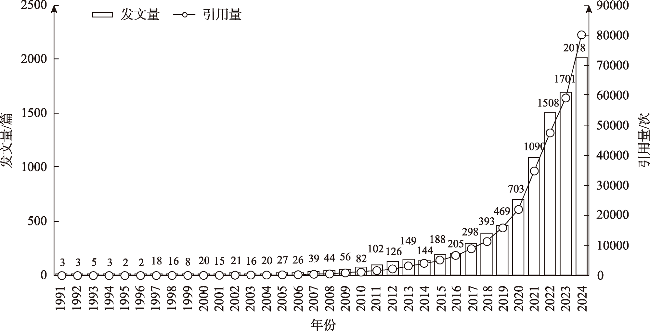
气候变化减缓与循环经济耦合研究始于1991年,各年发文量和文章引用量如图1所示。研究进程可以划分为起步探索阶段(1991—2006年)、平稳发展阶段(2007—2019年)和快速发展阶段(2020—2024年)。针对上述3个发展阶段,梳理和总结气候变化减缓与循环经济耦合研究的发展历程。
图1 1991—2024年气候变化减缓与循环经济耦合研究的年发文量和年文章引用量

Figure 1 Annual publication and citation of research on coupling of climate change mitigation and circular economy, 1991-2024

(1)起步探索阶段(1991—2006年)
20世纪末期,随着气候变化问题和可持续发展理念受到更多关注,学者开始尝试以循环经济方式解决气候变化问题。1991年,Forrest等[18]提出在美国初级金属行业采取节能和回收利用措施以减少能源消耗和碳排放,这是气候变化减缓和循环经济实践的第一次有机融合。其后,学术研究主要关注废弃资源的回收利用过程,初步探讨了循环经济理论在工业固废管理中的应用[19,20]。该阶段发文量较低,但二者的学术融合为后续研究奠定了坚实的基础。
(2)平稳发展阶段(2007—2019年)
随着政府间气候变化专门委员会(IPCC)荣获诺贝尔和平奖、《巴黎协定》达成等一系列标志性事件发生,气候变化减缓和循环经济耦合研究范畴不断扩展,发文量稳步上升。这一阶段,研究拓展到城市和工业固废管理领域,尤其关注如何在产业园区内以资源回收利用方式实现碳减排,并衍生出产业共生、城市-产业共生及生态产业园等产业生态学概念[21-23]
(3)快速发展阶段(2020—2024年)
2019年起,世界主要经济体陆续承诺碳中和目标的实现期限,其中也包括中国,这对于政策导向性研究具有较强影响[24]。这一阶段,气候变化减缓与循环经济耦合研究进入快速发展阶段,发文量和引用量大幅增加,该研究领域得到了广泛关注。研究内容也更为丰富,相关研究以固废管理为切入点,从能源、交通、建筑、工业等行业视角,覆盖从产业链到城市规划、从技术创新到政策制定等方面,对气候变化减缓与循环经济的协同效应进行了更加系统而定量的研究[25-27]

4 气候变化减缓与循环经济耦合研究现状

本文从主要发文国家(地区)、作者、机构、期刊和高被引文章的角度对气候变化减缓与循环经济耦合研究进展和特征进行归纳总结。1991—2024年,来自148个国家(地区)8346个机构的36187位作者在1496本期刊上共发表论文9520篇。

4.1 主要国家、作者和机构分析

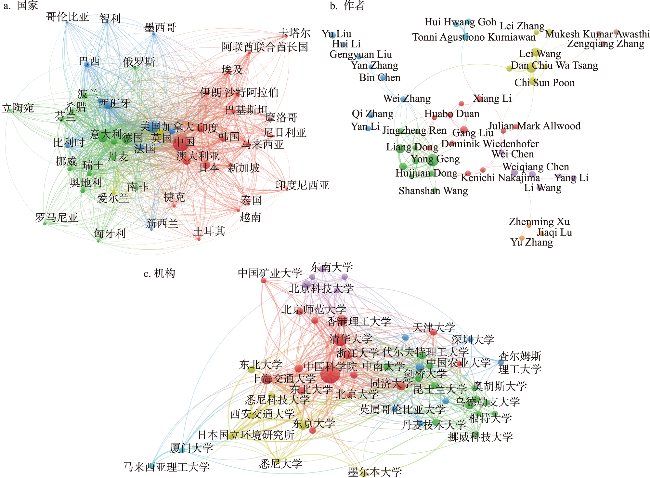
各个国家(地区)、学者和研究机构在气候变化减缓与循环经济耦合研究领域的发文量(表1)和合作网络(图2)可反映其在该领域的参与程度与学术地位。
表1 气候变化减缓与循环经济耦合研究中主要国家、作者和机构发文情况

Table 1 Publication contributions by major countries, authors, and institutions in research on coupling study of climate change mitigation and circular economy

国家 发文量/篇 作者 发文量/篇 机构 发文量/篇
中国 2784 Yong Geng 51 中国科学院 330
美国 1249 Dan Chiu Wa Tsang 35 清华大学 150
英国 806 Liang Dong 30 上海交通大学 111
意大利 621 Chi Sun Poon 27 香港理工大学 103
德国 621 Tsuyoshi Fujita 23 东京大学 91
西班牙 578 Weiqiang Chen 19 同济大学 84
澳大利亚 567 Tonni Agustiono Kurniawan 17 北京科技大学 77
印度 526 Seeram Ramakrishna 17 浙江大学 74
日本 437 Edgar G. Hertwich 17 剑桥大学 70
荷兰 372 Huijuan Dong 17 新加坡国立大学 70
图2 气候变化减缓与循环经济耦合研究的国家、作者和机构间合作网络

Figure 2 Collaborative networks among countries, authors, and institutions in research on coupling of climate change mitigation and circular economy

4.1.1 发文贡献

从国家(地区)层面看,中国学者在气候变化减缓与循环经济耦合研究中处于绝对领先地位,累计发表论文2784篇,占全球总发文量约1/3。这得益于国家层面对“双碳”目标的系统部署、政策推动,以及科研投入的持续增加。美国和英国分别以1249篇和806篇位居第二和第三,意大利和德国并列第四,各发表621篇。西班牙、澳大利亚、印度、日本和荷兰发文量均超过370篇,表明该领域已形成广泛的国际研究格局。
从核心作者来看,中国学者在全球高产作者中占据主导地位。上海交通大学耿涌(Yong Geng)以51篇论文高居榜首,展现出其在该领域的引领作用;香港理工大学曾超华(Dan Chiu Wa Tsang)、香港城市大学董亮(Liang Dong)分别以35篇和30篇位列其后。其他具有代表性的作者还包括香港理工大学潘智生(Chi Sun Poon,27篇)、东京大学藤田壮(Tsuyoshi Fujita,23篇)、中国科学院陈伟强(Weiqiang Chen,19篇)等,反映出亚洲学者在该领域方向上的持续深耕和国际影响力。
从研究机构角度看,全球最高产机构主要集中于中国。中国科学院以330篇论文居首,是该领域最重要的科研支撑力量。清华大学(150篇)、上海交通大学(111篇)和香港理工大学(103篇)紧随其后,显示出中国科研机构和高校在该领域的强大集聚力。东京大学(91篇)、剑桥大学(70篇)、新加坡国立大学(70篇)等国际高校的积极参与,进一步凸显了该议题的全球学术吸引力。

4.1.2 合作网络

从国家(地区)间合作网络看(图2a),气候变化减缓与循环经济耦合研究呈现出较为活跃的国际协作态势。中国、美国和英国处于全球合作网络的核心地位,与澳大利亚、日本、德国等国家建立了稳定的合作关系,形成了以中美英为中心、辐射多国的国际合作格局。此外,欧洲国家内部学术联系也较为紧密,合作关系稳固。这反映出发达国家在推动学术资源整合方面的优势,也显示出中国在全球研究网络中的话语权不断提升。
从作者合作层面看(图2b),全球已形成8个主要的合著群体。多数群体内部成员来自同一或相邻国家,具有相似的学习或工作背景。例如,以耿涌为核心的合著群体成员多具有日本国立环境研究所的学习或工作经历;以曾超华为核心的群体则主要集中于香港理工大学。这表明特定科研平台在学术合作网络的形成和拓展中发挥了重要的纽带作用。
从机构合作角度看(图2c),尽管跨机构合作较为广泛,但高频合作仍主要集中于同一国家或地区内部,呈现出明显的地缘集聚特征。中国科研机构和高校在全球合作网络中活跃度高、参与范围广,尤其是中国科学院、清华大学、上海交通大学与香港理工大学之间的紧密合作,构建了中国科研合作网络的核心圈层。日本国立环境研究所与东京大学之间的协作也同样密切。因此,区域内部协同与跨国合作相辅相成,共同推动了该领域研究的国际化进程。

4.2 主要期刊和高被引文献分析

虽然不同期刊在特定领域内的发文量与期刊总发文量相关,但主要发文期刊和高被引文献在一定程度上能够反映该领域的关注方向。
气候变化减缓与循环经济耦合研究前10名主要发文期刊(表2)以环境科学领域期刊为主,涉及能源、建筑等领域。其中Journal of Cleaner Production、Sustainability和Resources, Conservation & Recycling期刊发表该主题的研究较多。
表2 气候变化减缓与循环经济耦合研究领域的主要期刊和高被引文献

Table 2 Main journals and highly cited literature in field of coupling of climate change mitigation and circular economy

主要期刊 高被引文献
期刊名称 发文量/篇 作者 期刊名称 年份 引用量/次
Journal of Cleaner Production 835 Larcher等[28] Nature Chemistry 2015 6260
Sustainability 614 Trenberth[31] Climate Research 2011 2515
Resources, Conservation and Recycling 372 Harper等[29] Nature 2019 2159
Science of the Total Environment 238 Murray等[35] Journal of Business Ethics 2017 1512
Energies 192 Peters等[36] Environmental Science & Technology 2007 1284
Construction and Building Materials 166 Rebitzer等[37] Environmental International 2004 1269
Journal of Environmental Management 164 Whipple等[34] Journal of Physical Chemistry Letters 2010 1239
Renewable and Sustainable Energy Reviews 161 Fan等[30] Chemical Reviews 2020 1234
Waste Management 135 Janssens等[32] Nature Geoscience 2010 1229
Environmental Science and Pollution Research 125 Olah等[33] Journal of Organic Chemistry 2009 1198
气候变化减缓与循环经济耦合研究前10位高被引文献主要集中于两类研究方向(表2):一类以能源环境技术综述为主,系统梳理了锂离子电池在材料选择、合成方法、环境成本及回收再利用方面的关键问题,强调全生命周期视角下的资源效率提升与环境影响控制[28-30];同时,气候变化对自然过程的影响机制也被广泛讨论,包括全球变暖对降水分布的调节作用[31]、氮沉降对土壤碳排放的抑制机制[32],以及CO2资源化路径的发展前景,如将其转化为甲醇燃料和化工产品的技术可行性与应用潜力[33,34]。另一类文献侧重社会经济与政策层面,围绕循环经济的概念演进与现实应用,探讨其在政策体系与商业模式中的嵌入路径[35];同时,基于投入产出分析和结构分解方法,分析了技术进步、产业结构调整、城镇化和消费模式变化对碳排放的系统性影响[36]。生命周期评估工具在产品、技术及政策层面的广泛应用也成为关注重点,为多维度环境绩效评估提供了方法支撑[37]

5 气候变化减缓与循环经济耦合协同研究热点及变化

随着社会碳中和转型进程的加速,气候变化减缓与循环经济耦合研究受到越来越广泛的关注。下文综述了该领域的主要研究主题和演变趋势。

5.1 研究热点

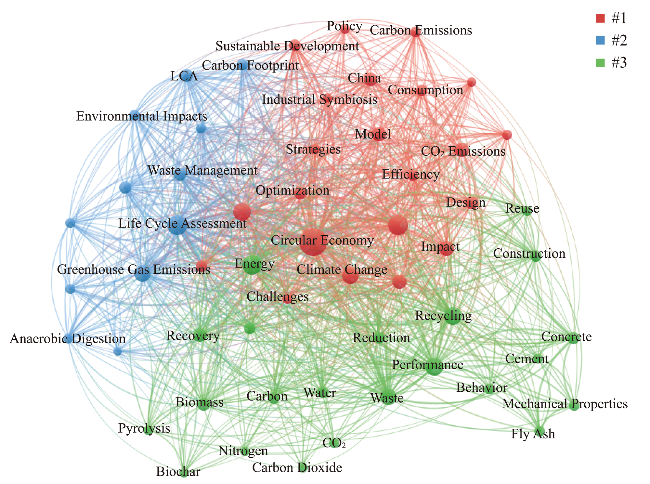
气候变化减缓与循环经济耦合研究的关键词聚类图有助于理解领域内研究热点。本文将领域内出现频率最高的60个关键词分成3组,代表3个研究方向(图3),即废弃物管理(#1)、生命周期评价(#2)、产业共生(#3)。
图3 气候变化减缓与循环经济耦合研究的关键词聚类

Figure 3 Keyword clustering of research on coupling of climate change mitigation and circular economy

(1)废弃物管理主题
废弃物管理是以循环经济理念推动气候变化减缓的重要路径,其主要作用机制体现在两个方面:一是通过构建可持续的全链条废弃物管理体系,提高资源利用效率并减少环境负荷;二是通过发展再生资源利用体系,降低对原生资源的依赖,从而减少碳排放。
废弃物管理包括垃圾产生、分类、收运、处置等阶段,各阶段均可通过提高资源管理效率,实现温室气体减排。例如,在产生阶段,可借助数据建模识别垃圾产量变化趋势和驱动因素,为政策制定提供依据[38,39];在分类阶段,通过多主体行为模拟评估政策对居民分类行为的影响,有助于提升分类效率[40,41];在收运阶段,结合优化算法进行设施选址和路线规划,能够显著降低运输环节的能耗和碳排放[42,43];在处置阶段,分析不同技术路径下的碳排放和环境成本,有助于识别最佳处置方案[44,45]
此外,推动再生资源替代原生资源是实现资源闭环利用的关键路径。再生材料的使用能够显著减少矿产资源开采和能源投入[46]。例如,通过电池回收等循环策略,可以有效缓解电动汽车产业对关键金属的依赖[47,48];在钢铁行业,从废弃物和高温炉渣中回收原材料和余热,以提升资源利用效率和控制碳排放上升[49,50];塑料行业也在推进CO₂和生物质的资源化利用,并通过提高材料回收率,实现净零排放与能源节约双重目标[51,52];废纸、利乐包等低值可回收物的回收也展现出可观的减碳潜力[53,54]
(2)生命周期评价主题
生命周期评价是一种综合性工具,用于汇总产品或系统的输入、输出,并评估其潜在环境影响[55]。其不仅帮助识别高排放环节、优化资源利用,还有助于推动可持续产品设计和废物循环利用,从而使减排效益和资源效率最大化[56]
为评估温室气体减排潜力,学界在各行业、针对不同产品、过程和技术,设计多种资源回收技术和策略,以生命周期评价方法量化环境影响和碳减排效果,并在能源[57]、建筑[58]、工业[59]、交通[60]、农业[61]等领域得到广泛应用。在废弃物管理领域,生命周期评价的应用也逐渐多元,涵盖不同的研究区域、垃圾种类、功能单位、评价方法和研究目标。例如,Zhu等[62]针对农业废弃物生产生物炭技术开展生命周期评估,并比较了典型生物炭生产技术的环境影响;Sarkar等[63]研究了由食物垃圾等可再生原料生产低碳燃料和化学品的工艺,并对比不同工艺的环境可持续性。其中,食物垃圾[64]和焚烧垃圾[65]等类型的城市生活垃圾处置带来的温室气体排放受到重视。同时,生命周期评价正向多模型集成和政策支持工具方向发展,通过与物质流分析[66]、系统动力学[67]、数据包络分析[68]、多目标优化[69]等方法的融合,提升对复杂系统中资源-环境-经济关系的模拟能力和政策适应性。
(3)产业共生主题
产业共生作为循环经济的重要组织形式,通过区域企业间副产品、能源、水等资源的交换与共享,构建出一种模拟自然生态系统的闭环模式,使本应废弃的资源在不同企业间重新获得利用价值,实现资源的多级利用与环境影响最小化[70,71]
产业共生最典型的应用场景是产业园区和工业集群,不同类型的企业依托地理邻近性与产业关联性,形成以供需关系为纽带的网络系统[72]。化工园区通过副产品交换和能源系统协同,还提升了区域内的能源利用效率和企业间协同效益[73,74]。例如,以丹麦卡伦堡工业园区为代表的经典模式,已被广泛验证可在环境效益、经济回报和风险分摊等多方面实现共赢[75];钢铁与化工等资源密集型产业的集群共生实践展现出强大的减碳潜力,尤其是在物质交换、能量梯级利用与废热回收等方面取得积极成效[76]。此外,通过生物燃料、热电联产、再生资源等新兴领域的融合共生,构建了基于产业互补性的多层次协作结构,进一步降低了对传统化石能源的依赖[77,78]
产业共生的研究边界已突破传统工业园区的范畴,逐步向城市层面延伸,形成“城市-工业系统共生”的新范式。在这一模式下,城市固体废弃物被视作潜在的资源输入,通过与工业系统联动实现物质循环与能量回收,不仅缓解城市废弃物管理压力,也拓展了产业共生的资源基础[79,80]。通过城市废弃物的资源化处理与工业原料体系的协同设计,部分地区已初步建立起固废回收—加工—再制造的一体化路径,显著提升能效水平、实现温室气体减排[81],并体现了固体废弃物的多维价值潜力[82,83]

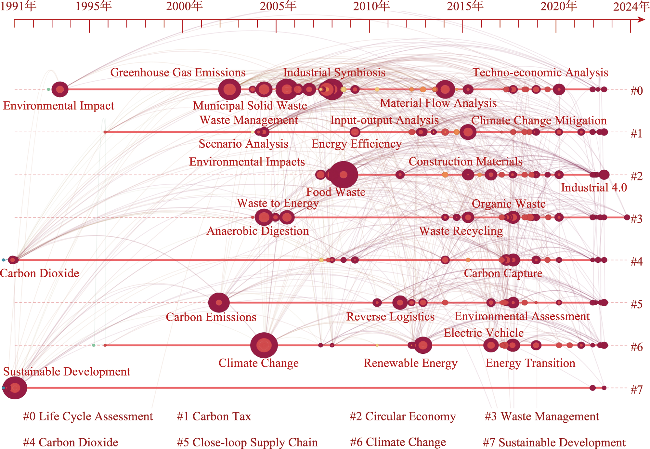
5.2 研究脉络

通过关键词时间线图(图4),本文发现气候变化减缓与循环经济耦合研究的重点领域包括:生命周期评价、碳税、循环经济、废弃物管理、CO2、闭环供应链、气候变化、可持续发展等。同时,结合关键词突现分析,发现发展中国家(2012—2018年),特别是中国(2015—2018年),是研究的重点地区。因此,本文将这些领域归纳为4个研究视角:气候变化、循环经济、废弃物管理、生命周期评价,梳理研究热点演化规律,以研判未来研究方向。
图4 气候变化减缓与循环经济耦合研究的关键词时间线图

Figure 4 Keyword timeline of research on coupling of climate change mitigation and circular economy

(1)气候变化(#1、#4、#6)
气候变化研究的核心目标是低碳转型和可持续发展,涉及碳排放、温室气体排放、气候变化减缓、全球变暖潜势、净零排放、新能源、碳税等多个议题[84-86]。研究中,生命周期评价[87]、投入产出法[88]、可计算一般均衡模型[89]等工具被广泛应用,以量化和预测不同政策和技术路径对环境的影响。自2012年以来,气候变化研究的关键词逐渐从传统的温室气体排放转变为碳足迹、低碳[90,91];并在2022年后,随着零碳目标提出,碳中和成为研究的新热点[92]。同时,研究的焦点也在逐步转向新能源领域,尤其是在能源系统脱碳的背景下,电动汽车、关键金属供应链以及电池回收等新兴话题逐渐成为气候变化减缓和循环经济耦合研究的热点[93,94]
(2)循环经济(#2、#5)
循环经济作为可持续发展理念,始终围绕废物管理和资源回收展开。2010—2018年,产业生态与产业共生成为该领域的研究热点,重点探讨了资源流动和工业协同等方面[95,96]。伴随这一趋势,研究视野逐步扩展至交通系统(2012—2018年)[97]、土地利用(2014—2020年)[98]、农食系统(2018—2020年)[99]、水泥(2020—2022年)[100]等新兴领域,尤其注重制造业和建筑业的闭环供应链构建[101]。随着“工业4.0”时代到来,数字化技术为循环经济注入了新的活力,智能制造、人工智能、物联网等前沿技术在循环经济中得到了广泛应用,极大地促进气候变化减缓和循环经济交叉领域的创新与变革[102,103]
(3)废弃物管理(#3)
废弃物管理是实现循环经济的核心环节。研究对象从传统的废弃物管理(2009—2019年),尤其是城市固体废物(2012—2013年),转变至农食废弃物管理(2018—2020年)。从技术角度出发,废弃物管理领域的研究从早期的固体废物处理逐步发展到更为复杂的技术应用,如厌氧消化、废弃物能源化、碳利用、捕集和储存等[104-106]。同时,钢渣、飞灰、沼气等废料的处理也逐渐成为研究的重要方向[107,108]。从政策角度出发,生产者延伸责任制等政策开始受到广泛关注,这能够推动企业对产品生命周期末期的环境责任[109,110];此外,随着人工智能技术的快速发展,其在废弃物分类、回收优化和处理效率提升方面的应用显示出了巨大的潜力,推动了“无废”和“零碳”城市建设目标[111,112]
(4)生命周期评价(#0)
生命周期评价作为一种重要的环境影响评估工具,广泛应用于温室气体排放核算,特别是在2011—2017年间。生命周期评价在固废处理、产业共生、水资源回收等领域发挥了重要作用,尤其是在优化技术方案和提高资源效率方面[113-115]。同时,学者常将生命周期方法与物质流分析结合,全面解析产品全生命周期中的物质代谢规律及其环境影响[116,117]。随着技术的不断进步,生命周期评价方法逐渐拓展至零碳技术领域,特别是在可再生能源、碳捕集与储存等前沿技术的评估中,生命周期评价的应用得到了更加广泛的推广[118,119]。2022年之后,技术经济分析逐渐成为研究中的热门方法,它不仅关注环境影响,还结合经济效益和技术可行性,为低碳技术的决策提供了更加全面的支持[120,121]

6 结论与研究展望

6.1 结论

本文基于WoS数据库,通过文献计量分析,梳理了1991—2024年气候变化减缓与循环经济耦合研究的发展历程、研究现状和热点话题。主要研究结论如下:
(1)研究发展历程循序渐进。气候变化减缓与循环经济耦合研究经历了3个主要发展阶段:起步探索阶段(1991—2006年)、平稳发展阶段(2007—2019年)和快速发展阶段(2020—2024年)。初期研究主要集中在回收利用和固废管理。近年来,随着碳中和目标的推动,研究主题逐渐扩展到更多产业、地区、技术和政策中。
(2)中国学者主导国际研究。目前,在气候变化减缓与循环经济耦合研究领域,来自148个国家(地区)8346个机构的36187位作者在1496本期刊上共发表论文9520篇。其中,中国占据主导地位,且与美国、英国等主要国家保持密切合作。中国科学院、清华大学等研究机构在国际合作网络中处于中心位置,凸显了中国在该领域的科研实力和国际影响力。
(3)研究聚焦四大热点领域。气候变化减缓与循环经济耦合研究的主要研究方向为废弃物管理、生命周期评价、产业共生。通过梳理气候变化、循环经济、废弃物管理、生命周期评价4个关键领域的研究热点演化过程,发现碳中和与零碳目标、新能源场景、数智化技术、多方法融合将引领未来研究热点。同时,发现发展中国家,特别是中国,是气候变化减缓与循环经济耦合研究的重点地区。

6.2 研究展望

未来可以从以下4个方面拓展相关研究,以推动气候变化减缓与循环经济耦合领域的知识创新和实践应用。
(1)深化国际合作。国际合作是推动气候变化减缓与循环经济耦合研究进程的重要手段。然而,目前主要合著群体大多来自相同国家(地区)、研究机构。未来研究应深化不同国家(地区)和机构间合作,探讨不同国家(地区)实现政策协调与技术互补的合作机制。为促进国际合作,一方面,应在保证现有国际气候协议、双边和多边合作模式的基础上,提出气候俱乐部、区域碳市场、联合气候行动等新型合作形式;另一方面,应关注在国际合作中如何兼顾不同国家(地区)的经济发展水平、技术能力和资源禀赋,特别是如何在合作中保障发展中国家和新兴经济体的利益。这有助于制定更加公平、可持续的全球合作框架,为气候变化减缓与循环经济目标的实现提供理论支持。
(2)促进学科交流。气候变化减缓与循环经济耦合研究的复杂性要求跨越学科边界,开展多学科交叉研究。目前研究多局限于单一领域。未来应探索有效融合环境科学、经济学、工程学、社会科学等多学科的理论和方法,以构建系统化的研究框架。例如,经济学的环境政策工具可以与工程技术的低碳技术结合,从而评估和优化碳中和路径;环境科学中的生态足迹分析可以与材料科学中的新型可持续材料研究结合,评估新材料的循环利用潜力和碳减排效益。跨学科合作交流能丰富研究视角、创新解决方案,推动气候变化减缓与循环经济理论的深入结合。
(3)推进技术革新。技术革新是实现气候变化减缓与循环经济的核心驱动力,而目前主要学者、机构和期刊更加关注政策层面研究。未来研究应重点探讨技术进步对气候变化减缓与循环经济的影响及其机制。一方面,研究可以从技术发展角度,探索新兴电子信息技术(如人工智能、大数据、物联网等)在资源优化、废弃物管理和碳减排中的应用潜力。例如,以大数据分析优化资源流动和再生利用路径,通过人工智能提升工业流程的能源效率。另一方面,应关注碳捕集与封存负碳技术与循环经济模式结合,进一步推动碳排放的负增长。这不仅能揭示技术革新在气候变化减缓与循环经济中的关键作用,还能为未来技术政策制定提供科学依据。
(4)把握发展机遇。数字经济时代和工业4.0时代的到来意味着数字化和智能化技术能够为资源管理和碳排放控制提供更多支持,这为气候变化减缓与循环经济耦合研究提供了全新的应用场景和机遇。现有研究已经初步关注到数字经济、工业4.0的发展机遇,未来研究应进一步探索新技术创新协同管理的模式。例如,将区块链技术应用于资源追溯和碳排放监测;以智能制造优化生产流程和供应链,实现全生命周期的资源节约和碳减排。通过把握新兴技术带来的发展机遇,为气候变化减缓与循环经济协同发展提供前沿理论和实践支持。
[1]
何建坤, 李政, 张希良, 等. 《中国长期低碳发展战略与转型路径研究》综合报告[M]. 北京: 中国环境出版集团, 2021.

[He J K, Li Z, Zhang X L, et al. China’s Long-Term Low-Carbon Development Strategies and Pathways Comprehensive Report[M]. Beijing: China Environment Publishing Group, 2021.]

[2]
王建芳, 苏利阳, 谭显春, 等. 主要经济体碳中和战略取向、政策举措及启示[J]. 中国科学院院刊, 2022, 37(4): 479-489.

[Wang J F, Su L Y, Tan X C, et al. Carbon neutrality policy measures in global major economies[J]. Bulletin of Chinese Academy of Sciences, 2022, 37(4): 479-489.]

[3]
王灿, 蔡闻佳, 张诗卉, 等. 2023全球碳中和年度进展报告[R]. 北京: 清华大学, 2023.

[Wang C, Cai W J, Zhang S H, et al. 2023 Global Carbon Neutrality Annual Progress Report[R]. Beijing: Tsinghua University, 2023.]

[4]
Zhang S, Chen W Y. China’s energy transition pathway in a carbon neutral vision[J]. Engineering, 2022, 14: 64-76.

[5]
张希良, 黄晓丹, 张达, 等. 碳中和目标下的能源经济转型路径与政策研究[J]. 管理世界, 2022, 38(1): 35-66.

[Zhang X L, Huang X D, Zhang D, et al. Research on the path and policy of energy economy transition under the goal of carbon neutrality[J]. Journal of Management World, 2022, 38(1): 35-66.]

[6]
温宗国, 许毛, 李会芳, 等. 循环经济助力中国碳中和目标实现的潜力: 以塑料、纺织及农业-食品领域为例[R]. 北京: 清华大学, 2022.

[Wen Z G, Xu M, Li H F, et al. The Potential of Circular Economy to Help Achieve China’s Carbon Neutrality Goal: A Case Study of Plastics, Textiles and Agri-food[R]. Beijing: Tsinghua University, 2022.]

[7]
Geng Y, Sarkis J, Ulgiati S, et al. Measuring China’s circular economy[J]. Science, 2013, 339(6127): 1526-1527.

[8]
魏文栋, 陈竹君, 耿涌, 等. 循环经济助推碳中和的路径和对策建议[J]. 中国科学院院刊, 2021, 36(9): 1030-1038.

[Wei W D, Chen Z J, Geng Y, et al. Toward carbon neutrality: Circular economy approach and policy implications[J]. Bulletin of Chinese Academy of Sciences, 2021, 36(9): 1030-1038.]

[9]
Zhang Z, Hu G W, Mu X Z, et al. From low carbon to carbon neutrality: A bibliometric analysis of the status, evolution and development trend[J]. Journal of Environmental Management, 2022, DOI: 10.1016/j.jenvman.2022.116087.

[10]
Tan F L, Yang J, Zhou C. Historical review and synthesis of global carbon neutrality research: A bibliometric analysis based on R-tool[J]. Journal of Cleaner Production, 2024, DOI: 10.1016/j.jclepro.2024.141574.

[11]
Xu X R, Gou X J, Zhang W K, et al. A bibliometric analysis of carbon neutrality: Research hotspots and future directions[J]. Heliyon, 2023, DOI: 10.1016/j.heliyon.2023.e18763.

[12]
Liu Z, Qiu Z W. A systematic review of transportation carbon emissions based on CiteSpace[J]. Environmental Science and Pollution Research, 2023, 30(19): 54362-54384.

[13]
Saavedra Y M B, Iritani D R, Pavan A L R, et al. Theoretical contribution of industrial ecology to circular economy[J]. Journal of Cleaner Production, 2018, 170: 1514-1522.

[14]
Norouzi M, Chàfer M, Cabeza L F, et al. Circular economy in the building and construction sector: A scientific evolution analysis[J]. Journal of Building Engineering, 2021, DOI: 10.1016/j.jobe.2021.102704.

[15]
Scandurra F, Salomone R, Caeiro S, et al. The maturity level of the agri-food sector in the circular economy domain: A systematic literature review[J]. Environmental Impact Assessment Review, 2023, DOI: 10.1016/j.eiar.2023.107079.

[16]
Xue L, Song G B, Liu G. Wasted food, wasted resources? A critical review of environmental impact analysis of food loss and waste generation and treatment[J]. Environmental Science & Technology, 2024, 58(17): 7240-7255.

[17]
柳可, 张安录. 耕地利用效率研究进展: 基于文献计量视角[J]. 资源科学, 2023, 45(3): 494-511.

DOI

[Liu K, Zhang A L. Research progress and hotspots of cultivated land use efficiency in China and internationally: Based on a bibliometric analysis[J]. Resources Science, 2023, 45(3): 494-511.]

[18]
Forrest D, Szekely J. Global warming and the primary metals industry[J]. JOM, 1991, 43(12): 23-30.

[19]
Pimenteira C A P, Pereira A S, Oliveira L B, et al. Energy conservation and CO2 emission reductions due to recycling in Brazil[J]. Waste Management, 2004, 24(9): 889-897.

PMID

[20]
Gielen D, Moriguchi Y. CO2 in the iron and steel industry: An analysis of Japanese emission reduction potentials[J]. Energy Policy, 2002, 30(10): 849-863.

[21]
Dong H J, Ohnishi S, Fujita T, et al. Achieving carbon emission reduction through industrial & urban symbiosis: A case of Kawasaki[J]. Energy, 2014, 64: 277-286.

[22]
Dong L, Fujita T, Zhang H, et al. Promoting low-carbon city through industrial symbiosis: A case in China by applying HPIMO model[J]. Energy Policy, 2013, 61: 864-873.

[23]
Hashimoto S, Fujita T, Geng Y, et al. Realizing CO2 emission reduction through industrial symbiosis: A cement production case study for Kawasaki[J]. Resources, Conservation and Recycling, 2010, 54(10): 704-710.

[24]
邓旭, 谢俊, 滕飞. 何谓“碳中和”?[J]. 气候变化研究进展, 2021, 17(1): 107-113.

[Deng X, Xie J, Teng F. What is carbon neutrality?[J]. Climate Change Research, 2021, 17(1): 107-113.]

[25]
Simoes S G, Lima A T M. Materials, resources, and CO2 impacts of building new renewable power plants to reach EU’s goals of carbon neutrality[J]. Journal of Cleaner Production, 2023, DOI: 10.1016/j.jclepro.2023.138138.

[26]
van Ewijk S, Stegemann J A, Ekins P. Limited climate benefits of global recycling of pulp and paper[J]. Nature Sustainability, 2021, 4(2): 180-187.

[27]
Evro S, Oni B A, Tomomewo O S. Global strategies for a low-carbon future: Lessons from the US, China, and EU’s pursuit of carbon neutrality[J]. Journal of Cleaner Production, 2024, DOI: 10.1016/j.jclepro.2024.142635.

[28]
Larcher D, Tarascon J M. Towards greener and more sustainable batteries for electrical energy storage[J]. Nature Chemistry, 2015, 7(1): 19-29.

DOI PMID

[29]
Harper G, Sommerville R, Kendrick E, et al. Recycling lithium-ion batteries from electric vehicles[J]. Nature, 2019, 575(7781): 75-86.

[30]
Fan E S, Li L, Wang Z P, et al. Sustainable recycling technology for Li-Ion batteries and beyond: Challenges and future prospects[J]. Chemical Reviews, 2020, 120(14): 7020-7063.

DOI PMID

[31]
Trenberth K E. Changes in precipitation with climate change[J]. Climate Research, 2011, 47(1-2): 123-138.

[32]
Janssens I A, Dieleman W, Luyssaert S, et al. Reduction of forest soil respiration in response to nitrogen deposition[J]. Nature Geoscience, 2010, 3(5): 315-322.

[33]
Olah G A, Goeppert A, Prakash G K S. Chemical recycling of carbon dioxide to methanol and dimethyl ether: From greenhouse gas to renewable, environmentally carbon neutral fuels and synthetic hydrocarbons[J]. The Journal of Organic Chemistry, 2009, 74(2): 487-498.

[34]
Whipple D T, Kenis P J A. Prospects of CO2 utilization via direct heterogeneous electrochemical reduction[J]. The Journal of Physical Chemistry Letters, 2010, 1(24): 3451-3458.

[35]
Murray A, Skene K, Haynes K. The circular economy: An interdisciplinary exploration of the concept and application in a global context[J]. Journal of Business Ethics, 2017, 140(3): 369-380.

[36]
Peters G P, Weber C L, Guan D B, et al. China’s growing CO2 emissions: A race between increasing consumption and efficiency gains[J]. Environmental Science & Technology, 2007, 41(17): 5939-5944.

[37]
Rebitzer G, Ekvall T, Frischknecht R, et al. Life cycle assessment: Part 1: Framework, goal and scope definition, inventory analysis, and applications[J]. Environment International, 2004, 30(5): 701-720.

DOI PMID

[38]
Zhang C, Dong H, Geng Y, et al. Machine learning based prediction for China’s municipal solid waste under the shared socioeconomic pathways[J]. Journal of Environmental Management, 2022, DOI: 10.1016/j.jenvman.2022.114918.

[39]
董莉, 刘景洋, 张泽乾, 等. 基于动态物质流的北京市城乡住房建筑垃圾产生量模拟预测[J]. 中国环境科学, 2025, 45(4): 2041-2052.

[Dong L, Liu J Y, Zhang Z Q, et al. Simulation and prediction of construction and demolition waste from urban and rural housing in Beijing based on dynamic material flow analysis[J]. China Environmental Science, 2025, 45(4): 2041-2052.]

[40]
Gao M, Chen Y F. Multi-agent collaborative model of e-waste recycling[J]. Journal of Environmental Management, 2024, DOI: 10.1016/j.jenvman.2023.119457.

[41]
Meng X Y, Zhang Y T, Meng F X, et al. The way out for urban household solid waste classification in China: From the perspective of multi-agent based behavior simulation[J]. Journal of Cleaner Production, 2024, DOI: 10.1016/j.jclepro.2024.143363.

[42]
Lv J Y, Dong H J, Geng Y, et al. Optimization of recyclable MSW recycling network: A Chinese case of Shanghai[J]. Waste Management, 2020, 102: 763-772.

DOI PMID

[43]
Sandoval-Reyes M, He R, Semeano R, et al. Mathematical optimization of waste management systems: Methodological review and perspectives for application[J]. Waste Management, 2024, 174: 630-645.

DOI PMID

[44]
Liu C C, Dong H J, Cao Y, et al. Environmental damage cost assessment from municipal solid waste treatment based on LIME3 model[J]. Waste Management, 2021, 125: 249-256.

DOI PMID

[45]
张晨怡, 董会娟, 耿涌. 中国城市生活垃圾处理碳排放时空分布特征及减排潜力[J]. 中国人口·资源与环境, 2024, 34(4): 23-35.

[Zhang C Y, Dong H J, Geng Y. Spatio-temporal distribution characteristics and reduction potentials of China’s MSW-related GHG emissions[J]. China Population, Resources and Environment, 2024, 34(4): 23-35.]

[46]
汪鹏, 王翘楚, 韩茹茹, 等. 全球关键金属-低碳能源关联研究综述及其启示[J]. 资源科学, 2021, 43(4): 669-681.

DOI

[Wang P, Wang Q C, Han R R, et al. Nexus between low-carbon energy and critical metals: Literature review and implications[J]. Resources Science, 2021, 43(4): 669-681.]

DOI

[47]
应雄, 汪寿阳, 杨宇瑶. 能源转型下的锂、钴、镍资源需求及回收潜力分析: 基于电动汽车的视角[J]. 中国科学院院刊, 2024, 39(7): 1226-1234.

[Ying X, Wang S Y, Yang Y Y. Analysis of demand and recycling potential of lithium, cobalt, and nickel under energy transition: From perspective of electric vehicles[J]. Bulletin of Chinese Academy of Sciences, 2024, 39(7): 1226-1234.]

[48]
Peiseler L, Schenker V, Schatzmann K, et al. Carbon footprint distributions of lithium-ion batteries and their materials[J]. Nature Communications, 2024, DOI: 10.1038/s41467-024-54634-y.

[49]
田旭, 李照令, 耿涌, 等. 碳中和目标下中国钢铁行业碳减排的资源环境影响[J]. 资源科学, 2024, 46(4): 700-716.

DOI

[Tian X, Li Z L, Geng Y, et al. Resource and environmental impacts of carbon emission reduction in China’s iron and steel sector under the carbon neutrality goal[J]. Resources Science, 2024, 46(4): 700-716.]

DOI

[50]
陈浩, 胡静茹, 王寿兵, 等. 基于ARIMA-LEAP模型的中国钢铁行业二氧化碳排放特征和减排路径研究[J/OL]. 中国环境科学, (2024-08-20) [2025-05-12]. https://doi.org/10.19674/j.cnki.issn1000-6923.20240024.004.

[Chen H, Hu J R, Wang S B, et al. Research on carbon dioxide emission characteristics and emission reduction path of China’s iron and steel industry based on ARIMA-LEAP model[J/OL]. China Environmental Science, (2024-08-20) [2025-05-12]. https://doi.org/10.19674/j.cnki.issn1000-6923.20240024.004.]

[51]
Liang H D, Dong H J, Zhang C Y, et al. Combining LCA-MFA models to identify China’s plastic value chain environmental impact mitigation pathways[J]. iScience, 2023, DOI: 10.1016/j.isci.2023.107701.

[52]
Chen G Y, Li J Y, Sun Y N, et al. Replacing traditional plastics with biodegradable plastics: Impact on carbon emissions[J]. Engineering, 2024, 32: 152-162.

[53]
Dong H J, Yu F, Bi Z J, et al. Life cycle environmental and economic assessment of Tetra Pak recycling technologies[J]. Resources, Conservation and Recycling, 2024, DOI: 10.1016/j.resconrec.2023.107355.

[54]
Li Q Q, Chu Z J. Carbon emissions reduction potential of low-value recyclable waste in China: Provincial measurement under multiple scenarios[J]. Resources, Conservation and Recycling, 2025, DOI: 10.1016/j.resconrec.2025.108149.

[55]
Dai Y, Dong H J, Sun L X, et al. Life cycle environmental impact assessment of titanium dioxide production in China[J]. Environmental Impact Assessment Review, 2024, DOI: 10.1016/j.eiar.2023.107412.

[56]
Guinée J B, Heijungs R, Huppes G, et al. Life cycle assessment: Past, present, and future[J]. Environmental Science & Technology, 2011, 45(1): 90-96.

[57]
张雅娟, 王铮, 李双成. 能源电力系统转型对中国环境影响评估[J]. 资源科学, 2023, 45(9): 1830-1843.

DOI

[Zhang Y J, Wang Z, Li S C. Environmental impact assessment of energy and power system transformation in China[J]. Resources Science, 2023, 45(9): 1830-1843.]

DOI

[58]
Roberts M, Allen S, Clarke J, et al. Understanding the global warming potential of circular design strategies: Life cycle assessment of a design-for-disassembly building[J]. Sustainable Production and Consumption, 2023, 37: 331-343.

[59]
Piron M, Bovo E, Lucchetta G, et al. Soft-sensors to drive manufacturing toward clean production: LCA based on Digital Twin[J]. Journal of Cleaner Production, 2025, DOI: 10.1016/j.jclepro.2025.145192.

[60]
杨来, 余碧莹, 冯烨. 电动汽车生命周期碳排放评估: 以中国乘用车为例[J]. 中国人口·资源与环境, 2023, 33(5): 113-124.

[Yang L, Yu B Y, Feng Y. Life cycle assessment of electric vehicle carbon emissions: A case study of passenger vehicles in China[J]. China Population, Resources and Environment, 2023, 33(5): 113-124.]

[61]
陈伟, 洪静兰, 李照令, 等. 2011-2020年中国大豆生产碳排放效率时空演变及影响因素[J]. 中国人口·资源与环境, 2024, 34(2): 70-80.

[Chen W, Hong J L, Li Z L, et al. Spatio-temporal evolution of carbon emission efficiency and influencing factors of China’s soybean production from 2011 to 2020[J]. China Population, Resources and Environment, 2024, 34(2): 70-80.]

[62]
Zhu X F, Labianca C, He M J, et al. Life-cycle assessment of pyrolysis processes for sustainable production of biochar from agro-residues[J]. Bioresource Technology, 2022, DOI: 10.1016/j.biortech.2022.127601.

[63]
Sarkar O, Katakojwala R, Venkata Mohan S. Low carbon hydrogen production from a waste-based biorefinery system and environmental sustainability assessment[J]. Green Chemistry, 2021, 23(1): 561-574.

[64]
De Oliveira Fernandes M A, Baêta B E L, Adarme O F H, et al. LCA-based carbon footprint analysis of anaerobic digestion of coffee husk waste[J]. Renewable and Sustainable Energy Reviews, 2025, DOI: 10.1016/j.rser.2024.114993.

[65]
Liao N L, F, Li X J, et al. Life cycle assessment of small-scale incineration facilities: Reducing environmental burdens in underdeveloped areas[J]. Journal of Cleaner Production, 2025, DOI: 10.1016/j.jclepro.2025.144747.

[66]
张宇婷, 胡宇鹏, Kosajan V, 等. 中国湿巾代谢分析及环境影响评估[J]. 中国环境科学, 2021, 41(11): 5438-5445.

[Zhang Y T, Hu Y P, Kosajan V, et al. Material metabolism analysis and environmental impact assessment of wet wipes in China[J]. China Environmental Science, 2021, 41(11): 5438-5445.]

[67]
Yi Y Q, Wu J Z, Zuliani F, et al. Integration of life cycle assessment and system dynamics modeling for environmental scenario analysis: A systematic review[J]. Science of the Total Environment, 2023, DOI: 10.1016/j.scitotenv.2023.166545.

[68]
Gennitsaris S, Sagani A, Sofianopoulou S, et al. Integrated LCA and DEA approach for circular economy-driven performance evaluation of wind turbine end-of-life treatment options[J]. Applied Energy, 2023, DOI: 10.1016/j.apenergy.2023.120951.

[69]
Hagenaars R H, Heijungs R, Tukker A, et al. Hybrid LCA for sustainable transitions: principles, applications, and prospects[J]. Renewable and Sustainable Energy Reviews, 2025, DOI: 10.1016/j.rser.2025.115443.

[70]
Turken N, Geda A. Supply chain implications of industrial symbiosis: A review and avenues for future research[J]. Resources, Conservation and Recycling, 2020, DOI: 10.1016/j.resconrec.2020.104974.

[71]
Wang L, Zhang Q, Zhang G Q, et al. Can industrial symbiosis policies be effective? Evidence from the nationwide industrial symbiosis system in China[J]. Journal of Environmental Management, 2023, DOI: 10.1016/j.jenvman.2023.117346.

[72]
Ramir D. T. Certeza L V, Purnama A R, Ahsan A, et al. Review of mathematical programming models for energy-based industrial symbiosis networks[J]. Renewable and Sustainable Energy Reviews, 2025, DOI: 10.1016/j.rser.2025.115377.

[73]
Xie X, Fu H, Zhu Q S, et al. Integrated optimization modelling framework for low-carbon and green regional transitions through resource-based industrial symbiosis[J]. Nature Communications, 2024, DOI: 10.1038/s41467-024-48249-6

[74]
Wang H, Gu K Y, Sun H, et al. Reconfirmation of the symbiosis on carbon emissions and air pollution: A spatial spillover perspective[J]. Science of the Total Environment, 2023, DOI: 10.1016/j.scitotenv.2022.159906.

[75]
Jacobsen N B. Industrial symbiosis in Kalundborg, Denmark: A quantitative assessment of economic and environmental aspects[J]. Journal of Industrial Ecology, 2006, 10(1): 239-255.

[76]
Li H Q, Bao W J, Xiu C H, et al. Energy conservation and circular economy in China’s process industries[J]. Energy, 2010, 35(11): 4273-4281.

[77]
Cao Q Y, Xiao Z D, Cheng T C E, et al. Manufacturers’ performance with industrial symbiosis under cap-and-trade policy considering waste supply-demand mismatch[J]. International Journal of Production Economics, 2025, DOI: 10.1016/j.ijpe.2025.109523.

[78]
Mollica M, Fraccascia L, Nastasi A. What drives the success of online platforms for industrial symbiosis? An agent-based model[J]. Ecological Economics, 2025, DOI: 10.1016/j.ecolecon.2024.108502.

[79]
Grimmel P, Niemeyer J F, Tan C F, et al. Urban-industrial symbiosis recommendation platform for urban factories: Leveraging historical exchange patterns through feature analysis for real-world applications[J]. Journal of Industrial Ecology, 2025, DOI: 10.1111/jiec.70015.

[80]
Sun L, Du C L, Li Z L, et al. Urban-industrial symbiosis practices in Tokyo Metropolis and the indication of carbon emissions reduction and environmental benefits[J]. Cities, 2025, DOI: 10.1016/j.cities.2025.105840.

[81]
Xiao S J, Dong H J, Geng Y, et al. Low carbon potential of urban symbiosis under different municipal solid waste sorting modes based on a system dynamic method[J]. Resources, Conservation and Recycling, 2022, DOI: 10.1016/j.resconrec.2021.106108.

[82]
Fan Y V, Varbanov P S, Klemeš J J, et al. Urban and industrial symbiosis for circular economy: Total EcoSite Integration[J]. Journal of Environmental Management, 2021, DOI: 10.1016/j.jenvman.2020.111829.

[83]
Pang K Y, Liew P Y, Woon K S, et al. Multi-period multi-objective optimisation model for multi-energy urban-industrial symbiosis with heat, cooling, power and hydrogen demands[J]. Energy, 2023, DOI: 10.1016/j.energy.2022.125201.

[84]
Silvério A C, Ferreira J, Fernandes P O, et al. How does circular economy work in industry? Strategies, opportunities, and trends in scholarly literature[J]. Journal of Cleaner Production, 2023, DOI: 10.1016/j.jclepro.2023.137312.

[85]
Xie J L, Xia Z Q, Tian X, et al. Nexus and synergy between the low-carbon economy and circular economy: A systematic and critical review[J]. Environmental Impact Assessment Review, 2023, DOI: 10.1016/j.eiar.2023.107077.

[86]
Wang N, Bai Y B, Guo Z Q, et al. Synergies between the circular economy and carbon emission reduction[J]. Science of the Total Environment, 2024, DOI: 10.1016/j.scitotenv.2024.175603.

[87]
Wang L C, Qiu T Z, Zhang M, et al. Carbon emissions and reduction performance of photovoltaic systems in China[J]. Renewable and Sustainable Energy Reviews, 2024, DOI: 10.1016/j.rser.2024.114603.

[88]
Gue I H V, Tan R R, Chiu A S F, et al. Environmentally-extended input-output analysis of circular economy scenarios in the Philippines[J]. Journal of Cleaner Production, 2022, DOI: 10.1016/j.jclepro.2022.134360.

[89]
Lu Y Y, Schandl H, Wang H M, et al. China’s pathway towards a net zero and circular economy: A model-based scenario analysis[J]. Resources, Conservation and Recycling, 2024, DOI: 10.1016/j.resconrec.2024.107514.

[90]
Diez-Cañamero B, Mendoza J M F. Circular economy performance and carbon footprint of wind turbine blade waste management alternatives[J]. Waste Management, 2023, 164: 94-105.

DOI PMID

[91]
Yan Y F, Wang R, Chen S D, et al. Mapping carbon footprint along global value chains: A study based on firm heterogeneity in China[J]. Structural Change and Economic Dynamics, 2022, 61: 398-408.

[92]
Garg A, Raut R D, Kumar M, et al. Does the circular economy transition aid to carbon neutrality? Examining net-zero policy and stakeholder impact from the environmental justice viewpoint[J]. Journal of Cleaner Production, 2025, DOI: 10.1016/j.jclepro.2025.144851.

[93]
Onat N C, Mandouri J, Kucukvar M, et al. Rebound effects undermine carbon footprint reduction potential of autonomous electric vehicles[J]. Nature Communications, 2023, DOI: 10.1038/s41467-023-41992-2.

[94]
Song A Y, Dan Z H, Zheng S Q, et al. An electricity-driven mobility circular economy with lifecycle carbon footprints for climate-adaptive carbon neutrality transformation[J]. Nature Communications, 2024, DOI: 10.1038/s41467-024-49868-9.

[95]
Ramírez-Rodríguez L C, Ormazabal M, Jaca C. Mapping sustainability assessment methods through the industrial symbiosis life cycle for a circular economy[J]. Sustainable Production and Consumption, 2024, 50: 253-267.

[96]
Palagonia C, Michelini L, Mattelin-Pierrard C. Spanning the industrial symbiosis within the circular economy: Critical issues and future research agenda[J]. Journal of Industrial Ecology, 2025, DOI: 10.1111/jiec.70005.

[97]
Yildizbasi A, Celik S E, Arioz Y, et al. Exploring the synergy between circular economy and emerging technologies for transportation infrastructure: A systematic literature review[J]. Journal of Cleaner Production, 2025, DOI: 10.1016/j.jclepro.2024.144553.

[98]
Nogueira G P, Petrielli G P, Chagas M F, et al. Sustainability synergies and trade-offs considering circularity and land availability for bioplastics production in Brazil[J]. Nature Communications, 2024, DOI: 10.1038/s41467-024-53201-9.

[99]
Abbate S, Centobelli P, Cerchione R, et al. Coming out the egg: Assessing the benefits of circular economy strategies in agri-food industry[J]. Journal of Cleaner Production, 2023, DOI: 10.1016/j.jclepro.2022.135665.

[100]
Lima A T, Kirkelund G M, Lu Z, et al. Mapping circular economy practices for steel, cement, glass, brick, insulation, and wood: A review for climate mitigation modeling[J]. Renewable and Sustainable Energy Reviews, 2024, DOI: 10.1016/j.rser.2024.114697.

[101]
Shobande O A, Tiwari A K, Ogbeifun L, et al. Demystifying circular economy and inclusive green growth for promoting energy transition and carbon neutrality in Europe[J]. Structural Change and Economic Dynamics, 2024, 70: 666-681.

[102]
Kurniawan T A, Maiurova A, Kustikova M, et al. Accelerating sustainability transition in St. Petersburg (Russia) through digitalization-based circular economy in waste recycling industry: A strategy to promote carbon neutrality in era of Industry 4.0[J]. Journal of Cleaner Production, 2022, DOI: 10.1016/j.jclepro.2022.132452.

[103]
Liu H W, Chen Y Q, Wu J, et al. Allocation of CO2 emission quotas for industrial production in Industry 4.0: Efficiency and equity[J]. Computers & Industrial Engineering, 2024, DOI: 10.1016/j.cie.2024.110375.

[104]
Shi Y, Huang Y D, Xu J P. A clean optimization approach for sustainable waste-to-energy using integrated technology[J]. Renewable Energy, 2024, DOI: 10.1016/j.renene.2023.119750.

[105]
Fan Z Y, Dong H J, Geng Y, et al. Life cycle cost-benefit efficiency of food waste treatment technologies in China[J]. Environment, Development and Sustainability, 2023, 25(6): 4935-4956.

[106]
Ro J W, Yothers C, Kendall A, et al. Economic and environmental performance of microalgal energy products: A case study exploring circular bioeconomy principles applied to recycled anaerobic digester waste flows[J]. Journal of Environmental Management, 2024, DOI: 10.1016/j.jenvman.2024.120802.

[107]
Zhang Y Y, Yu L H, Cui K K, et al. Carbon capture and storage technology by steel-making slags: Recent progress and future challenges[J]. Chemical Engineering Journal, 2023, DOI: 10.1016/j.cej.2022.140552.

[108]
Kurniawan T A, Othman M H D, Liang X, et al. Challenges and opportunities for biochar to promote circular economy and carbon neutrality[J]. Journal of Environmental Management, 2023, DOI: 10.1016/j.jenvman.2023.117429.

[109]
Jaunich M K, Decarolis J, Handfield R, et al. Life-cycle modeling framework for electronic waste recovery and recycling processes[J]. Resources, Conservation and Recycling, 2020, DOI: 10.1016/j.resconrec.2020.104841.

[110]
Tong X, Wang T, Li J L, et al. Extended producer responsibility to reconstruct the circular value chain[J]. Circular Economy, 2024, DOI: 10.1016/j.cec.2024.100076.

[111]
Khayyam H, Naebe M, Milani A S, et al. Improving energy efficiency of carbon fiber manufacturing through waste heat recovery: A circular economy approach with machine learning[J]. Energy, 2021, DOI: 10.1016/j.energy.2021.120113.

[112]
Lu W S, Lou J F, Webster C, et al. Estimating construction waste generation in the Greater Bay Area, China using machine learning[J]. Waste Management, 2021, 134: 78-88.

DOI PMID

[113]
Fuchs V J, Mihelcic J R, Gierke J S. Life cycle assessment of vertical and horizontal flow constructed wetlands for wastewater treatment considering nitrogen and carbon greenhouse gas emissions[J]. Water Research, 2011, 45(5): 2073-2081.

DOI PMID

[114]
Zhao W, der Voet E V, Zhang Y F, et al. Life cycle assessment of municipal solid waste management with regard to greenhouse gas emissions: Case study of Tianjin, China[J]. Science of the Total Environment, 2009, 407(5): 1517-1526.

DOI PMID

[115]
Dong L, Liang H W, Zhang L G, et al. Highlighting regional eco-industrial development: Life cycle benefits of an urban industrial symbiosis and implications in China[J]. Ecological Modelling, 2017, 361: 164-176.

[116]
Dong D, Tukker A, Steubing B, et al. Assessing China’s potential for reducing primary copper demand and associated environmental impacts in the context of energy transition and “Zero waste” policies[J]. Waste Management, 2022, 144: 454-467.

DOI PMID

[117]
Long Y Q, Song Q B, Huang B J, et al. Characterizing temporal and spatial characteristics of urban building material metabolism and embodied carbon emissions through a 4D GIS-MFA-LCA model[J]. Resources, Conservation and Recycling, 2024, DOI: 10.1016/j.resconrec.2024.107642.

[118]
Fimbres Weihs G A, Jones J S, Ho M, et al. Life cycle assessment of co-firing coal and wood waste for bio-energy with carbon capture and storage: New South Wales study[J]. Energy Conversion and Management, 2022, DOI: 10.1016/j.enconman.2022.116406.

[119]
Pinto A S S, Mcdonald L J, Galvan J L H, et al. Improving life cycle assessment for carbon capture and circular product systems[J]. The International Journal of Life Cycle Assessment, 2024, 29(3): 394-415.

[120]
Halter F, Wietschel L, Thorenz A, et al. Techno-sustainable analysis of circular economy-indicators for corporate supply chains[J]. Journal of Cleaner Production, 2025, DOI: 10.1016/j.jclepro.2025.145078.

[121]
Sen A, Bakshi B R. Techno-economic and life cycle analysis of circular phosphorus systems in agriculture[J]. Science of the Total Environment, 2023, DOI: 10.1016/j.scitotenv.2023.162016.

Outlines

/