Spatial-industry paths of technology transfer: An empirical study of Northeast China
Received date: 2021-07-01
Request revised date: 2021-10-27
Online published: 2022-04-13
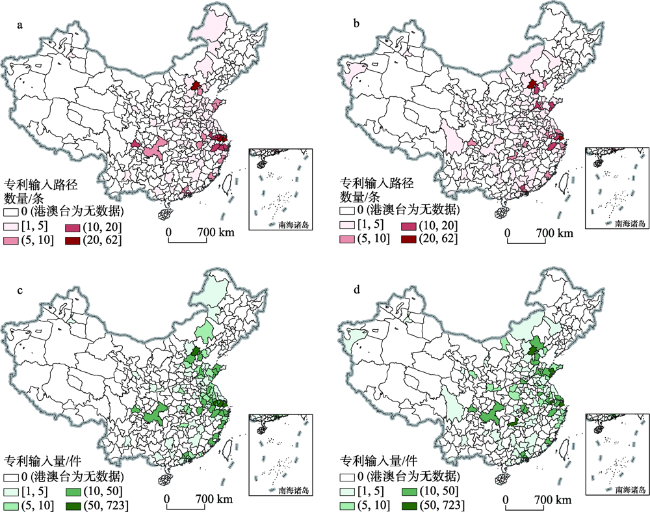
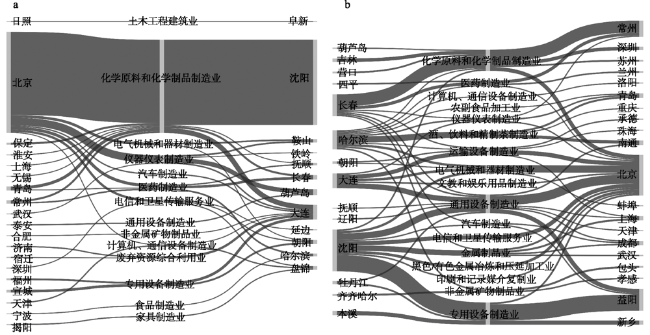
As the Chinese economy entered a “new normal” state, the development of Northeast China suffered keenly. Innovation plays an important role in promoting industrial development. Thus, revealing the industry characteristics and specific paths of innovation resources flow is an important approach for examining industrial development in the region. This study explored the characteristics of flow of innovation resources from the industry and spatial perspectives as well as the mechanism. The results indicate that: (1) Patent transfers in Northeast China have obvious spatial and industry clustering characteristics. The number of patents transferred within the Northeast region is significantly greater than that of cross-regional patent transfer. Patent input and output networks have similar spatial patterns, but the spatial aggregation of the patent input network is significantly higher than that of the patent output network. Patents transferred within the Northeast region are mainly concentrated in equipment manufacturing and heavy chemical industries such as chemical raw materials and chemical product manufacturing, general equipment manufacturing, and the pharmaceutical manufacturing industry. (2) The spatial-industry routes of patent transfer in the Northeast region are mainly concentrated in the equipment manufacturing and heavy chemical industries between the cities of Dalian, Shenyang, Harbin, and Changchun. Cross-regional patent input network shows certain path aggregation characteristics, and 30% of patent transfers are concentrated in the raw materials and chemical product manufacturing from Beijing to Shenyang. In contrast, the number of patents on each patent output path is relatively balanced. (3) The administrative level of the city, the number of innovation carriers, the degree of opening, inter-city innovation cooperation, geographical proximity, industrial development proximity and urban innovation proximity have significant impact on the patent transfer in northeast China. This study can provide some reference for the development of industries in Northeast China.
Key words: innovation; technology transfer; industry; cross-regional; Tobit model; Northeast China
WANG Jiaoe , DU Fangye , JING Yue , DU Delin . Spatial-industry paths of technology transfer: An empirical study of Northeast China[J]. Resources Science, 2022 , 44(2) : 365 -374 . DOI: 10.18402/resci.2022.02.12
表1 变量选择及含义Table 1 Variables and their descriptions |
| 变量名称 | 变量编码 | 含义 |
|---|---|---|
| 因变量 | ||
| 专利转移量 | Patent | 空间—行业路径上的专利数量/件 |
| 城市主体属性 | ||
| 输入城市经济基础 | GDP_D | 2016年专利输入城市GDP/亿元 |
| 输出城市经济基础 | GDP_O | 2016年专利输出城市GDP/亿元 |
| 输入城市科研投入 | R&D_D | 专利输入城市的R&D经费投入/亿元 |
| 输出城市科研投入 | R&D_O | 专利输出城市的R&D经费投入/亿元 |
| 输入城市行政等级 | Lev_D | 虚拟变量:专利输入城市是否为省会或直辖市(0:是;1:否) |
| 输出城市行政等级 | Lev_O | 虚拟变量:专利输出城市是否为省会或直辖市(0:是;1:否) |
| 输入城市创新能力 | Pat_D | 专利输入城市的专利授权量/件 |
| 输出城市创新能力 | Pat_O | 专利输出城市的专利授权量/件 |
| 输入城市创新载体数量 | Plat_D | 专利输入城市的国家重点实验室数量/个 |
| 输出城市创新载体数量 | Plat_O | 专利输出城市的国家重点实验室数量/个 |
| 输入城市对外开放程度 | Open_D | 专利输入城市实际外商投资额/亿元 |
| 输出城市对外开放程度 | Open_O | 专利输出城市实际外商投资额/亿元 |
| 城市间的联系与差异 | ||
| 创新合作基础 | Coop | 专利输出和输入城市的专利合作数量/件 |
| 经济发展基础差异 | Dif_GDP | 专利输出和输入城市GDP的差值/亿元 |
| 行业发展差异 | Dif_PV | 专利输出和输入城市对应行业产值的差值/亿元 |
| 科研投入差异 | Dif_R&D | 专利输出和输入城市R&D经费投入的差值/亿元 |
| 创新能力差异 | Dif_Inn | 专利输出和输入城市专利授权量的差值/件 |
| 邻近性 | ||
| 地理邻近性 | Pro_Geo | 计算两城市间路网距离dij(单位为km),并将其标准化,可得地理邻近性 ,计算公式为: |
| 产业结构邻近性 | Pro_Str | 式中: 和 分别为城市i和城市j行业k的产值比重;n表示行业数量 |
| 城市创新邻近性 | Pro_Inn | 式中: 和 分别为城市i和城市j的专利授权量; 和 分别为权重系数,均采用0.5; 和 分别代表耦合度和协调度 |
表2 2016年东北地区前10条区域内专利转移路径Table 2 Top 10 paths of patent transfer within Northeast China, 2016 |
| 排名 | 输出城市 | 输入城市 | 行业 | 数量/件 | 占东北区域内专利转移量比重/% |
|---|---|---|---|---|---|
| 1 | 沈阳 | 朝阳 | 电气机械和器材制造业 | 15 | 3.7 |
| 2 | 长春 | 大连 | 化学原料和化学制品制造业 | 14 | 3.5 |
| 3 | 哈尔滨 | 鸡西 | 医药制造业 | 12 | 3.0 |
| 4 | 大连 | 沈阳 | 计算机、通信设备制造业 | 11 | 2.7 |
| 5 | 沈阳 | 大连 | 运输设备制造业 | 9 | 2.2 |
| 6 | 长春 | 通化 | 医药制造业 | 8 | 2.0 |
| 7 | 大连 | 营口 | 金属制品业 | 7 | 1.7 |
| 8 | 沈阳 | 长春 | 其他制造业 | 7 | 1.7 |
| 9 | 吉林 | 长春 | 化学原料和化学制品制造业 | 6 | 1.5 |
| 10 | 沈阳 | 抚顺 | 通用设备制造业 | 6 | 1.5 |
| 总计 | 95 | 23.5 |
表3 Tobit回归模型结果Table 3 Results of the Tobit model |
| 变量名称 | 回归系数 |
|---|---|
| 城市主体属性 | |
| 输入城市行政等级 | 2.51** |
| 输出城市行政等级 | 2.42** |
| 输出城市创新载体数量 | 0.04*** |
| 输入城市创新载体数量 | 0.05*** |
| 输出城市对外开放程度 | -1.28e-6 |
| 输入城市对外开放程度 | 1.58e-6*** |
| 城市间合作与差异 | |
| 创新合作 | 0.60** |
| 行业发展差异 | -4.14e-9 |
| 科研投入差异 | 0.01 |
| 创新能力差异 | -0.01** |
| 邻近性 | |
| 地理邻近性 | -0.01** |
| 行业发展邻近性 | -3.25*** |
| 城市创新邻近性 | 81.04*** |
| 样本量 | 454230 |
| 对数似然值 | -7872.4 |
| Likelihood ratio Chi2(df) | 2630.7 |
注:*,**,***分别表示在0.10、0.05、0.01的水平(双侧)上显著。 |
| [1] |
杜德林, 王姣娥, 焦敬娟, 等. 珠三角地区产业与创新协同发展研究[J]. 经济地理, 2020, 40(10):100-107.
[
|
| [2] |
|
| [3] |
|
| [4] |
|
| [5] |
段德忠, 杜德斌, 谌颖, 等. 中国城市创新网络的时空复杂性及生长机制研究[J]. 地理科学, 2018, 38(11):1759-1768.
[
|
| [6] |
|
| [7] |
刘承良, 管明明, 段德忠. 中国城际技术转移网络的空间格局及影响因素[J]. 地理学报, 2018, 73(8):1462-1477.
[
|
| [8] |
刘承良, 牛彩澄. 东北三省城际技术转移网络的空间演化及影响因素[J]. 地理学报, 2019, 74(10):2092-2107.
[
|
| [9] |
|
| [10] |
周灿, 曾刚, 曹贤忠. 中国城市创新网络结构与创新能力研究[J]. 地理研究, 2017, 37(7):1297-1308.
[
|
| [11] |
穆荣平. 德国向中国的技术转移: 上海大众汽车公司案例研究[J]. 科研管理, 1997, 18(6):71-78.
[
|
| [12] |
吕国庆, 曾刚, 郭金龙. 长三角装备制造业产学研创新网络体系的演化分析[J]. 地理科学, 2014, 34(9):1051-1059.
[
|
| [13] |
|
| [14] |
段德忠, 杜德斌, 谌颖, 等. 中国城市创新技术转移格局与影响因素[J]. 地理学报, 2018, 73(4):738-754.
[
|
| [15] |
金凤君, 王姣娥, 杨宇, 等. 东北地区创新发展的突破路径与对策研究[J]. 地理科学, 2016, 36(9):1285-1292.
[
|
| [16] |
宋周莺, 车姝韵, 王姣娥. 东北地区的创新能力演化及其经济带动作用分析[J]. 地理科学, 2016, 36(9):1388-1396.
[
|
| [17] |
焦敬娟, 王姣娥, 刘志高. 东北地区创新资源与产业协同发展研究[J]. 地理科学, 2016, 36(9):1338-1348.
[
|
| [18] |
|
| [19] |
|
| [20] |
程时雄, 刘丹. 企业异质性、东道国特征与对外直接投资进入模式选择[J]. 经济经纬, 2018, 35(4):50-58.
[
|
| [21] |
|
| [22] |
|
| [23] |
|
| [24] |
戴靓, 曹湛, 朱青, 等. 中国城市群知识多中心发展评价[J]. 资源科学, 2021, 43(5):886-897.
[
|
| [25] |
桂钦昌, 杜德斌, 刘承良, 等. 全球城市知识流动网络的结构特征与影响因素[J]. 地理研究, 2021, 40(5):1320-1337.
[
|
| [26] |
盛彦文, 苟倩, 宋金平. 城市群创新联系网络结构与创新效率研究: 以京津冀、长三角、珠三角城市群为例[J]. 地理科学, 2020, 40(11):1831-1839.
[
|
| [27] |
刘承良, 管明明. 基于专利转移网络视角的长三角城市群城际技术流动的时空演化[J]. 地理研究, 2018, 37(5):981-994.
[
|
| [28] |
|
| [29] |
|
| [30] |
|
| [31] |
|
| [32] |
|
| [33] |
闫姗姗, 刘承良. 中国对外技术转移网络的空间演化及其影响因素[J/OL]. 世界地理研究, 2021. https://kns.cnki.net/kcms/detail/31.1626.p.20210506.1544.006.html.
[
|
| [34] |
|
| [35] |
|
| [36] |
周密, 孙浬阳. 专利权转移、空间网络与京津冀协同创新研究[J]. 科学学研究, 2016, 34(11):1736-1743.
[
|
| [37] |
国家知识产权局. 国际专利分类与国民经济行业分类参照关系表[S]. 北京: 国家知识产权局办公室, 2018.
[National Intellectual Property Administration. Reference Table of International Patent Classification and National Economy Industry Classification[S]. Beijing: Office of National Intellectual Property Administration, 2018.]
|
| [38] |
龙云, 任力. 农地流转制度对农户耕地质量保护行为的影响: 基于湖南省田野调查的实证研究[J]. 资源科学, 2017, 39(11):2094-2103.
[
|
| [39] |
|
| [40] |
肖凡, 陈家麟, 夏丽丽, 等. 伴随资金流的技术溢出-股东技术水平对高新技术企业创新的影响[J]. 地理科学, 2020, 40(9):1460-1467.
[
|
/
| 〈 |
|
〉 |