Forecast on China’s cultivated land protection baseline in the new era by multi- scenario simulations
Received date: 2020-11-01
Request revised date: 2021-01-03
Online published: 2021-08-25
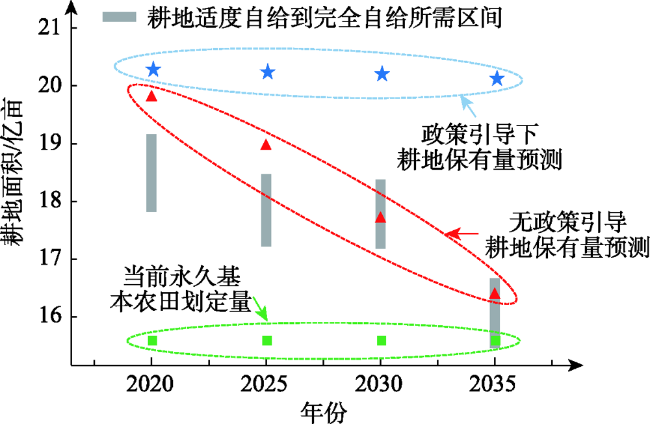
Cultivated land is the cornerstone of national food security. However, there have been debates about how much cultivated land should be preserved to meet the bottom line of China’s food demand in the new era. Therefore, this study started from clarifying the minimum demand of cultivated land under different scenarios. A prediction model was constructed, which considered population, grain consumption per capita, and grain yield per unit cultivated area. Then, the cultivated land demand was simulated under three scenarios completely self-sufficient, highly self-sufficient, and moderately self-sufficient. Combining with the prediction of the cultivated land change, cultivated land protection was proposed at three levels, including the ideal amount that could be protected (IACP), the basic amount that should be protected (BASP), and the minimum amount that must be protected (MAMP). The results show that: in 2020, 2025, 2030, and 2035, the IACP requires to preserve at least 1.920 billion, 1.839 billion, 1.847 billion and 1.657 billion mu, respectively; the BASP requires to preserve at least 1.849 billion, 1.772 billion, 1.778 billion and 1.612 billion mu, respectively; the MAMP requires to preserve at least 1.780 billion, 1.709 billion, 1.709 billion and 1.551 billion mu, respectively. There into, the BASP of cultivated land may be chosen as a rational strategy of protection. However, if the strict control policy is abandoned in the future, it will be difficult to meet the demand of completely self-sufficient in grain production in 2030 and 2035. Therefore, differentiated,continuous and strict policy of land protection should be implemented to ensure food security in China.
YU Haochen , ZENG Siyan , WANG Qingbin , DAI Jin , BIAN Zhengfu , CHEN Fu . Forecast on China’s cultivated land protection baseline in the new era by multi- scenario simulations[J]. Resources Science, 2021 , 43(6) : 1222 -1233 . DOI: 10.18402/resci.2021.06.13
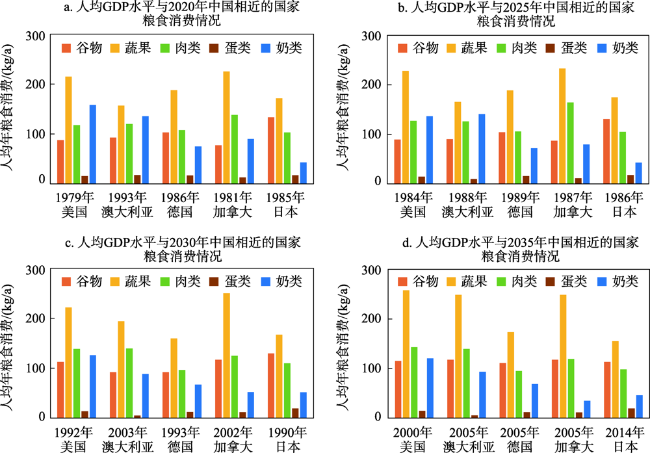
图2 2020—2035年与中国相近人均GDP的发达国家粮食消费结构注:横轴代表与中国预测年份人均GDP相近的某一国家的对应年份。 Figure 2 Grain consumption structure of developed countries with per capita GDP similar to that of China, 2020-2035 |
表1 2020—2035年中国人均粮食需求Table 1 China’s per capita grain demand, 2020-2035 (kg/a) |
| 年份 | 口粮 | 其他用粮 | 合计 | |||
|---|---|---|---|---|---|---|
| 饲料用粮(耕地部分) | 工业用粮 | 种子用粮 | 过程损耗 | |||
| 2020 | 130.12 | 207.66 | 64.20 | 6.45 | 24.23 | 432.66 |
| 2025 | 126.58 | 210.88 | 68.80 | 6.39 | 24.23 | 436.88 |
| 2030 | 120.49 | 232.91 | 73.90 | 6.38 | 24.23 | 457.91 |
| 2035 | 114.86 | 219.80 | 79.50 | 6.41 | 24.23 | 444.80 |
表2 不同粮食自给情景下2020—2035年中国耕地需求量Table 2 Cultivated land demand in China under different grain self-sufficient scenarios, 2020-2035 |
| 方案 | 情景设定 | 耕地需求量/亿亩 | |||
|---|---|---|---|---|---|
| 2020年 | 2025年 | 2030年 | 2035年 | ||
| 完全自给 | 口粮100%,其他用粮100% | 19.20 | 18.39 | 18.47 | 16.75 |
| 高度自给 | 口粮100%,其他用粮95% | 18.49 | 17.72 | 17.78 | 16.12 |
| 适度自给 | 口粮100%,其他用粮90% | 17.80 | 17.09 | 17.09 | 15.48 |
| [1] |
魏泳安. 习近平新时代粮食安全观研究[J]. 上海经济研究, 2020, (6):14-23.
[
|
| [2] |
|
| [3] |
|
| [4] |
于昊辰, 卞正富. 耕地的适度对外依存及其应对策略[J]. 土地科学动态, 2020, (4):36-39.
[
|
| [5] |
|
| [6] |
Department of Economic and Social Affairs, United Nations. World Population Prospects: The 2017 Revision[R/OL]. ( 2017-06-21) [2020-11-01]. https://www.un.org/zh/node/89760.
|
| [7] |
|
| [8] |
|
| [9] |
李效顺, 蒋冬梅, 卞正富. 基于粮食安全视角的中国耕地资源盈亏测算[J]. 资源科学, 2014, 36(10):2057-2065.
[
|
| [10] |
苏越. 耕地非粮化时空演变与管控研究[D]. 杭州: 浙江大学, 2020.
[
|
| [11] |
曾思燕, 于昊辰, 马静, 等. 中国耕地表层土壤重金属污染状况评判及休耕空间权衡[J/OL]. 土壤学报, ( 2021-04-01) [2021-04-02]. https://kns.cnki.net/kcms/detail/32.1119.P.20210331.1104.006.html
[
|
| [12] |
孙强, 蔡运龙. 日本耕地保护与土地管理的历史经验及其对中国的启示[J]. 北京大学学报(自然科学版), 2008, 44(2):249-256.
[
|
| [13] |
|
| [14] |
|
| [15] |
牛善栋, 方斌. 中国耕地保护制度70年: 历史嬗变、现实探源及路径优化[J]. 中国土地科学, 2019, 33(10):1-12.
[
|
| [16] |
漆信贤, 张志宏, 黄贤金. 面向新时代的耕地保护矛盾与创新应对[J]. 中国土地科学, 2018, 32(8):9-15.
[
|
| [17] |
汤怀志, 桑玲玲, 郧文聚. 中国耕地占补平衡政策实施困境及科技创新方向[J]. 中国科学院院刊, 2020, 35(5):637-644.
[
|
| [18] |
|
| [19] |
|
| [20] |
于昊辰, 卞正富, 陈浮. 矿山土地生态动态恢复机制: 基于LDN框架的分析[J]. 中国土地科学, 2020, 34(9):79-88.
[
|
| [21] |
任玉霜, 孙灵柱, 吕康银. 中国粮食虚拟土地进口效应分析: 基于2000-2018年的贸易数据[J]. 世界农业, 2020, (8):78-85.
[
|
| [22] |
|
| [23] |
王文旭, 曹银贵, 苏锐清, 等. 基于政策量化的中国耕地保护政策演进过程[J]. 中国土地科学, 2020, 34(7):69-78.
[
|
| [24] |
|
| [25] |
吴宇哲, 许智钇. 休养生息制度背景下的耕地保护转型研究[J]. 资源科学, 2019, 41(1):9-22.
[
|
| [26] |
蔡运龙, 傅泽强, 戴尔阜. 区域最小人均耕地面积与耕地资源调控[J]. 地理学报, 2002, 57(2):127-134.
[
|
| [27] |
赵姚阳, 王洁, 张莉, 等. 粮食安全新政背景下保障中国谷物基本自给的耕地需求研究[J]. 干旱区资源与环境, 2015, 29(8):1-6.
[
|
| [28] |
马云倩, 郭燕枝, 王秀丽, 等. 基于LASSO与GM(1, N)模型的中国粮食产量预测[J]. 干旱区资源与环境, 2018, 32(7):30-35.
[
|
| [29] |
梁姝娜, 张友祥, 王学稹. 基于BP神经网络和Logistic模型的中国人均粮食产量预测研究[J]. 华南师范大学学报(社会科学版), 2015, (5):102-106.
[
|
| [30] |
肖丽群, 吴群. 基于脱钩指数的2020年江苏省耕地保有量目标分析[J]. 资源科学, 2012, 34(3):442-448.
[
|
| [31] |
杨明智, 裴源生, 李旭东. 中国粮食自给率研究: 粮食、谷物和口粮自给率分析[J]. 自然资源学报, 2019, 34(4):881-889.
[
|
| [32] |
辛翔飞, 王济民. 中国粮食自给水平目标设定: 研究综述与政策启示[J]. 自然资源学报, 2019, 34(11):2257-2269.
[
|
| [33] |
胡鞍钢. 立足国内基本自给适度进口促进交换: 中国21世纪粮食战略的基本选择[J]. 经济研究参考, 1997, (67):24-27.
[
|
| [34] |
农业部软科学委员会办公室. 粮食安全与重要农产品供给[M]. 北京: 中国财政经济出版社, 2013.
[Office of Ministry of Agriculture Soft Science Committee. Food Security and the Supply of Major Agricultural Products[M]. Beijing: China Agricultural Press, 2013.]
|
| [35] |
|
| [36] |
赵玉峰, 杨宜勇. 中国中长期人口发展趋势及潜在风险[J]. 宏观经济管理, 2019, (8):11-17.
[
|
| [37] |
朱嘉伟, 周琳琳, 谢晓彤. 单产提升潜力衰减模型法在河南粮食单产中长期预测中的应用研究[J]. 自然资源学报, 2017, 32(9):1627-1638.
[
|
| [38] |
|
| [39] |
辛良杰, 王佳月, 王立新. 基于居民膳食结构演变的中国粮食需求量研究[J]. 资源科学, 2015, 37(7):1347-1356.
[
|
| [40] |
国家发展和改革委员会价格司. 全国农产品成本收益资料汇编-2017[M]. 北京: 中国统计出版社, 2017.
[Department of Price in National Development and Reform Commission. Compile of Cost-benefit Data of Agricultural Products in 2017[M]. Beijing: Statistics Press in China, 2017.]
|
| [41] |
何安华, 刘同山, 张云华. 中国粮食产后损耗及其对粮食安全的影响[J]. 中国物价, 2013, (6):79-82.
[
|
| [42] |
黄成毅, 邓良基, 方从刚. 基于灰色-马尔柯夫模型的区域耕地变化预测研究: 以四川盆地中部丘陵区为例[J]. 四川师范大学学报(自然科学版), 2009, 32(6):816-821.
[
|
| [43] |
张模蕴, 肖国安. 基于优化灰色模型的湖南省粮食产量预测方法改进研究[J]. 湘潭大学学报(哲学社会科学版), 2020, 44(3):118-122.
[
|
| [44] |
赵素霞, 牛海鹏. 基于灰色马尔科夫模型的河南省耕地压力状况研究[J]. 干旱区资源与环境, 2015, 29(8):46-51.
[
|
| [45] |
中国营养学会. 中国居民膳食指南[M]. 北京: 人民卫生出版社, 2018.
[Chinese Nutrition Society. Dietary Guidelines for Chinese Residents[M]. Beijing: People’s Medical Publishing House, 2018.]
|
| [46] |
徐羽, 辛良杰. 中国粮食生产的国际竞争力研究[J]. 生态与农村环境学报, 2020, 36(10):1243-1250.
[
|
| [47] |
韩璟, 卢新海, 匡兵. 中国海外耕地投资东道国的空间分布及地缘关系因素影响路径分析[J]. 中国土地科学, 2020, 34(10):79-88.
[
|
| [48] |
蒋瑜, 濮励杰, 朱明, 等. 中国耕地占补平衡研究进展与述评[J]. 资源科学, 2019, 41(12):2342-2355.
[
|
| [49] |
|
| [50] |
严金明, 赵哲, 夏方舟. 后疫情时代中国“自然资源安全之治”的战略思考[J]. 中国土地科学, 2020, 34(7):1-8.
[
|
| [51] |
王晓君, 何亚萍, 蒋和平. “十四五”时期的中国粮食安全: 形势、问题与对策[J]. 改革, 2020, (9):27-39.
[
|
| [52] |
|
| [53] |
张全景, 吕晓, 于伟. 农地流转的障碍因素与政策创新研究: 新型城镇化背景下山东省的实证[M]. 北京: 北京师范大学出版社, 2018.
[
|
| [54] |
宋小青, 欧阳竹. 1999-2007年中国粮食安全的关键影响因素[J]. 地理学报, 2012, 67(6):793-803.
[
|
/
| 〈 |
|
〉 |