Effects of high-speed rail on urban land use from the perspective of “space of flows”:An analysis based on DPSIR-PLS model
Received date: 2019-06-05
Request revised date: 2019-08-10
Online published: 2019-12-25
The purpose of this study is to analyze the mechanisms and pathways of impact of high-speed rail on urban land use, using the DPSIR (driving forces, pressures, state, impact, responses) conceptual model and PLS-SEM (partial least squares structural equation modeling). The aim is to construct an interpretive framework of the impact of high-speed railway on urban land use from the perspective of “space of flows” It is found that the key pathway of high-speed railway affecting urban land use is “high-speed railway-production factors-land use state-land use comprehensive benefits-local government response.” High-speed railway can change urban land use status, affect the comprehensive benefits of land use, and compel the local government to take corresponding measures through various production factors. The high-speed railway factor represented by the number of stations, the number of routes, and the total mileage is positively correlated with all kinds of production factors, including people, land, capital, and technology. Production factors can exert positive effects on both urban land use status and land use comprehensive benefits. The comprehensive benefits of land use positively stimulate local governments, while land use status has no significant effect on land use efficiency. Therefore, in the future construction of high-speed rail and urban development process, the positive effect of high-speed railway should be brought into play. The government can take high-speed railway development as an opportunity to optimize the urban land use pattern and promote the comprehensive benefits of land use through various incentive measures, thus realizing the optimization of urban land use systems.
ZHU Xinhua , ZHONG Sujuan . Effects of high-speed rail on urban land use from the perspective of “space of flows”:An analysis based on DPSIR-PLS model[J]. Resources Science, 2019 , 41(12) : 2262 -2273 . DOI: 10.18402/resci.2019.12.10
表1 城市土地利用指标体系及模型初次运行显著性检验结果Table 1 Evaluation index system of urban land use and the significance test result of initial run of the model |
| 潜变量层 | 变量 | 测量指标 | 文献来源 | 路径系数 | |
|---|---|---|---|---|---|
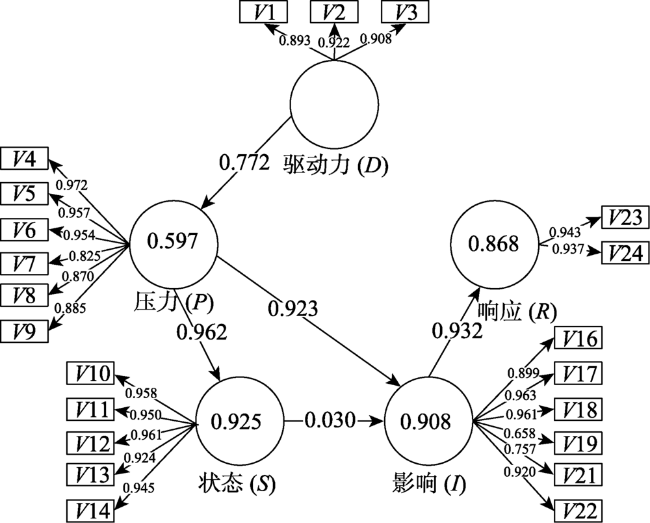
| 驱动力 | 高铁 | V1 | 高铁站数量/个 | Meijers[6]、张明志等[35] | 0.893*** |
| V2 | 高铁线路数量/条 | 卢新海等[36] | 0.922*** | ||
| V3 | 区域内高铁线路总里程/km | 江激宇等[37] | 0.908*** | ||
| 压力 | 人 | V4 | 第二、三产业就业人数/万人 | 卢新海等[36]、江激宇等[37] | 0.972*** |
| 土地 | V5 | 建成区面积/km2 | 梁建飞等[43] | 0.957*** | |
| 资金 | V6 | 公共财政支出/亿元 | 刘芳等[38] | 0.954*** | |
| V7 | 全社会固定资产投资总额/亿元 | 周博等[39] | 0.825*** | ||
| 技术 | V8 | 地均科技支出/(万元/km2) | 周博等[39] | 0.869*** | |
| 信息 | V9 | 邮电业务总量/亿元 | 周博等[39] | 0.886*** | |
| 状态 | 土地利用现状 | V10 | 房价水平/(元/m2) | 刘修岩等[40] | 0.957*** |
| V11 | 建设用地指数=建设用地面积/土地总面积/% | 钟少华等[41] | 0.950*** | ||
| V12 | 工业用地面积/km2 | 钟少华等[41] | 0.961*** | ||
| V13 | 道路交通设施用地/km2 | 钟少华等[41] | 0.925*** | ||
| V14 | 绿地与广场面积/km2 | 周博等[39]、胡碧霞等[42] | 0.946*** | ||
| V15 | 人均住房面积/(m2/人) | 梁建飞等[43]、Fornell等[45] | -0.003 | ||
| 影响 | 土地利用效益 | V16 | 区域人口密度=常住人口/总面积/(人/m2) | 刘芳等[38] | 0.897*** |
| V17 | 地均GDP/(万元/km2) | 张秋月等[13]、江激宇等[37] | 0.962*** | ||
| V18 | 公共财政收入/亿元 | 吴一凡等[2] | 0.959*** | ||
| V19 | 城镇居民人均可支配收入/元 | 钟少华等[41] | 0.664*** | ||
| V20 | 建成区绿化覆盖率/% | 郑金[14]、周博等[39] | -0.283 | ||
| V21 | 工业废气排放总量/亿m3 | 梁建飞等[43] | 0.756*** | ||
| V22 | 工业废水排放总量/万t | 梁建飞等[43] | 0.917*** | ||
| 响应 | 应对措施 | V23 | 节能环保支出/亿元 | 梁建飞等[43] | 0.936*** |
| V24 | 交通运输支出/亿元 | 何旭[44] | 0.912*** | ||
| V25 | 一般工业固体废物综合利用率/% | 钟少华等[41] | -0.076 | ||
| V26 | 生活污水处理率/% | 刘芳等[38] | 0.398 | ||
注:***指在0.001的水平上显著。 |
表2 测量模型信度检验指标及结果Table 2 Reliability test result of the measurement model |
| Cronbach’α | CR | AVE | |
|---|---|---|---|
| 驱动力(D) | 0.896 | 0.933 | 0.824 |
| 压力(P) | 0.959 | 0.967 | 0.832 |
| 状态(S) | 0.972 | 0.978 | 0.899 |
| 影响(I) | 0.930 | 0.947 | 0.752 |
| 响应(R) | 0.869 | 0.938 | 0.884 |
表3 测量模型区别效度检验结果Table 3 Discriminative validity test result of the measurement model |
| 压力(P) | 响应(R) | 影响(I) | 状态(S) | 驱动力(D) | |
|---|---|---|---|---|---|
| 压力(P) | 0.912 | ||||
| 响应(R) | 0.937 | 0.940 | |||
| 影响(I) | 0.867 | 0.932 | 0.953 | ||
| 状态(S) | 0.948 | 0.914 | 0.918 | 0.962 | |
| 驱动力(D) | 0.772 | 0.654 | 0.693 | 0.824 | 0.908 |
注:对角线为AVE平方根数值,其余为相关系数。 |
表4 研究假设检验结果Table 4 Research hypothesis test results |
| 研究假设 | 路径系数 | T值 | 假设检验结果 |
|---|---|---|---|
| H1:驱动力(D)→压力(P) | 0.722*** | 8.647 | 接受 |
| H2:压力(P)→状态(S) | 0.962*** | 26.674 | 接受 |
| H3:压力(P)→影响(I) | 0.923*** | 3.882 | 接受 |
| H4:状态(S)→影响(I) | 0.03 | 0.119 | 拒绝 |
| H5:影响(I)→响应(R) | 0.932*** | 12.224 | 接受 |
| [1] |
中共中央国务院. 国家新型城镇化规划(2014-2020)[EB/OL]. ( 2014- 03- 16) [2019-11-24]. http://www.gov.cn/xinwen/2014-03/16/content_2639841.html.
[ CPC Central Committee and State Council. National New Urbanization Plan(2014-2020) [EB/OL]. ( 2014- 03- 16) [2019-11-24]. http://www.gov.cn/xinwen/2014-03/16/content_2639841.html.]
|
| [2] |
吴一凡, 刘彦随, 李裕瑞 . 中国人口与土地城镇化时空耦合特征及驱动机制[J]. 地理学报, 2018,73(10):1865-1879.
[
|
| [3] |
|
| [4] |
沈丽珍, 顾朝林 . 区域流动空间整合与全球城市网络构建[J]. 地理科学, 2009,29(6):787-793.
[
|
| [5] |
|
| [6] |
|
| [7] |
|
| [8] |
杨跃龙, 韩笋生 . 从功能规划到战略规划: 高速铁路车站建设与城市发展研究评述[EB/OL]. ( 2019- 03- 13) [2019-11-24]. http://www.doc88.com/p-4661791451440.html.
[
|
| [9] |
梅林, 王丽艳 . 高铁网络下我国城市通达性与土地利用效率关系研究[J]. 经济问题探索, 2017, ( 12):102-109.
[
|
| [10] |
崔学刚, 方创琳, 张蔷 . 山东半岛城市群高速交通优势度与土地利用效率的空间关系[J]. 地理学报, 2018,73(6):1149-1161.
[
|
| [11] |
管京, 史旭敏 . 我国新建高铁站区综合开发中土地增值收益分配机制研究[J]. 城市发展研究, 2018,25(5):52-58.
[
|
| [12] |
周玉龙, 杨继东, 黄阳华 , 等. 高铁对城市地价的影响及其机制研究: 来自微观土地交易的证据[J]. 中国工业经济, 2018, ( 5):118-136.
[
|
| [13] |
张秋月, 张春梅 . 多约束背景下广西城市土地利用效率及变化分析[J]. 河南科学, 2019,37(2):314-319.
[
|
| [14] |
郑金 . 城市土地节约集约利用评价与规划实践: 以武汉市汉阳区为例[J]. 中国土地, 2019, ( 2):43-44.
[
|
| [15] |
林坚, 马俊青, 张叶笑 . 2017年土地科学研究重点进展评述及2018年展望: 土地资源、利用与规划分报告[J]. 中国土地科学, 2018,32(3):81-88.
[
|
| [16] |
吕永刚, 吴勇民 . 高铁效应与长三角经济地理格局重塑: 基于新产业革命的视角[J]. 现代经济探讨, 2019, ( 9):74-77.
[
|
| [17] |
高晓路, 许泽宁, 牛方曲 . 基于“点—轴系统”理论的城市群边界识别[J]. 地理科学进展, 2015,34(3):280-289.
[
|
| [18] |
杨荫凯, 韩增林 . 交通经济带的基本理论探讨[J]. 人文地理, 1999,14(2):6-10.
[
|
| [19] |
|
| [20] |
徐志伟, 宋佳 . 扩散还是回流: 中国高铁的经济空间分布重塑效应[J]. 华东经济管理, 2019,33(2):71-78.
[
|
| [21] |
韩会然, 杨成凤, 宋金平 . 北京市土地利用空间格局演化模拟及预测[J]. 地理科学进展, 2015,34(8):976-986.
[
|
| [22] |
陈佩虹, 王稼琼 . 交通与土地利用模型: 劳瑞模型的理论基础及改进形式[J]. 生产力研究, 2007, ( 14):77-80.
[
|
| [23] |
朱桃杏, 朱正国, 任建新 . 京津冀区域高铁工程与土地利用变化关系研究[J]. 铁道工程学报, 2018,35(1):100-105.
[
|
| [24] |
樊晓娟, 张永庆 . 京沪高铁对沿线城市经济集聚的影响研究[J]. 物流科技, 2018,41(12):108-111.
[
|
| [25] |
|
| [26] |
|
| [27] |
楼东, 夏梁省 . 流空间视角的浙江省城市网络研究[J]. 当代经济, 2019, ( 1):68-70.
[
|
| [28] |
贾宁凤, 曹蓉, 王晓雅 . 区域生态和经济系统耦合效应下的土地利用优化配置: 以山西省宁武县为例[J]. 山西大学学报(自然科学版), 2019,42(2):454-464.
[
|
| [29] |
|
| [30] |
朱文娟, 孙华 . 江苏省土地利用效益系统耦合相对发展演变研究[J]. 土壤通报, 2019,50(3):520-528.
[
|
| [31] |
单葆国, 邵玺, 余姗 , 等. 中国城市蔓延阶段特征及驱动因素分析[J]. 地球信息科学学报, 2018,20(3):302-310.
[
|
| [32] |
中华人民共和国自然资源部. 节约集约利用土地规定[EB/OL]. ( 2019- 08- 13) [2019-11-24]. http://f.mnr.gov.cn/201908/t20190813_2458552.html.
[ Ministry of Natural Resource of the People’s Republic of China. Regulations on the Economical and Intensive Use of Land[EB/OL]. ( 2019- 08- 13) [2019-11-24]. http://f.mnr.gov.cn/201908/t20190813_2458552.html.]
|
| [33] |
江苏自然资源. 江苏省出台推进国土资源生态文明建设的意见[EB/OL]. ( 2016- 07- 06) [2019-11-24]. http://zrzy.jiangsu.gov.cn/xwzx/mtsy/2016/07/06171955449767.html.
[ Jiangsu Natural Resources. Opinions of the Jiangsu Provincial Department of Land and Resources on Promoting the Construction of Ecological Civilization of Land [EB/OL]. ( 2016- 07- 06) [2019-11-24]. http://zrzy.jiangsu.gov.cn/xwzx/mtsy/2016/07/06171955449767.html.]
|
| [34] |
|
| [35] |
张明志, 余东华, 孙媛媛 . 高铁开通对城市人口分布格局的重塑效应研究[J]. 中国人口科学, 2018, ( 5):94-108.
[
|
| [36] |
卢新海, 陈丹玲, 匡兵 . 产业一体化与城市土地利用效率的时空耦合效应: 以长江中游城市群为例[J]. 中国土地科学, 2018,32(9):66-73.
[
|
| [37] |
江激宇, 李啸, 章丽萍 . 基于PSR模型的城市土地集约利用评价研究: 以安徽省为例[J]. 辽宁工业大学学报(社会科学版), 2019,21(2):17-20.
[
|
| [38] |
刘芳, 钟太洋 . 城市人口规模、空间扩张与人均公共财政支出: 基于全国285个城市面板数据分析[J]. 地域研究与开发, 2019,38(2):61-65.
[
|
| [39] |
周博, 杜晓霞, 马林兵 , 等. 基于PSR模型的土地利用系统健康动态评价[J]. 中山大学学报(自然科学版), 2018,57(4):9-15.
[
|
| [40] |
刘修岩, 杜聪, 李松林 . 自然地理约束、土地利用规制与中国住房供给弹性[J]. 经济研究, 2019,54(4):99-115.
[
|
| [41] |
钟少华, 时鹏, 杨文刚 , 等. 基于PSR模型的土地利用系统健康评价及障碍因子诊断: 以延长县为例[J]. 水土保持研究, 2019,26(2):283-289.
[
|
| [42] |
胡碧霞, 李菁, 匡兵 . 绿色发展理念下城市土地利用效率差异的演进特征及影响因素[J]. 经济地理, 2018,38(12):183-189.
[
|
| [43] |
梁建飞, 陈松林 . 厦门市土地利用多功能性评价及障碍因子诊断[J]. 亚热带资源与环境学报, 2019,14(1):87-95.
[
|
| [44] |
何旭 . 协同发展背景下京津冀财政支出结构优化分析[D]. 北京: 中国财政科学研究院, 2018.
[
|
| [45] |
|
| [46] |
|
| [47] |
|
| [48] |
隋同周 . 长三角高铁建设给城市发展“提速”[EB/OL]. ( 2019- 03- 05) [2019-11-24]. http://news.tielu.cn/pinglun/2019-03-05/183194.html.
[
|
| [49] |
武前波, 陶娇娇, 吴康 , 等. 长江三角洲高铁日常通勤行为特征研究: 以沪杭、宁杭、杭甬线为例[J]. 城市规划, 2018,42(8):90-97.
[
|
| [50] |
李峰清 . 基于高铁网络的我国城镇化空间模式再探: 基于上海-长三角腹地的检验及辨析[J]. 城市规划, 2018,42(3):109-117.
[
|
| [51] |
陆应果, 郑伟哉 . 长三角铁路建设加快步伐助力区域一体化[J]. 上海企业, 2019. 436(3):25-26.
[
|
| [52] |
侯鹏, 孟宪生 . 新时代我国区域经济一体化的空间战略[J]. 甘肃社会科学, 2019, ( 2):196-203.
[
|
| [53] |
王启轩, 张艺帅, 程遥 . 信息流视角下长三角城市群空间组织辨析及其规划启示: 基于百度指数的城市网络辨析[J]. 城市规划学刊, 2018, ( 3):105-112.
[
|
| [54] |
刘西忠 . 沪浙皖推动一体化发展的现实启示[J]. 群众, 2019, ( 5) : 16-18.
[
|
| [55] |
赵燕菁 . 阶段与转型: 走向质量型增长[J]. 城市规划, 2018,42(2):9-18.
[
|
| [56] |
赵燕菁 . 土地财政:历史、 逻辑与抉择[J]. 城市发展研究, 2014,21(1):1-13.
[
|
/
| 〈 |
|
〉 |