Spatial distribution and temporal changes of facility agriculture on the Tibetan Plateau
Received date: 2018-12-19
Request revised date: 2019-01-13
Online published: 2019-06-25
Copyright
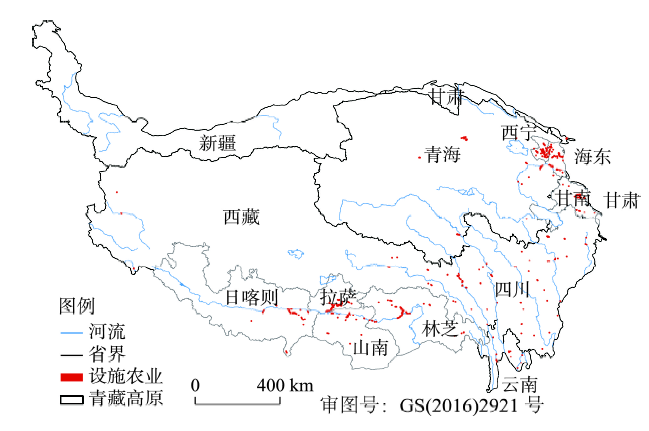
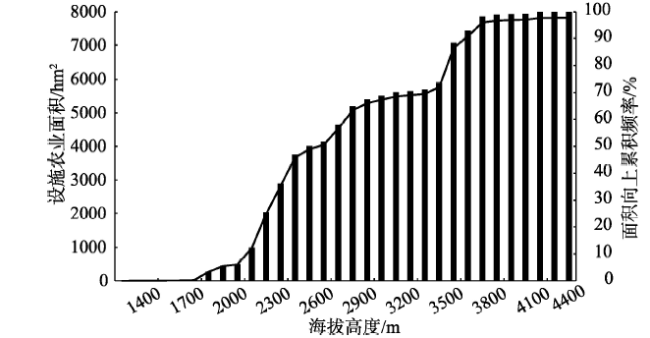
During the past decade, the rapid growth of facility agriculture has been a new highlight of agricultural development in the Tibetan Plateau. Revealing the spatial distribution and change characteristics of facility agriculture is helpful for understanding its development trend and can provide supports for its planning and spatial layout on the plateau. Based on the high-resolution imagery data of Google Earth in 2018, this study obtained and revealed the spatial distribution of facility agriculture on the plateau by visual interpretation combined with geostatistical analysis. Further, the spatiotemporal changes of facility agriculture in Xining and Lhasa Cities were analyzed based on high-resolution images of 2008 and 2018. The results show that: (1) In 2018, the total area of facility agriculture on the Tibetan Plateau was 7821.74 hm2, mainly distributed at the periphery of cities in river basins, roughly in line with the rivers. Of the total facility agriculture lands, 58.10% was distributed in Qinghai Province and 36.49% in Tibet Autonomous Region; (2) Facility agriculture showed a significant altitudinal differentiation under the influence of topographic factors. The land was distributed between 1400 m and 4600 m, mostly concentrated in two elevation zones of 2200~2600 m and 3600~3700 m; (3) Facility agriculture grew rapidly in Xining and Lhasa Cities from 2008 to 2018, with the area increased from 293.73 hm2 and 429.01 hm2 to 2111.45 hm2 and 1422.30 hm2, respectively. At the same time, more than 60% of facility agriculture lands in the urban areas was occupied by built-up land, resulting in significant changes in the spatial pattern; (4) There is a good prospect for the development of facility agriculture in the region because of strongly anticipated growing demands for vegetables and melons driven by the rapid urbanization and tourism development. To that end, a general planning for facility agricultural development is needed in order to avoid the lands being frequently changed and resulting in wasteful use, improve the situation of highly depending on single type of greenhouses, and avoid possible ecological problems such as plastic pollution.
WEI Hui , LV Changhe , LIU Yaqun , YANG Kaijie . Spatial distribution and temporal changes of facility agriculture on the Tibetan Plateau[J]. Resources Science, 2019 , 41(6) : 1093 -1101 . DOI: 10.18402/resci.2019.06.08
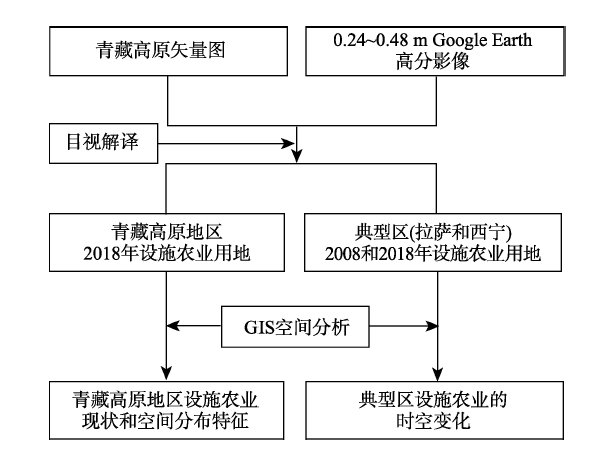
Figure 1 Technical roadmap of the study图1 研究技术路线图 |
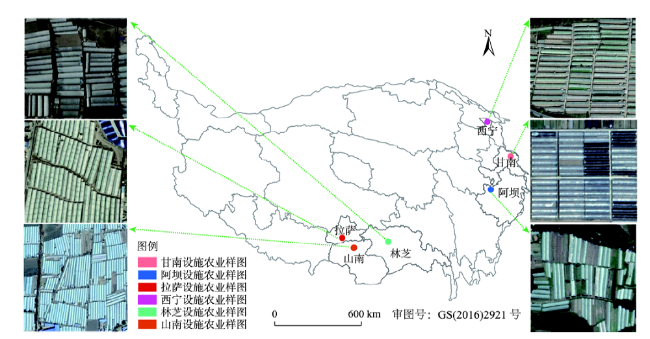
Figure 2 Sample images of facility agriculture on the Tibetan Plateau图2 青藏高原设施农业高分影像图示 |
Figure 3 Spatial distribution of facility agriculture on the Tibetan Plateau, 2018图3 2018年青藏高原设施农业空间分布 |
Table 1 Distribution of facility agriculture in provinces/autonomous region of the Tibetan Plateau表1 青藏高原设施农业在各省区的分布情况 |
| 省区 | 设施农业面积/hm² | 面积占比/% |
|---|---|---|
| 青海 | 4544.56 | 58.10 |
| 甘肃 | 225.92 | 2.89 |
| 西藏 | 2854.46 | 36.49 |
| 四川 | 154.04 | 1.97 |
| 云南 | 42.76 | 0.55 |
Figure 4 Distribution of facility agriculture in different elevation zones on the Tibetan Plateau图4 青藏高原不同海拔梯度下的设施农业分布情况 |
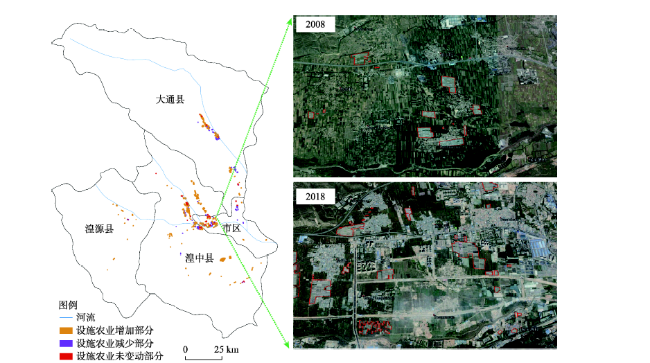
Figure 5 Spatiotemporal changes of facility agriculture in Xining City, 2008-2018图5 2008—2018年西宁市设施农业的时空变化 |
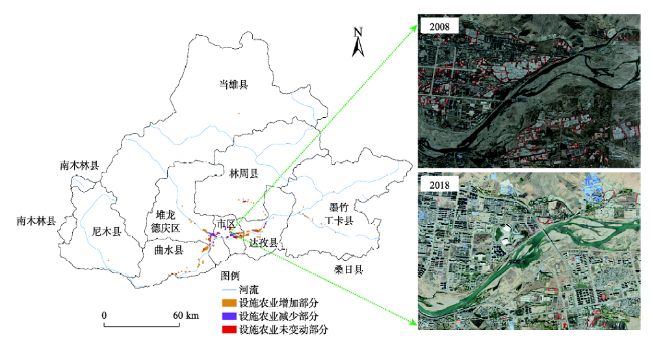
Figure 6 Spatiotemporal changes of facility agriculture in Lhasa City, 2008-2018图6 2008—2018年拉萨市设施农业的时空变化 |
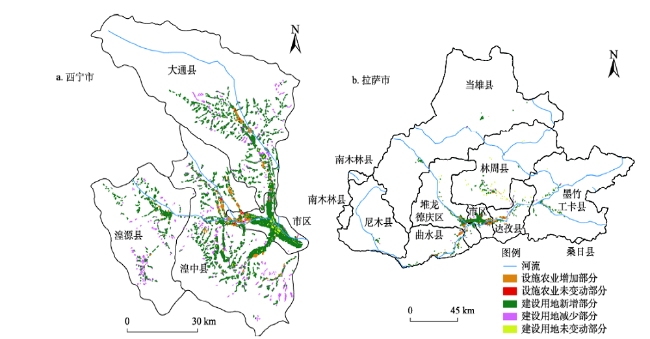
Figure 7 Spatial relationship between facility agriculture development and construction land expansion图7 设施农业发展与建设用地扩张的空间关系 |
The authors have declared that no competing interests exist.
| [1] |
[
|
| [2] |
[
|
| [3] |
[
|
| [4] |
[
|
| [5] |
[
|
| [6] |
[
|
| [7] |
[
|
| [8] |
[
|
| [9] |
[
|
| [10] |
[
|
| [11] |
[
|
| [12] |
[
|
| [13] |
[
|
| [14] |
[
|
| [15] |
[
|
| [16] |
郭正模. 设施农业:西藏高原核心农区发展: “立体农业”的基本模式选择[J]. 决策咨询, 2014, (6): 17-21.
[
|
| [17] |
[
|
| [18] |
[
|
| [19] |
[
|
| [20] |
[
|
| [21] |
[
|
| [22] |
[
|
| [23] |
[
|
| [24] |
[
|
| [25] |
[
|
| [26] |
[
|
| [27] |
[
|
| [28] |
|
| [29] |
[
|
| [30] |
[
|
| [31] |
[
|
| [32] |
[
|
| [33] |
[
|
| [34] |
中华人民共和国国家质量监督检验检疫总局. GB/T 25413-2010: 农田地膜残留量限值及测定[S]. 北京: 中国标准出版社, 2011.
[General Administration of Quality Supervision,Inspection and Quarantine of the People’s Republic of China. GB/T 25413-2010: Limit and Test Method for Residual Quantity of Agricultural Mulch Film[S]. Beijing: Standards Press of China, 2011.]
|
| [35] |
[
|
/
| 〈 |
|
〉 |