Study on spatial distribution and its influencing factors of natural tourism resource in China-Mongolia-Russia Economic Corridor
Received date: 2018-04-23
Request revised date: 2018-10-09
Online published: 2018-11-12
Copyright
Tourism resources are the foundation of the development of tourism. The integration of cross-border tourism resources and the co-construction of cooperation model are the important issues of "the Belt and Road" national strategy. Using the nearest neighbor index, geographic concentration index, Gini coefficient, kernel density analysis, and other mathematical and spatial analysis methods, the spatial pattern and influencing factors of the natural tourism resources in China-Mongolia-Russia Economic Corridor of "the Belt and Road" are identified and characterized. The conclusions can be drawn as the following: (1) The natural tourism resources of the China-Mongolia-Russia Economic Corridor are spatially aggregative, and the distribution density generally presents a “multi-core” distribution pattern, mainly concentrated in the Moscow-Saint Petersburg region, Ekaterina-Tyumen region, Novosibirsk region, Baykal Lake urban agglomeration, and coastal areas of China and Russia. (2) Natural tourism resources are usually along lakes, rivers, borders, and artery traffic. (3) Topographical features, lakes, and water systems are the internal factors that affect the distribution of natural tourism resources, while economic development level, traffic accessibility, population size and others are important external forces affecting its distribution.(4) The natural tourism resources of the China-Mongolia-Russia Economic Corridor are complementary. Different geological foundations and natural geographical conditions are associated with different types of natural tourism resources. The precipitation in Mongolia is rare, mainly grassland. In the northeast of China, the plain is widespread and the soil is fertile, forming natural tourism resources based on forests. Russia is located in a high-latitude region across the Eurasian continent, where plateaus and plains are interlaced, and forming natural tourism resources dominated by lakes, snow, ice, and forests. Therefore, under "the Belt and Road" Initiative, the government departments of China, Mongolia, and Russia should make full use of the complementarity of natural tourism resources, create differentiated tourism products, actively innovate tourism cooperation development modes, and jointly build the “International Tourism Belt of China-Mongolia-Russia Economic Corridor”.
ZHOU Li , WU Dianting , LI Zehong , WANG Yongming , QIAO Luming , XIAO Ye . Study on spatial distribution and its influencing factors of natural tourism resource in China-Mongolia-Russia Economic Corridor[J]. Resources Science, 2018 , 40(11) : 2168 -2176 . DOI: 10.18402/resci.2018.11.03
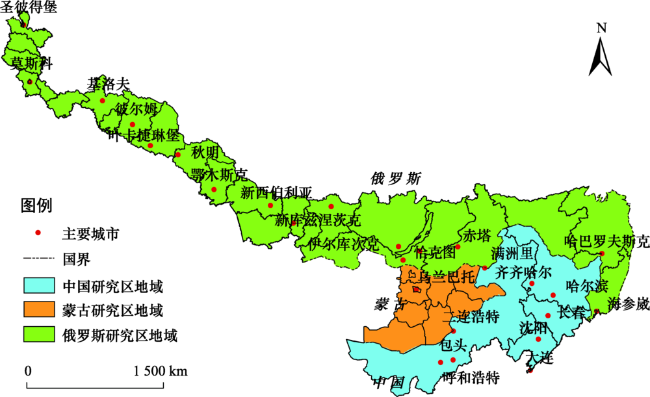
Figure 1 The case region of China-Mongolia-Russia Economic Corridor图1 中蒙俄经济走廊研究区范围 |
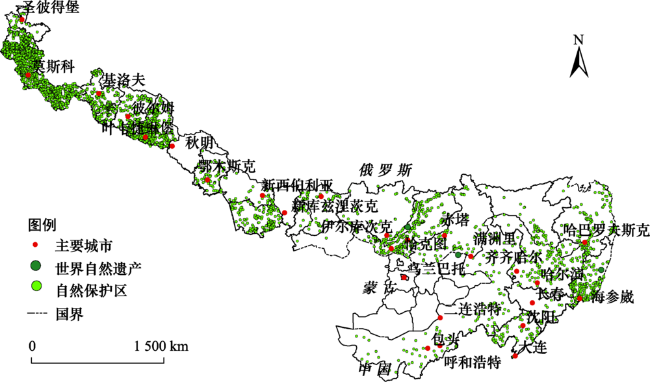
Figure 2 The spatial distribution of natural tourism resources in China-Mongolia-Russia Economic Corridor图2 中蒙俄经济走廊自然旅游资源空间分布 |
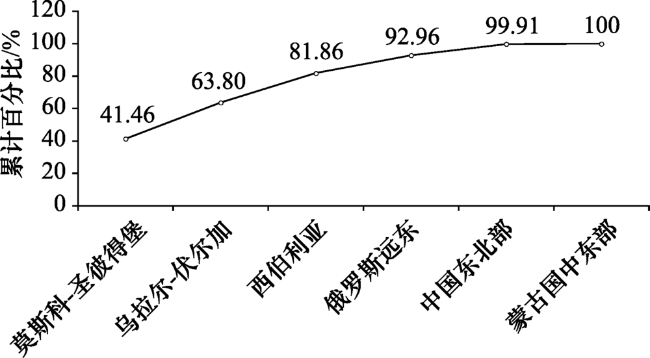
Table 1 Distribution of natural tourism resources in six areas表1 自然旅游资源在六大分区中的分布 |
| 分区 | 自然旅游资源数量/个 | 所占比重/% | 累计比重/% |
|---|---|---|---|
| 圣彼得堡-莫斯科地区 | 1 815 | 41.46 | 41.46 |
| 乌拉尔-伏尔加地区 | 978 | 22.34 | 63.80 |
| 西伯利亚地区 | 791 | 18.07 | 81.86 |
| 俄罗斯远东地区 | 486 | 11.10 | 92.96 |
| 中国东北部地区 | 304 | 6.94 | 99.91 |
| 蒙古国地区 | 4 | 0.09 | 100.00 |
| 合计 | 4 378 | 100.00 |
Figure 3 Lorenz curve of regional natural tourism resources in China-Mongolia-Russia Economic Corridor图3 中蒙俄经济走廊各区域自然旅游资源数量罗伦兹曲线 |
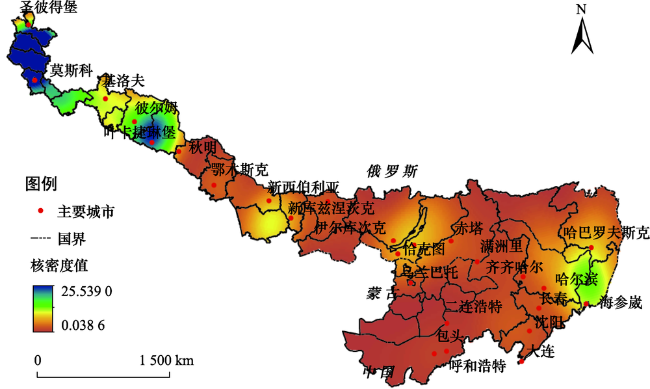
Figure 4 Distribution kernel density of natural tourism resources in China-Mongolia-Russia Economic Corridor图4 中蒙俄经济走廊自然旅游资源分布核密度 |
The authors have declared that no competing interests exist.
| [1] |
[
|
| [2] |
国家发展改革委.建设中蒙俄经济走廊规划纲要[EB/OL]. (2016-06-23)[2018-06-25].
[National Development and Reform Commission. Planning Outline for the Economic Corridor between China, Mongolia and Russia[EB/OL].(2016-06-23)[2018-06-25].
|
| [3] |
[
|
| [4] |
[
|
| [5] |
[
|
| [6] |
[
|
| [7] |
[
|
| [8] |
|
| [9] |
|
| [10] |
[
|
| [11] |
[
|
| [12] |
[
|
| [13] |
[
|
| [14] |
[
|
| [15] |
[
|
| [16] |
[
|
| [17] |
[
|
| [18] |
[
|
| [19] |
[
|
| [20] |
[
|
| [21] |
[
|
| [22] |
[
|
| [23] |
[
|
| [24] |
[
|
| [25] |
[
|
| [26] |
[
|
| [27] |
[
|
| [28] |
[
|
| [29] |
[
|
| [30] |
[
|
| [31] |
[
|
| [32] |
[
|
| [33] |
[
|
| [34] |
[
|
| [35] |
[
|
| [36] |
[
|
/
| 〈 |
|
〉 |