Spatial and temporal characteristics and prediction of carbon emissions from road traffic in the Beijing-Tianjin-Hebei Region
Received date: 2017-01-21
Request revised date: 2017-04-27
Online published: 2017-07-20
Copyright
In the 21st century,China entered an era of highway passenger transport,which is bound by regional energy supply and that strongly impacts carbon emissions. With the rapid increase in the number of private cars,road passenger transport has made a significant contribution to carbon emissions,and future contributions to regional carbon emissions will increase further. This is undoubtedly a huge challenge for China's carbon reduction goals. By using the bottom-up approach for estimating carbon emissions,the Beijing-Tianjin-Hebei region (hereafter,ereafte Jing-Jin-Ji)of highway passenger transport carbon emissions were estimated and analyzed from 2005 to 2014. With the help of a LEAP model,we set three kinds of regulations including benchmark growth,proportional control and total amount of control. The future of regional highway passenger transport carbon emissions is forecasted. We found that from the evolution of time,although per capita carbon emission intensity is greatly reduced,regional overall highway passenger transport carbon emissions grow steadily,and regional carbon reduction pressure increases. From a spatial differentiation perspective,the carbon emissions of the two cities Beijing and Tianjin is leading. The steady rise of carbon emissions in the 11 cities of Hebei also meant that the proportion of carbon emissions in the Jing-Jin-Ji region in Hebei increased. We predict that the total quantity control scenario is a proportional control situation and more carbon emissions,but no matter the regional carbon emission reductions, carbon emissions will keep rising until 2030. The design of highway passenger transport control requires scientific areas and greater effort. These data should be used to improve highway passenger transport policy and regional carbon reduction in China.
Key words: road transport; carbon emissions; LEAP Model; forecast; Beijing-Tianjin-Hebei region
MA Haitao , KANG Lei . Spatial and temporal characteristics and prediction of carbon emissions from road traffic in the Beijing-Tianjin-Hebei Region[J]. Resources Science, 2017 , 39(7) : 1361 -1370 . DOI: 10.18402/resci.2017.07.13
Table 1 Annual mileage of different types of passenger vehicles and energy consumption表1 京津冀区域不同类型公路客运车辆的年均行驶里程和能源消耗量 |
| 交通工具 | 年平均行驶里程/km | 平均燃料消耗 | 燃料 | 碳排放系数/(tCO2/t) |
|---|---|---|---|---|
| 出租汽车 | 71 175 | 15.07km/kg | 汽油 | 2.93 |
| 0.07m3/km | 天然气 | 2.16 | ||
| 公共汽车 | 34 000 | 3.91km/kg | 汽油 | 2.93 |
| 0.15m3/km | 天然气 | 2.16 | ||
| 私人汽车 | 18 000 | 15.07km/kg | 汽油 | 2.93 |
| 摩托车 | 10 000 | 50.23km/kg | 汽油 | 2.93 |
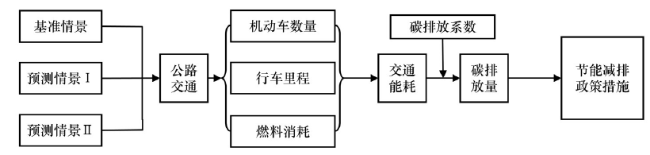
Figure 1 The research idea based on LEAP model图1 基于LEAP模型的研究思路 |
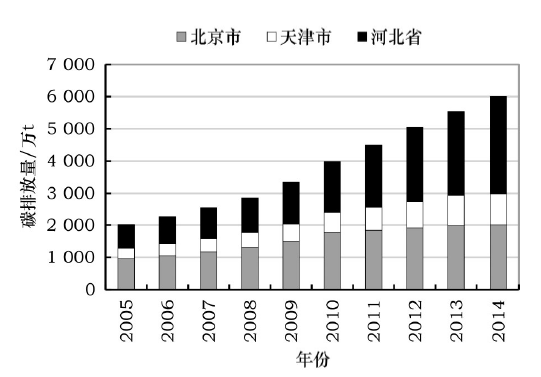
Figure 2 Carbon emissions from road traffic in Jing-Jin-Ji Region from 2005 to 2014图2 京津冀区域公路客运交通碳排放总量变化 |
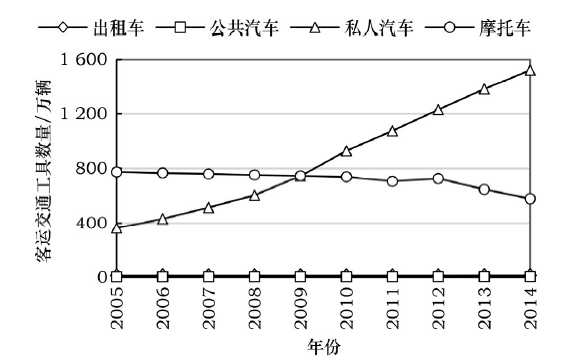
Figure 3 The number of all kinds of passenger vehicle in Jing-Jin-Ji Region from 2005 to 2014图3 2005-2014年京津冀区域各类客运车辆数量 |
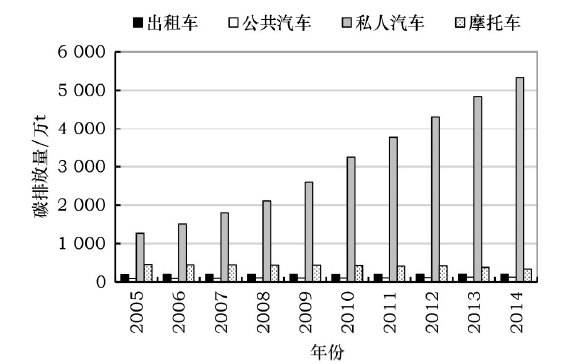
Figure 4 Carbon emissions of various kinds of vehicles in Jing-Jin-Ji Region from 2005 to 2014图4 2005-2014年京津冀区域四种公路交通工具的碳排放量 |
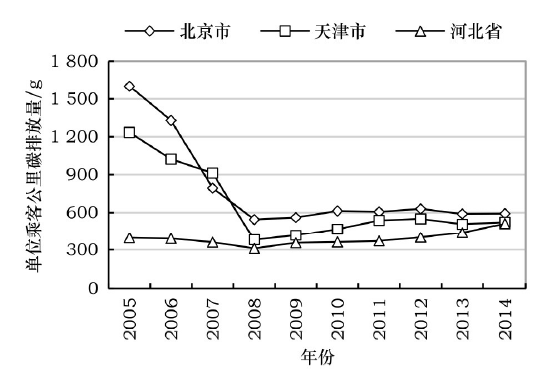
Figure 5 Passenger transport carbon intensityof the Jing-Jin-Ji Region from 2005 to 2014图5 2005-2014年京津冀公路客运交通单位乘客公里碳排放量 |
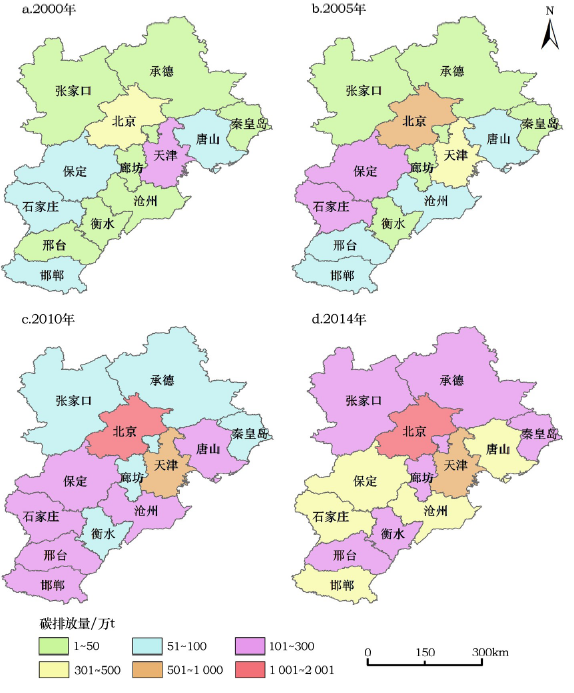
Figure 6 The regional difference of the highway passenger transport carbon emissions in Jing-Jin-Ji Region图6 京津冀地级以上城市公路客运交通碳排放的区域差异 |
Table 2 Scenario and the details表2 情景假设及具体内容 |
| 情景设定 | 具体内容 |
|---|---|
| 基准增长情景 | 未来没有任何减排措施,机动车总量依旧维持现在的增长水平,私家车、公交车也维持既有增长水平 |
| 比例控制情景 | 私家车、摩托车数量2020年在基准情景基础上减少10%,2025年、2030年分别减少15%、20%;公交车到2020年出行比例达到40%左右,公交车年平均行驶里程到2020年比2010年增加10%,2030年比2010年增加20%。公交车、出租车的新能源车(CNG、电动)2020年达到总量的40%,2030年达到总量的50% |
| 总量控制情景 | 私家车总量到2020年北京市不超过600万辆,天津市不超过350万辆,河北省不超过1 000万辆,2030年北京市不超过700万辆,天津市不超过500万辆,河北省不超过1 500万辆,公交车和出租车的数量维持原有的增长水平。技术减排,2020年机动车平均汽油消耗在2010年基础上减少5%,2030年减少10%。 |
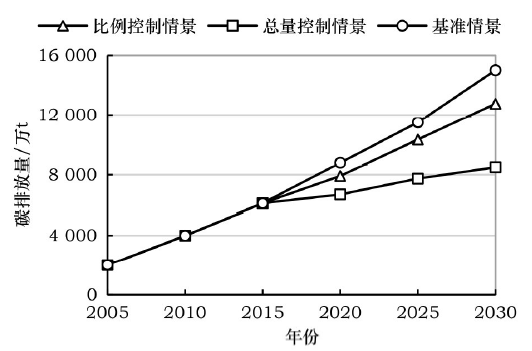
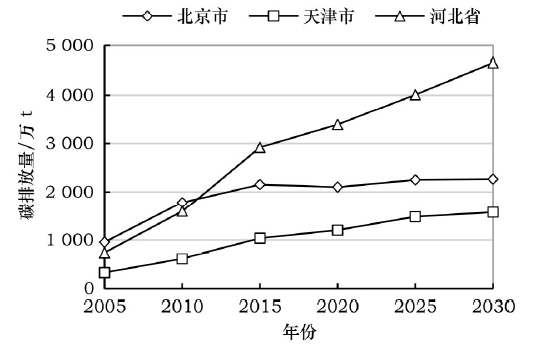
Figure 7 Highway passenger transportation emissions under different scenarios in Jing-Jin-Ji Region from 2005 to 2030图 7 2005-2030年京津冀不同情景下公路客运交通碳排放总量 |
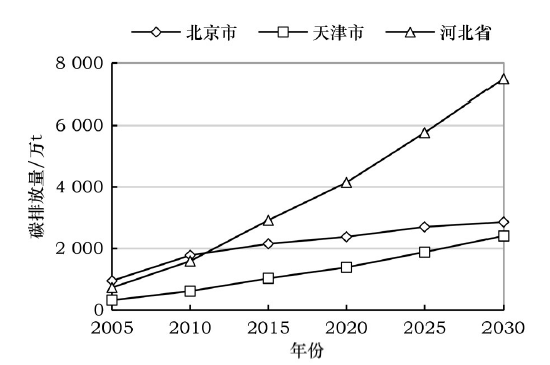
Figure 8 Proportional control scenario prediction carbon emissions in Jing-Jin-Ji Region from 2005 to 2030图8 2005-2030年京津冀三地比例控制情景碳排放量预测 |
Figure 9 Total quantity control scenario prediction carbon emissions in Jing-Jin-Ji Region from 2005 to 2030图9 2005-2030年京津冀三地总量控制情景碳排放量预测 |
The authors have declared that no competing interests exist.
| [1] |
[
|
| [2] |
|
| [3] |
|
| [4] |
|
| [5] |
[
|
| [6] |
[
|
| [7] |
[
|
| [8] |
[
|
| [9] |
[
|
| [10] |
[
|
| [11] |
[
|
| [12] |
[
|
| [13] |
[
|
| [14] |
国家统计局城市社会经济调查司. 中国城市统计年鉴2013[M]. 北京:中国统计出版社,2013.
[National Bureau of Statistics of China. China City Statistics Yearbook 2013[M]. Beijing:China Statistics Press,2013.]
|
| [15] |
海德堡能源与环境研究所. 中国交通:不同交通方式的能源消耗与排放研究报告[R]. 海德堡:海德堡能源与环境研究所,2008.
[Institute of Energy and Environment. Transport in China:Different Transport Modes Energy Consumption and Emission[R]. Heidelberg:Institute of Energy and Environment,2008.]
|
| [16] |
IPCC国家温室气体清单特别工作组. 2006年IPCC国家温室气体清单指南[M]. 神奈川:日本全球环境战略研究所,2006.
[IPCC National Greenhouse Gas Inventory Task Force. 2006 IPCC Guidelines for National Greenhouse Gas Inventories[M]. Kanagawa:Japan Global Environmental Strategy Institute,2006.]
|
| [17] |
[
|
| [18] |
北京交通委员会,北京发展和改革委员会. 北京市十二五时期交通发展建设规划[EB/OL].(2012-08-20)[2017-01-21].
[Beijing Transportation Commission, Beijing Develop-ment and Reform Commission. Beijing 12th Five-Year Transpor-tation De-velopment and Construction Planning[EB/OL].(2012-08-20)[2017-01-21].
|
| [19] |
北京市人民政府.北京市城市总体规划(2004-2020)[EB/OL]. (2005-04-25)[2017-01-21].
[Beijing Municipal People's Govern-ment. Beijing Urban Master Plan (2004-2020)[EB/OL]. (2005-04-25)[2017-01-21].
|
| [20] |
河北省人民政府. 河北省国民经济和社会发展第十三个五年规划纲要[EB/OL]. (2016-08-02)[2017-01-21].
[Hebei Province People's Government. Outline of the 13th Five-Year Plan for the National Economic and Social Development of the Hebei Province [EB/OL]. (2016-08-02)[2017-01-21].
|
| [21] |
[
|
| [22] |
[
|
| [23] |
[
|
| [24] |
[
|
| [25] |
[
|
| [26] |
[
|
| [27] |
[
|
| [28] |
[
|
| [29] |
[
|
| [30] |
[
|
| [31] |
[
|
/
| 〈 |
|
〉 |