Quasi-agents in internet community group tours: a comparison of information searching behavior between tour organizers and participants
Received date: 2016-01-10
Request revised date: 2016-04-05
Online published: 2016-09-22
Copyright
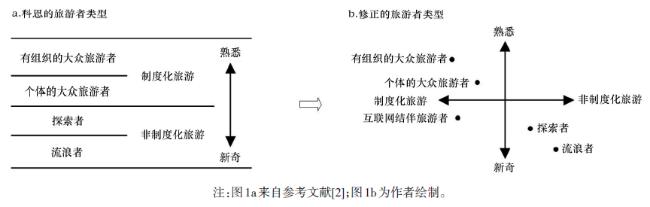
Group tours based on Internet communities has been a leading travel mode in China for the past ten years. In each tour,the tour organizers usually issue the tour plan in the community and call for participants,who play a similar role as the tour agent. This paper aims to discover the requirements and processes of tour organizers playing the agent role. As an exploratory study it uses qualitative methods and a case study. A group of independent travelers active in a virtual community related to Weihai Tourism was selected as a typical case after comparison with other cases. Adopting a participatory observation,we made contact in more than 10 independent travel online chat groups,covering 1463 traveler participants. As a participant of trips,conducted in-depth interviews with trip organizers and participants during and after travel; four organizers and 30 participants were interviewed. We compared the information searching behavior between the organizers and participants and discovered distinct differences in information searching channels,content,involvement and motives. These differences led to the organizer accumulating superior information,and this superiority in information was the basis of their agent role. Along with tour organization,the agent role was solidified by word-of-mouth. Since the agent role of the tour organizers was different from the traditional travel agency,which was not based on commercial contract but instead on information superiority,experience superiority and word-of-mouth,we define these people as quasi-agents. The definition of quasi-agent was used to analyze the characteristics of Internet community group tours. The characteristics of Internet community group tours are not in accordance with Cohen’s typology of tourists and is hard to sort into any typology;thus,a revised method of tourist typology is discussed.
Key words: internet; group tour; information searching; quasi-agent
ZHU Feng , WANG Gang , XU Lin . Quasi-agents in internet community group tours: a comparison of information searching behavior between tour organizers and participants[J]. Resources Science, 2016 , 38(9) : 1672 -1680 . DOI: 10.18402/resci.2016.09.05
Table 1 Comparison of motives and behavior between organizers and participants表1 召集者与参与者信息搜寻行为及动机比较 |
| 召集者 | 参与者 | |
|---|---|---|
| 渠道 | 网络、人际关系 | 召集者、网络 |
| 内容 | 路线及时间计划、天气以及目的地可进入性、食宿安排、队友情况 | 装备、目的地风景、路线长短及难度、召集者背景 |
| 努力程度 | 花费时间较长,努力程度高 | 花费时间较短,努力程度较低 |
| 动机 | 个人爱好、满足驴友需求、树立个人身份地位、商业动机 | 人际交往、体验深刻、成本低、释放压力、时间灵活 |
Table 2 Comparison between commercial agents and quasi-agents表2 商业代理与不完全旅游代理的比较 |
| 旅行社的商业代理 | 不完全代理 | |
|---|---|---|
| 代理目的 | 赚取代理佣金 | 个人兴趣、商业利益 |
| 代理基础 | 批量购买的价格优势、专业化分工的经验及信息优势 | 旅行经验、信息优势 |
| 形成条件 | 旅行社商业合同 | 互联网口碑传播 |
| 代理效果 | 相对较低的费用、标准化的线路 | 兴趣团体的交流、个性化的旅行体验 |
Figure 1 Cohen’s tourist typology and the revised图1 科恩旅游者类型及其修正 |
The authors have declared that no competing interests exist.
| [1] |
[
|
| [2] |
|
| [3] |
|
| [4] |
|
| [5] |
[
|
| [6] |
[
|
| [7] |
[
|
| [8] |
|
| [9] |
|
| [10] |
|
| [11] |
[
|
| [12] |
[
|
| [13] |
[
|
| [14] |
[
|
| [15] |
[
|
| [16] |
[
|
| [17] |
|
| [18] |
[
|
| [19] |
|
| [20] |
|
| [21] |
|
| [22] |
[
|
| [23] |
[
|
/
| 〈 |
|
〉 |